HowTo Amigurumi
Free Crochet Pattern
Beautiful Detailed Adorable

Tooth Fairy Amigurumi Pattern

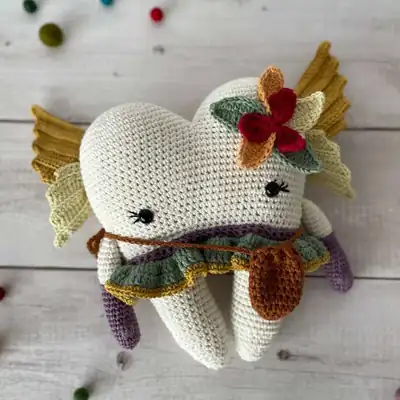
Tooth Fairy amigurumi front view with flower crown
4.0Rating
8-10 HoursTime
AdvancedSkill
Highlights

What makes it special

Cute Companion

An adorable friend to cherish, handcrafted with love to bring comfort and joy for years to come.

All-Day Adventure

An 8-10 hour journey—perfect for dedicating a weekend to a truly special amigurumi that pairs charm with thoughtful techniques.

Advanced Level

This pattern is designed for experienced crocheters who enjoy colorwork, seamless shaping, and careful assembly to create a durable, playful amigurumi.

Meet a project that blends whimsy with meticulous technique: a Tooth Fairy amigurumi that’s as heartwarming to gift as it is satisfying to crochet. This design invites you to play with color and texture, turning ordinary cotton into a magical companion. It’s the kind of keepsake that sparks bedtime stories and brightens nursery shelves. Whether you’re curling up with a quiet weekend crochet or sewing together a small bundle of joy for a little one, this is the pattern that feels like a warm hug in yarn form.

From the first slip knot to the final whisk of embroidery, you’ll enjoy a journey that rewards patience and care. The tooth motif at the center provides a playful anchor, while the wings and skirt add whimsy and movement. It’s a thoughtful gift that’s easy to customize with your favorite color palette, making it perfect for a personal touch or a charming nursery display.

About This Tooth Fairy Amigurumi Pattern

This is a hand-crocheted dream you can tuck into a nursery shelf and watch come to life as a friendly Tooth Fairy Amigurumi. Designed for the dedicated crafter, this pattern blends Aran weight white cotton for the tooth body with complementary DK accents to yield a doll that stands about 10 inches tall when stuffed and posed. Every detail—from the round tooth-shaped torso and puffed cheeks to the delicate wings, crossbody pouch, and tiny leaves—reads playful yet refined, so it looks equally at home on a bedside table or in a photo keepsake.

You’ll work with a magic ring to form a secure core, master invisible decreases for clean seams, and use just enough stuffing to keep its shape without becoming overfilled. With a thoughtful color plan (white tooth, nougat pouch, lilac gloves and waistband, mustard wings and skirt hem, plus tiny red or artichoke leaves) and precise colorwork, this project rewards patience and careful finishing. The finished piece is sturdy for little hands to cuddle, can be dressed with optional shoes or lashes, and becomes a heartfelt gift that can be treasured for years.

From the moment you prepare your yarns and hook, this Tooth Fairy project invites you into a world where textures tell a story. The tooth body is worked in Aran weight white cotton to keep the shape sturdy and smooth, while the crossbody bag, wings, and skirt are built with a palette of DK cotton in Nougat, Lilac, Mustard, and Artichoke for depth and movement. You’ll encounter a typical amigurumi construction flow: single crochet rounds around a fixed core, careful increases and decreases, and the secret magic of layering color to create contrast without breaking the silhouette. The pattern uses a mix of stitches—MR to start, BLO for seamless torsos, and subtle surface embroidery for the nose and eyelashes—so the final figure holds its pose without looking stiff. Safety eyes finish the face at 12 mm, giving a friendly, awake expression that children respond to.

Construction-wise, the Tooth Fairy is shaped in sections that stitch together neatly: head and torso as a soft core, arms and legs sculpted with careful color transitions, and a separate crossbody pouch that attaches with a small ring or tie. The wings are worked in DK weight and stitched to the back with a sparse seam to keep flexibility. The skirt and leaves are stitched with Artichoke and Mustard, then finished with a tiny hem and optional 4-DCBo bobbles for whimsy. I include inner details for the nose using a touch of black embroidery thread, plus lashes in black DK or thread to add character. The result is a durable, portable companion that stands or sits with ease.

Because this is an advanced pattern, the finishing steps reward meticulous yarn management—carry colors neatly, tuck ends as you go, and switch to a smaller hook for crisp colorwork where the eye lands. Once complete, give the piece a gentle blocking if needed and store with a small sachet to keep the cotton soft. The Tooth Fairy looks delightful perched on a shelf, tucked into a child’s bedtime routine, or used as a gift to celebrate a lost tooth with a tiny smile that says you care.

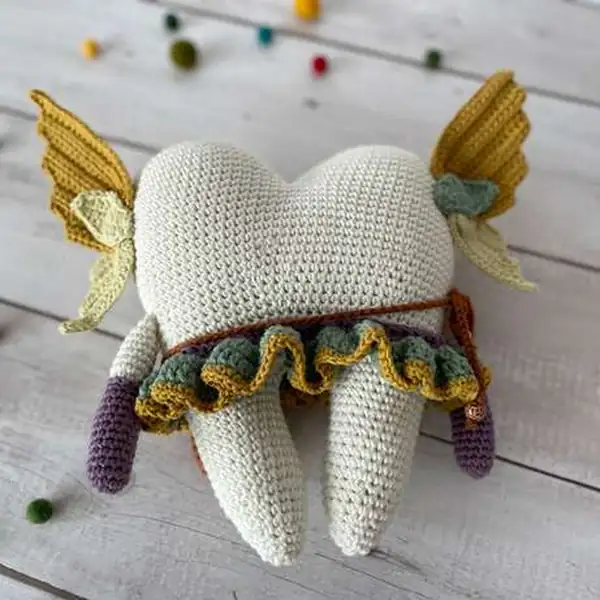
Tooth Fairy wings close-up showing color changes

The Tooth Fairy Amigurumi pattern is designed for advanced crocheters who love precision and texture, offering a balanced challenge that yields a polished, toy-grade result. The tooth body relies on a sturdy MR start and tight single crochet rounds, while the limbs use color blocks to keep the arms and legs airy yet defined. You’ll alternate DK weights—Nougat for the crossbody pouch, Lilac for gloves, and Mustard for wings—along with the white Aran for the core, so you develop an eye for how light and shade travel across a three-dimensional piece. The wings incorporate a lightweight stitch rhythm that keeps them buoyant, and the skirt absorbs color with a gentle hem that avoids stiffness. Expect to pause for color changes and finishes, but enjoy the sense of accomplishment as you stitch the tiny leaves and applique accents that bring the character to life.

Careful assembly is part of the artistry—sewing or crocheting the limbs to mirror-image sides, attaching the crossbody bag securely with a small strap or ring, and applying facial features with embroidery for longevity. The design includes few, well-placed color breaks so the toy reads crisp even after hours of handling, and the optional wooden buttons provide a tactile, gift-ready touch for the bag tie. I also remind you to test your gauge before you begin and to check the final height against the target of roughly 10 inches tall. With patience and a few careful finishes, your Tooth Fairy becomes a dependable keepsake that keeps its charm after countless bedtime stories.
Stitches & Skills You'll Use

In this pattern, the cornerstone is MR to anchor the body and a sequence of tight SC rounds that build the compact torso of the tooth. I rely on BLO for the torso seam to keep the front neat and the back smooth, while the limbs are joined with careful DEC to avoid puckers. The wings and skirt begin with basic DC stitches and graduate into texture working Mustard and Artichoke colorwork to mimic wings' contour. The nose is stitched with a single strand of black embroidery thread, while lashes are defined with a few long stitches that stay secure with a dab of fabric glue avoided for safety. The body is worked in a symmetrical fashion so the tooth looks balanced from every angle, and the crossbody bag is constructed with a small chain of chains and DC to create a sturdy strap that can be tied at the front or back.

Color blocking is the star of the show here: you’ll see careful transitions from White to Nougat, Lilac, and Artichoke layers, with Mustard used as a highlight for wings and the hem of the skirt. The 4-DCBo (double crochet bobble) stitch adds playful texture along the wings and the bag trim, while short color carries keep ends neat and unobtrusive. You’ll place safety eyes at the midline of the head for a friendly gaze, and the embroidery work for the nose and lashes adds subtle personality without overwhelming the face. Finally, the limbs are stuffed and attached with invisible joins so the Fairy can hold a pose—standing, sitting, or leaning against a pillow with effortless charm.

Finishing touches emphasize durability and display quality: you’ll reinforce the back seam with a final BLO row to minimize bulk, and you’ll use a small amount of smoothing to blend color changes where arms meet the torso. The crossbody bag ties can be swapped for tiny wooden buttons if you prefer a tactile detail that doubles as a keepsake. Throughout, the pattern teaches you to respect scale—how a few millimeters of stuffing, a precise decrease, or a careful chain spacer can change the silhouette dramatically. With these techniques, your Tooth Fairy will hold her shape through years of hugs and adventures.

Why You'll Love This Tooth Fairy Amigurumi Pattern

If you crave a project that challenges your crochet technique while delivering a darling, display-worthy result, this Tooth Fairy Amigurumi fits the bill. The design blends classic amigurumi structure with thoughtful colorwork that makes every feature—wings, pouch, and leaves—pop with character. The 10-inch tall finished figure is substantial enough to feel like a keepsake, yet light enough to cuddle during bedtime stories. Working with a dual-yarn strategy—Aran cotton for the torso and DK cottons for the wardrobe accents—teaches color separation and weight distribution, two skills that elevate your overall amigurumi game. It’s also a superb way to showcase color theory in practical form: white reads as a bright, toothy center, while Nougat, Lilac, Mustard, and Artichoke add depth without muddying the silhouette.

Beyond aesthetics, this pattern rewards methodical, patient crocheters who appreciate clean finishes, invisible decreases, and careful seam management. The Eye placement, nose detail, and lash work are small but powerful details that transform a simple ball of yarn into a friendly, memorable character. It’s an ideal project for gifting to a child celebrating a loose tooth or for a dental-health themed giveaway, charity drive, or classroom prize. If you enjoy customizing dolls with unique palettes, this pattern serves as an excellent canvas to experiment with color balance, texture, and accessory styling, all while keeping the core proportions intact.

As a finished piece, it pairs beautifully with a tiny note about dental care, a mini toothbrush, or a keep-sake certificate—turning this amigurumi into a thoughtful, story-rich gift. The sense of achievement you’ll feel when you tie off the last thread, shape the wings just so, and pose the character for a photo is matched only by the smile it inspires in a child who receives it. This is more than a pattern; it’s an invitation to slow down, crochet with intention, and craft a little magic that endures.

Colour & Yarn Inspiration

Color is the heart of this Tooth Fairy’s personality, and you can push the palette in many directions without losing the toy’s iconic silhouette. The white tooth body stays as a crisp canvas, while the crossbody pouch can become a pop of color—think warm caramel Nougat, lilac accents for a soft, dreamy vibe, and mustard wings for bright contrast against the white core. If you love botanical tones, swap Artichoke for olive or sage to echo leaves and create a nature-inspired combination. For a modern twist, try a monochrome tooth with a single accent color on the wings or leaves; you’ll still see the same silhouette, but the mood shifts dramatically.

For a playful children’s room, consider candy-bright combinations: a white tooth, a bubblegum pink pouch, electric blue accents, and lemon-yellow wings—this version is almost edible in its cheer. If you’re crocheting for a child with allergies or a sensitive patch, choose all-organic cotton colors in muted tones (cream, taupe, soft sage) to maintain a calming, cozy vibe. To deepen shading without adding weight, incorporate subtle surface embroidery or tiny color changes at the edges where the wings meet the torso. The key is to stay mindful of balance: a small amount of bold color goes a long way against the white tooth body.

Whether you’re crafting with a specific room in mind or aiming for a gift that matches a child’s favorite palette, this pattern supports a wide range of color explorations while keeping the character’s charm intact.

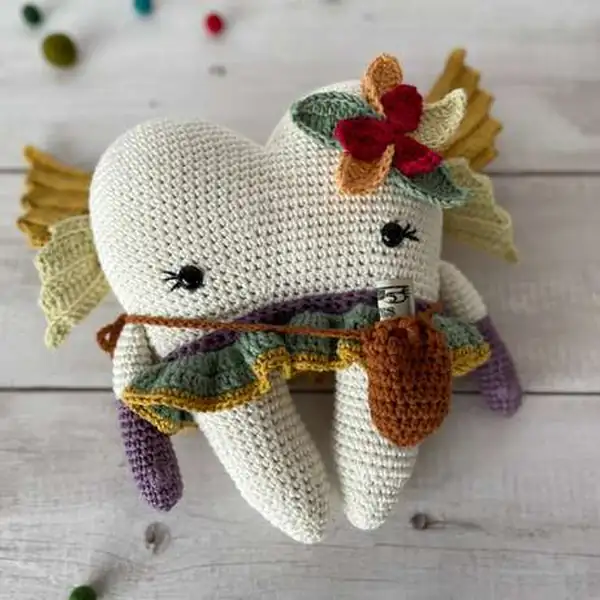
Face close-up with embroidered eyelashes

Switch Things Up

One of the great joys of crochet is making a design your own, and this Tooth Fairy pattern is a fantastic invitation to switch things up without losing the core charm. Start by swapping the color palette: a pure white tooth can be paired with a soft blush pink bag or a pastel mint cape for a fresh, modern look. If you prefer a bolder aesthetic, try a deep indigo for the wings against a bright white body and add metallic thread highlights for a little sparkle. You can even adjust the scale by using heavier or lighter yarns and tweaking the hook size to keep the overall height close to 10 inches, but with a different silhouette.

Variations to consider include changing the color of the crossbody bag tie to a tiny wooden button or bead, replacing the leaves with delicate embroidered motifs, or adding a tiny star on one wing to suggest a nighttime theme. For a seasonal twist, swap Artichoke for sage green and add an orange-tleck of Mustard for autumn, or lean into a wintry look with icy blues and champagne. You can also create a family of Tooth Fairies by varying facial features, eyelashes, and the size of the pouch; the pattern supports multiple characters without sacrificing build quality. Finally, you might convert the crossbody pouch into a tiny treasure pouch by inserting a fragrant sachet before gifting—little touches that elevate the experience while staying faithful to the core pattern.

If you want to preserve the exact measurements for a specific shelf or doll collection, keep a consistent gauge by checking your tension with a small swatch and adjust hook size as needed. The technique remains scalable: you can maintain the core proportions while playing with color blocks, texture, and accessory placement. The more you experiment, the more you’ll see how a handful of stitches can transform the feel of the Tooth Fairy while preserving the sense of whimsy that makes this piece so beloved.

Ultimately, the Tooth Fairy pattern is a canvas for your personal spark—whether you’re making one for a friend, a classroom project, or your own child’s bedtime ritual, the result should be a toy that looks and feels like it was made just for them.

Ways to Use & Gift It

Gift the Tooth Fairy Amigurumi with a tiny story card, a fresh toothbrush, and a note about dental care to create a complete bedtime ritual. The crossbody pouch can hold a small note or a coin, turning the toy into a playful message carrier for a child who has just lost a tooth. For a classroom or library gift, pair the doll with a mini bookmark and a dental-health tip sheet printed on sturdy card stock; the durable yarns and safety eyes will withstand repeated handling by curious hands. You can also personalize the pouch by adding the recipient’s name or initials with a few quick surface embroidery stitches and a tiny, decorative button tie—small touches that turn the amigurumi into a treasured keepsake.

If you’re giving the Tooth Fairy pattern as a gift to another crocheter, include a color kit and a hook set so they can experiment with palette combinations right away. A simple sewing kit with a tapestry needle and thread will help them finish the tiny facial features and bag accessory neatly. Another thoughtful way to present this pattern is alongside a dental-health children’s book; the pair creates a focused, comforting bedtime routine that encourages good habits while celebrating a small milestone.

Lastly, consider gifting a finished Tooth Fairy alongside a framed photo of your child’s first lost tooth—this creates a multi-sensory memory that your family will revisit again and again. The toy’s sturdy construction and cheerful expression make it a versatile keepsake that can move from nursery shelf to bedpost to school desk as the child grows, carrying with it stories of early memories and early dental wins.

Common Mistakes & How to Fix Them

Losing your stitch count — place a marker at the start of each round. Working too loosely, which lets the stuffing show through the fabric. Forgetting to stuff firmly before closing a piece. Sewing parts on before pinning and checking the proportions.

Maker's Notes

From the moment I designed this Tooth Fairy Amigurumi, I imagined a soft, bedtime companion. The finished figure stands about 10 inches tall, a cuddly friend that fits on a pillow. The tooth is crocheted in Rico Essentials Organic Cotton Aran in white, using two 100 g balls to keep it bright and sturdy. Starting with a magic ring, the head grows into a rounded, friendly face that charms children.

Next I shape the body with a snug, seamless silhouette, blending an Aran/DK weight mix to hold form. The crossbody pouch sits across the torso in nougat DK, providing warm contrast to the tooth. Gloves and skirt waistband appear in lilac DK, while wings gain mustard for sunny whimsy. Artichoke from Stylecraft Naturals Organic Cotton DK shapes the wings, skirt hem, and tiny leaves, with red leaf accents for pop.

Then I attach 12 mm safety eyes to anchor the face, followed by a stitched nose. Black embroidery thread creates delicate eyelashes and a tiny smile that reads friendly. The wings are attached at the shoulders with a gentle slope so the fairy seems to hover. Optional wooden buttons can tie the crossbody strap, adding a touch of whimsy and texture.

As you crochet the head and body, I recommend an invisible decrease to close the neck neatly. The assembly uses a few handy techniques, from SC and BLO to fsc and invisible decreases to emphasize shaping. Polyester stuffing should be firm enough to hold the pose without pushing out seams. A few stitch markers keep track of rounds, color changes, and the order of assembly.

Finally, this free Tooth Fairy Amigurumi pattern invites you to gift dream-catching magic to bedtime rituals. The finished figure makes a memorable keepsake for a tooth under your pillow or a playful nursery companion. Care is simple: gentle hand wash, reshape while damp, and store away from direct heat. Advanced crocheters will enjoy the layered colorwork and the satisfying assembly of the tooth, pouch, wings, and skirt.

I tried a substitution: Substituting yarns or weights will affect size, texture, and overall look, so it’s important to test and adjust. If you swap the Aran white for a DK weight, the tooth’s body will become lighter and may shorten slightly; increase the round count or switch to a larger hook to regain the 10-inch height. Replacing the DK colors with a similarly weighted yarn can preserve color contrast, but be mindful of colorfastness on darker tones that may bleed onto lighter sections. When using cotton-blend yarns, expect a slightly stiffer fabric that can alter the drape of the wings; you may need to loosen your stuffing a touch to maintain the intended silhouette. If you substitute safety eyes with embroidery eyes, ensure the stitches are firm and consider a light dot of fabric glue (or a secure running stitch) behind the eye for durability. In all cases, adjust your tension and check the final proportions by comparing with the original measurements before finishing. These substitutions can extend the pattern’s accessibility to different budgets and materials while preserving the toy’s character and poseability.

Tooth Fairy Amigurumi Pattern

This is a hand-crocheted dream you can tuck into a nursery shelf and watch come to life as a friendly Tooth Fairy Amigurumi. Designed for the dedicated crafter, this pattern blends Aran weight white cotton for the tooth body with complementary DK accents to yield a doll that stands about 10 inches tall when stuffed and posed. Every detail—from the round tooth-shaped torso and puffed cheeks to the delicate wings, crossbody pouch, and tiny leaves—reads playful yet refined, so it looks equally at home on a bedside table or in a photo keepsake. You’ll work with a magic ring to form a secure core, master invisible decreases for clean seams, and use just enough stuffing to keep its shape without becoming overfilled. With a thoughtful color plan (white tooth, nougat pouch, lilac gloves and waistband, mustard wings and skirt hem, plus tiny red or artichoke leaves) and precise colorwork, this project rewards patience and careful finishing. The finished piece is sturdy for little hands to cuddle, can be dressed with optional shoes or lashes, and becomes a heartfelt gift that can be treasured for years.

Advanced 8-10 Hours
Pattern at a glance
Skill level
Advanced
Time to make
8-10 Hours
Hook size
4.0 mm (G) and 3.0 mm (C)
Yarn weight
Aran / DK mix
Finished size
Approx. 10 in tall / 25 cm
Gauge
4"x4" = 20 stitches x 22 rows
Yarn used
Main color ~200-250 g; Accent colors ~50-100 g

Materials Needed

Main Fabric
  • 01
    Aran weight: Rico Essentials Organic Cotton Aran - White (tooth) - 2 x 100 g balls
  • 02
    DK weight: Rico Essentials Organic Cotton DK - Nougat (cross body pouch) - 1 x 50 g ball
  • 03
    DK weight: Rico Essentials Organic Cotton DK - Lilac (gloves & skirt waistband) - 1 x 50 g ball
  • 04
    DK weight: Rico Essentials Organic Cotton DK - Mustard (wings & skirt hem) - 1 x 50 g ball
  • 05
    DK weight: Rico Essentials Organic Cotton DK - Red (small leaves) - 1 x 20 g ball
  • 06
    DK weight: Stylecraft Naturals Organic Cotton DK - Artichoke (wings, skirt & leaves) - 1 x 50 g ball
  • 07
    Other colors for nose, eyelashes and details as needed
Tools Required
  • 01
    Crochet hooks: 4.00 mm (G) and 3.00 mm (D)
  • 02
    Safety eyes 12 mm (2 pieces)
  • 03
    Black embroidery thread (or black DK weight yarn split in half)
  • 04
    Tapestry needle
  • 05
    Stitch markers
  • 06
    Scissors
  • 07
    Polyester stuffing
  • 08
    Optional: wooden buttons for crossbody bag tie

— NOTES :

Round 1: st 6 in a magic circle [6];
Round 2: inc in each st around [12];
Round 3: (sc, inc) x6 [18];
Round 4: (sc 2, inc) x6 [24];
Round 5: (sc 3, inc) x6 [30];
Round 6: (sc 4, inc) x6 [36];
Round 7: (sc 5, inc) x6 [42];
Round 8: (sc 6, inc) x6 [48] PHOTO 01;
Round 9: sc around [48] PHOTO 02;
Round 10: sc around [48] PHOTO 02;
Round 11: sc around [48] PHOTO 02;
Round 12: sc around [48] PHOTO 02;
Round 13: sc around [48] PHOTO 02;
Round 14: sc around [84];
Round 15: sc around [84];
Round 16: sc around [84];
Round 17: sc around [84];
Round 18: sc around [84];
Round 19: sc around [84];
Round 20: sc around [84];
Round 21: sc around [84];
Round 22: sc around [84];
Round 23: (sc 12, dec) x6 [78];
Round 24: sc around [78];
Round 25: (sc 11, dec) x6 [72];
Round 26: sc around [72];
Round 27: sc around [72];
Round 28: (sc 10, dec) x6 [66];
Round 29: sc around [66];
Round 30: sc around [66];
Round 31: (sc 9, dec) x6 [60];
Round 32: sc around [60] PHOTO 05;
Round 33: sc around [60] PHOTO 05;
Round 34: sc around [60] PHOTO 05;
Round 35: sc in each st around [24] STUFF;
Round 36: sc in each st around [24] STUFF;
Round 37: sc in each st around [24] STUFF;
Round 38: sc in each st around [24] STUFF;
Round 39: sc in each st around [24] STUFF;
Round 40: sc in each st around [24] STUFF;
Round 41: sc in each st around [24] STUFF;
Round 42: sc in each st around [24] STUFF;
Round 43: sc in each st around [24] STUFF;
Round 44: sc in each st around [24] STUFF;
Round 45: sc in each st around [24] STUFF;
Round 46: sc in each st around [24] STUFF;
Round 47: (sc 2, dec) x6 [18];
Round 48: sc around [18];
Round 49: sc around [18];
Round 50: (sc, dec) x6 [12];
Round 51: sc around [12] STUFF / PHOTO 10 & 11;
Round 52: sc around [12] STUFF / PHOTO 10 & 11;
Round 53: dec around [6];

— NOTES :

Round 2: sc around [70];
Round 3: make 3 dc in each st around [210];
Round 4: dc around [210] PHOTO 16;
Round 5: sc around [210] PHOTO 17;

— Part 3 :

Round 1: st 6 hdc in a magic circle [6];
Round 2: hdc inc around [12];
Round 3: (hdc, hdc inc) x6 [18];
Round 4: hdc around [18];
Round 5: hdc around [18];
Round 6: hdc around [18];
Round 7: hdc around [18];
Round 8: dc around [18] PHOTO 19;

— NOTES :

Round 1: st 6 in a magic circle [6];
Round 2: inc in each st around [12];
Round 3: sc around [12];
Round 4: sc around [12];
Round 5: sc around [12];
Round 6: 4-DcBo in next st, sc in next 11 st [12];
Round 7: sc around [12];
Round 8: sc around [12];
Round 9: sc around [12];
Round 10: sc around [12];
Round 11: sc around [12];
Round 12: sc around [12];
Round 13: sc around [12];
Round 14: sc around [12];
Round 15: sl st around [12];
Round 16: BLO sc around [12] PHOTO 26;
Round 17: sc around [12];
Round 18: sc around [12];
Round 19: sc around [12];
Round 20: sc around [12];
Round 21: sc around [12];
Round 22: sc around [12];
Round 23: sc around [12];

— Part 5 :

Round 1: hdc in the 2nd back bump ch from hk and in each back bump ch thereafter [22] PHOTO 31;
Round 2: BLO hdc across, sl st into the magic circle, ch 1, turn [22] PHOTO 32;
Round 3: BLO hdc in next 19 st, leave final 3 st unworked [19];
Round 5: BLO hdc in next 16 st, leave final 3 st unworked [16];
Round 7: BLO hdc in next 13 st, leave final 3 st unworked [13];
Round 9: BLO hdc in next 10 st, leave final 3 st unworked [10] PHOTO 33;

— NOTES :

Round 1: hdc in 2nd back bump ch from hk and in each back bump ch thereafter [19];
Round 2: BLO hdc across, sl st into the magic circle, ch 1, turn [19];
Round 3: BLO hdc in next 16 st, leave final 3 st unworked [16];
Round 5: BLO hdc in next 13 st, leave final 3 st unworked [13];
Round 7: BLO hdc in next 10 st, leave final 3 st unworked [10];

— Part 7 :

Round 1: sc in 2nd ch from hk, hdc in next ch, dc in next 2 ch, tr in next 3 ch, dc in next 2 ch, hdc in;

— SMALL LEAVES - make 3, using the red yarn :

Round 1: sc in 2nd ch from hk, hdc in next ch, dc in next ch, tr in next ch, dc in next ch, hdc in next ch,;

Assembly Instructions

  1. Attach head to body by crocheting the neck opening closed with a whipstitch, ensuring a smooth transition.
  2. Position arms on either side of the body between rounds 12-14, angling slightly forward for a natural pose, and sew in place.
  3. Sew legs to the bottom of the body, spacing them evenly to support the toy and prevent tipping.
  4. Attach ears to the top of the head between rounds 6-8, spaced evenly for balance.
  5. Attach wings to the back following the reference photos; align with care to create a pleasing silhouette.

Important Notes

  • Stitch markers are essential for tracking rounds and color changes—place one at the start of each round.
  • Stuff the pieces gradually to avoid lumps; do not overstuff near joints to maintain mobility.
  • Weave in ends as you go rather than leaving long tails; it makes finishing cleaner.
  • Test-fit joints before final sewing to ensure the limbs align with the body’s symmetry.

This Tooth Fairy Amigurumi is a handmade treasure, designed to celebrate a child’s first lost tooth with warmth and whimsy. Its 10-inch height, friendly face, and delicate wings invite gentle play while the crossbody pouch adds a touch of magic—perfect for leaving a tiny coin or a note from the Tooth Fairy. Crafted from cotton yarns in a carefully coordinated palette, the figure is sturdy yet huggable and can be displayed on a bedside table, library shelf, or photo corner. The combination of Aran weight white for the tooth and DK accents in Nougat, Lilac, Mustard, and Artichoke creates a welcoming, layered look that holds up to years of bedtime storytelling. It’s more than a pattern; it’s a keepsake that can be cherished as a family memory and passed down through generations of tooth fairies.

Good to know

You ask, we answer

The Tooth Fairy amigurumi stands about 10 inches tall, depending on yarn weight and hook size used.

Yes, changing yarn weight will alter the final size; choose a hook size appropriate for your yarn to maintain the intended silhouette.

This pattern is advanced; you should be comfortable with color changes, working in the rounds, and assembling multiple parts.

Most crocheters finish in 8-10 hours, depending on experience and pace, with a few extra hours for assembly.

Wings and dress detail on tooth fairy amigurumi
Join 100k+ crocheters

Get new free patterns, stitch tips and exclusive content in your inbox.