HowTo Amigurumi
Free Crochet Pattern
Beautiful Detailed Adorable

Cow Stacking Toy Amigurumi Pattern

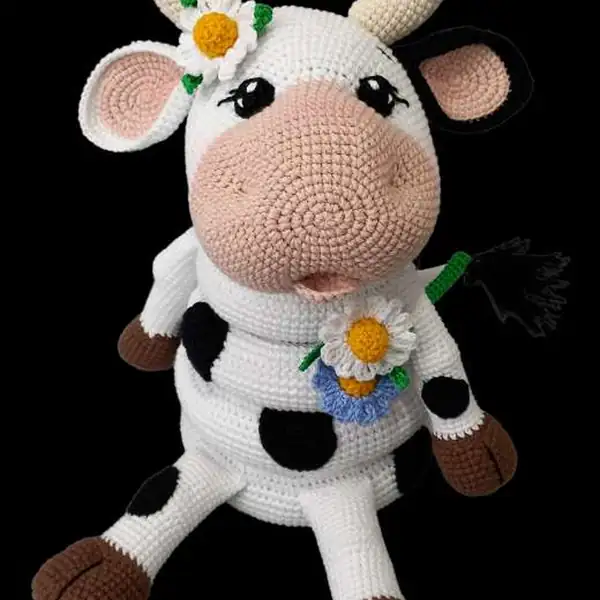
Close-up of the cow amigurumi head with horns
4.9Rating
12-15 HoursTime
AdvancedSkill
Highlights

What makes it special

Cute Companion

An adorable friend to cherish, handcrafted with love to bring comfort and joy for years to come.

Multi-Day Project

A rewarding 12+ hour journey—perfect for dedicated crafters who love detailed work and the challenge of a full amigurumi tower.

Advanced Level

This project is best for experienced crocheters who are comfortable with working in the round, color changes, several color transitions, invisible decreases, and multi-piece assembly. Expect long rounds, strategic stuffing, and careful seaming to bring the cow to life across multiple components.

This Cow Stacking Toy Amigurumi Pattern invites you into a cozy world of yarn and play. I designed it as a warm, huggable project that rewards careful stitches with a characterful toy you’ll reach for again and again. The design balances play value with craftsmanship: a cow figure standing about 21 cm tall, stacked from a series of rings and a sturdy core that holds its shape when little hands tug and twist. Using DK or worsted weight yarn and a tight gauge, this pattern blends soft texture with dependable construction so the cow feels lovely in your lap and sturdy on a shelf. It’s a satisfying challenge for advanced crocheters who love magic rings and invisible decreases, yet the result remains approachable enough for dedicated makers who want to grow their skills.

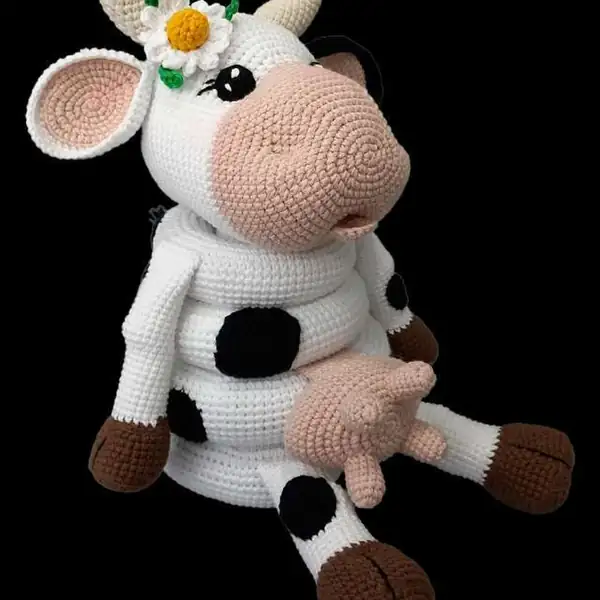
I've kept the finishing straightforward: clean seams, smooth color transitions, and gentle stuffing that preserves the toy’s round, friendly silhouette. The white base, the classic black spots, a warm brown body, and delicate pink accents come together to read as a real little cow—perfect for stacking, counting, and imaginative play. The pattern also offers practical customization options, including an optional Velcro udder for removable, washable details and safety eyes that bring the cow to life without sacrificing safety. Whether you’re gifting a newborn or a preschooler who loves building towers, this toy grows with them as their hands learn to balance and sort the rings.

About This Cow Stacking Toy Amigurumi Pattern

From the first slip of the crochet hook to the final whipstitch, this Cow Stacking Toy Amigurumi Pattern is built to celebrate the tactile joy of handmade play. The design centers on a snug, easy-to-hold core that supports multiple soft rings and four sturdy limbs, all worked in DK or worsted weight yarn to achieve a plush, squeezable feel. Each piece is shaped with precise rounds and invisible decreases so the limbs and muzzle disappear neatly into the cow’s contours, while colorwork brings the spots, ears, and udders to life. You’ll work the head, neck, and torso in a balanced sequence, then finish by assembling the limbs and accessories with careful pinning, seam lines, and a few well-placed slip stitches. The finished size remains approximately 21 cm tall, a size that fits neatly on a shelf or in a child’s hands for hours of stacking and imaginative play. The palette—white for the base, black for spots, brown for the body, ivory and pink accents—lends itself to playful variations while staying cohesive and adorably collectible.

Inside this guide you’ll find a complete parts list, a carefully organized round-by-round sequence, and a clear workflow designed for advanced crocheters. The pattern takes you from the MR start to the final seam on the head and body, then through the assembly of the four legs and the central axis that makes the rings stack confidently. Colorwork is introduced in manageable steps, with Color A White becoming the cow’s primary fabric, Color B Black forming the signature spots, and Color C Brown shaping the torso and ears. You’ll also learn options for a safety-eye finish or the softer look of embroidery eyes, plus an optional Velcro udder you can remove for washing. The stitches you’ll employ include SC, INC, DEC, BLO and FLO, plus HDC, DC and occasional TR for shaping and texture.

Everything is built to be balanced and reliable: the rings are crocheted separately, stuffed lightly, and then joined to a sturdy central post so they nest in order from smallest to largest. The udders, ears and tail are placed with pins and then sewn in with invisible stitches to preserve the toy’s smooth lines. I provide tips on stuffing density to keep the toy upright when stacked and to prevent wobble during play. The final dimensions match the official specification, and you’ll appreciate the calm rhythm of rounds as you switch from body segments to color changes. The pattern is written to support testers and color variations, so you can reflect a family’s personality in each cow.

Whether you’re crocheting for a baby shower gift, a storytelling prop, or a shelf-sitter that sparks counting games, this pattern is a reliable project that balances technique with charm. It teaches you to manage multiple color changes across round after round while keeping increases and decreases invisible where the curves meet. I’ve included notes on gauge tension, yarn management, and safe finishing techniques that help even seasoned crocheters avoid common missteps. By the end, you’ll have a tall, friendly amigurumi cow whose rings click together with satisfying precision, inviting countless stacking and storytelling sessions.

Side view of cow stacking toy showing base and legs

This pattern is intended for experienced crocheters who enjoy precision and texture. You’ll manage multiple components with consistent tension, then marry head, limbs and torso into a single friendly silhouette. Color placement requires attention to proportions, especially around the spots and udder, but the payoff is a warm, characterful cow that looks polished from every angle. The guide uses widely understood abbreviations (MR, SC, INC, DEC, BLO, FLO, CH, SL ST) and lists the exact rounds for each section, so you can follow along without guesswork. I’ve also included optional notes for safety eyes and a Velcro udder to broaden how this toy can be used and washed.

In addition to the core build, you’ll find ideas for adapting the pattern—swap in a different dominant color, adjust the ring counts for a taller or shorter stack, or tailor the spots to match a family’s pets. The finishing touches cover sewing, wire-free stability, and how to test for balance before you declare the job done. My goal is to give you confidence at every stage: from initial MR to final assembly, you’ll feel your crochet skills deepen while creating a toy that appeals to children and collectors alike.

Stitches & Skills You'll Use

Stitch by stitch, this toy reveals how each technique serves both shape and feel. The head begins with a MR, then builds outward with SC rounds, while the ears are shaped with small increases and color change tips that keep colorwork crisp. The muzzle is formed using a short series of DC to create a gentle rounding, and the spots are applied with careful color joins to maintain clean edges. The eyes can be added with safety eyes or stitched on with a simple chain of black wool, and decorative pink stitching defines the inner ears and cheeks. The entire cow is joined to its limbs with invisible seams that disappear into the body’s curves, keeping the silhouette smooth for stacking.

Next, the torso is created using a sequence of INC and DEC rounds to yield the characteristic cylindrical form, while the four legs are built as consistent bands using HDC and DC to preserve a plush look. I recommend BLO or FLO techniques in particular places to introduce subtle texture—like along the belly and the top line of the back—without breaking the color flow. The rings you’ll crochet for the stacking phase are separate and lightly stuffed so they slide over the central axis with a small but encouraging resistance, ensuring they balance neatly as you add each tier.

Finally, assembling the pieces requires pins for position, a careful plan for seam placement, and a dab of invisible needlework to hide joins. A couple of slip stitches lock each ring to the post and maintain alignment so the toy doesn’t wobble when nudged. The optional Velcro udder adds charming interactivity, while color choices and finishing details—like ivory accents and pink cheeks—bring personality to your cow as it rises from one ring to the next. Throughout the build, the stitches themselves — MR, SC, INC, DEC, BLO, FLO, CH, SL ST, HDC, DC, TR — stay consistent with the field’s best practices for amigurumi and stacking play.

Why You'll Love This Cow Stacking Toy Amigurumi Pattern

Why this pattern stands out is not only the tall, cheerful cow you end up with, but also the tactile journey of making it. Working with a DK or #3 weight yarn, you gain a sense of accomplishment as rounds stack neatly and color changes stay tidy. The advanced level is about control and consistency rather than difficulty; once you nail the MR and the invisible decreases, the rest falls into place with repeatable steps that become second nature. I designed the sequence to reward careful stitching, accurate stuffing, and precise seam placement, and the result is a friendly amigurumi that can be enjoyed as a counting toy, a display piece, or a cherished heirloom. The dimension—approx. 21 cm tall—ensures it feels substantial yet portable for quiet playtime.

Beyond technique, the Cow Stacking Toy pattern offers meaningful play opportunities. Children can practice counting the rings, grouping the colors, and naming the spots, while adults learn to manage yarn tension and color distribution. It’s the kind of project you can slow down for and still finish in a season, and the finished piece lends itself to storytelling—a tiny cow that climbs a tower, visits a barn, or becomes a classroom companion during lessons about shapes and sizes. For crafters who enjoy a clean finish, the purge of extra ends after color changes becomes a satisfying ritual, and the optional safety eyes or embroidered details add a personal touch.

I hope this pattern becomes a familiar project in your crochet repertoire, something you return to for a weekend of calm creativity. The cow stacks with confidence, the rings nest with a gentle snap, and the color palette invites both tradition and whimsy. If you’re sharing it with a friend, you’ll both treasure the quiet pride of watching the rings settle squarely and the little cow’s expression brighten with each added layer. It’s more than a pattern; it’s a small, well-behaved piece of handmade joy.

Colour & Yarn Inspiration

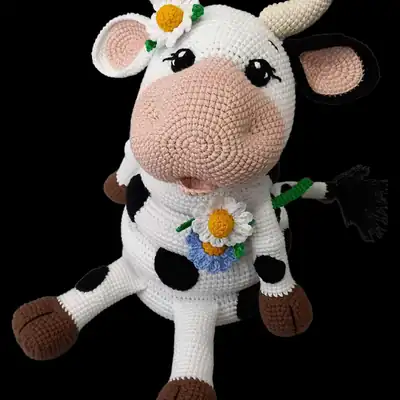
Classic dairy palette: white base with bold black spots, rich brown body, ivory accents, and a touch of pink for cheeks and inner ears creates a timeless look that reads as a real cow on the page. A sunlit pastel version uses ivory as the base, soft pink for accents, pale brown for the body, and tiniest black spots for contrast—perfect for a nursery with gentle tones. For a playful twist, swap in a charcoal base with white spots, a cocoa-brown body, and lemon-yellow flowers or mint-green leaves as accessories to evoke a farm garden scene. Each palette maintains the structure and stacking rhythm while inviting fresh character and storytelling possibilities.

Seasonal variations invite you to celebrate holidays in a cuddly way: red-berry accents for a harvest cow, or pale wine tones with forest-green patches to echo autumn barns. You can also customize eye color—black safety eyes, navy, or warm hazel—to shift the toy’s expression subtly. If you’re making a set for a classroom, coordinate colors with your school’s colors and tag each cow with a tiny label showing its ring order for a playful math lesson. The colorways remain flexible but always preserve the cozy, huggable feel that makes this amigurumi so appealing.

When switching colorways, keep the main color dominant across the body to preserve the cow’s silhouette and balance. Reserve the spots and accents for contrast so the stacking rings remain visually legible as you add each layer. This approach helps little hands learn color grouping and sequencing while the toy remains a charming, cohesive piece on display or in use during playtime.

Finished cow stacking toy with flowers and ring tower

Switch Things Up

Begin with a fresh color take by swapping the dominant base color while keeping the same ring structure; a creamy ivory base with brown spots can read as a dairy-inspired alternative that still stacks beautifully. You can also experiment with a smaller or larger scale by adjusting the ring counts and substituting a lighter or heavier yarn weight, provided you stay within the intended finished height. If you want to stretch your skills, try using BLO in the body rounds to add micro texture along the back and belly, then switch back to FLO for the final touches to keep the color line crisp. The pattern remains compatible with a range of DK to worsted yarns, so you can tailor the feel while preserving the stacking action.

Another path is to reinterpret the cow into other farm animals by changing the ears, horns, and facial proportions while maintaining the same central axis and ring system. Consider a white-on-white zebra look by placing subtle grey stripes and using a darker shade for the spots, or craft a pastel cow with pale pink and baby blue accents for a nursery-friendly vibe. You can also create themed sets—seasonal colors for holidays, or school colors for classroom decor—without altering the construction, since the core layering and balance stay consistent.

For storage-minded makers, build a compact kit by pre-stringing the color changes and pre-stuffing the rings so they slide together smoothly during assembly. If you’re teaching, set up a mini workshop with a demo on MR and stable seams, then let students choose their palette and finish details. The key to switching things up is preserving the feel of a soft, friendly amigurumi that stacks with confident balance, a toy both delightful to look at and satisfying to crochet.

Finally, consider swapping in different accessories—embroidered eyes instead of safety eyes, or a hand-stitched udder with Velcro removal—and test how those small changes alter the final look and reusability of the toy. No matter which variation you choose, the underlying technique remains a reliable scaffold for experimentation, so you can keep returning to this project and discovering new character and charm each time.

Ways to Use & Gift It

Gift this cow stacking amigurumi as a baby shower treasure, a first birthday present, or a keepsake that grows with a child through early counting games. Pack it with a small darling nest of rings in a cotton drawstring bag for a ready-to-wrap gift, and include a care card with washing instructions to reassure new parents about snuggly, washable playthings. For a teacher or caregiver gift, attach a tiny tag with a counting game idea—how many rings to stack in a friendly, interactive lesson. The sturdy build and soft texture make it an ideal companion for playtime, storytime, and quiet moments alike.

To personalize the gift, tailor the cow’s colors to the recipient’s nursery or favorite animals. Add the child’s name with a small embroidered patch or a stitched banner on a removable tote. You can also create a matching mini-collection—perhaps a piglet or a lamb—using the same stacking principle so siblings can build a whole farm of soft, handmade toys. The durable yarn and careful finishing ensure this toy remains safe, washable, and enjoyable for years to come.

For gifting occasions that call for a refined presentation, craft a keepsake box with tissue, a printed pattern card, and a brief assembly guide. The box can include a spare set of safety eyes and a mini skein of the main color to inspire future projects. This Cow Stacking Toy is not just a toy; it’s a memory you hand down with every loop and stitch, inviting hours of stacking, storytelling, and calm crochet joy.

Common Mistakes & How to Fix Them

Maker's Notes

Testing this pattern focuses on gauge accuracy, balance, and safe finishing for a child’s toy. Start with a swatch using the recommended DK/Worsted weight yarn and a 3.0 mm hook to verify your gauge matches the intended height of about 21 cm when stuffed. Check the central axis for sturdiness—rings should slide with some resistance but not bind. Ensure stuffing density keeps the head and body round without causing wobble on a flat surface. Test color transitions around spots and ears to ensure clean edges, and verify that seam placements don’t create gaps where stuffing could leak. If you use safety eyes, confirm their alignment with the muzzle is symmetrical and safe for little hands. Consider weighing the completed toy to ensure it’s not overly top-heavy when stacked.

During tests, document the number of rounds per section and note any variations caused by different yarn brands or fiber contents. Record how the rings stack on the central axis, including how many rings are used and whether you need to adjust stuffing to maintain even stacking. Evaluate the optional Velcro udder for durability in washing conditions and whether the attachment affects balance when stacked. Include tester feedback on readability of the rounds, the ease of pinning pieces before seaming, and the final look of various eye options. Your notes will help refine the instructions for a wider audience.

Finally, assess care guidelines: confirm that hand washing with mild detergent maintains color integrity and that air-drying preserves the toy’s shape. Ensure the finished height remains within the specified range across multiple test runs, and note any material substitutions that affect the look or balance. Collect all observations into a tidy report so future crocheters can reproduce the same delightful result with confidence.

I tried a substitution: Substituting yarn brands or weights will inevitably affect size, texture, and stacking behavior. If you switch from DK to a lighter sport weight, you’ll likely reduce the finished height slightly and the rings may slide more easily, so you may want to add one or two rounds to the stacking sequence and adjust stuffing to maintain balance. Conversely, using a bulkier worsted weight can increase both height and rigidity; in that case, reduce stuffing density and possibly omit a round or two in the rings. When replacing safety eyes with embroidered eyes, you’ll alter the toy’s expression and weight distribution, which can affect wobble and stacking feel. Always re-check gauge and adjust the hook size if needed to approach the target height of around 21 cm. Color substitutions should not affect the integrity of the shape as long as you maintain roughly the same contrast between the base color and the spots. If you choose a darker main color, ensure the white spots still read clearly; if you opt for a lighter or more saturated pink, test how it looks against the ivory and brown tones. For both substitutions and color swaps, re-test the central axis fit and make sure the rings nest snugly yet freely, so the toy remains safe and enjoyable for stacking games and storytelling sessions.

Cow Stacking Toy Amigurumi Pattern

From the first slip of the crochet hook to the final whipstitch, this Cow Stacking Toy Amigurumi Pattern is built to celebrate the tactile joy of handmade play. The design centers on a snug, easy-to-hold core that supports multiple soft rings and four sturdy limbs, all worked in DK or worsted weight yarn to achieve a plush, squeezable feel. Each piece is shaped with precise rounds and invisible decreases so the limbs and muzzle disappear neatly into the cow’s contours, while colorwork brings the spots, ears, and udders to life. You’ll work the head, neck, and torso in a balanced sequence, then finish by assembling the limbs and accessories with careful pinning, seam lines, and a few well-placed slip stitches. The finished size remains approximately 21 cm tall, a size that fits neatly on a shelf or in a child’s hands for hours of stacking and imaginative play. The palette—white for the base, black for spots, brown for the body, ivory and pink accents—lends itself to playful variations while staying cohesive and adorably collectible.

Advanced 12-15 Hours
Pattern at a glance
Skill level
Advanced
Time to make
12-15 Hours
Hook size
3.0 mm (D)
Yarn weight
DK / #3
Finished size
Approx. 21 cm tall / 8.3 in tall
Gauge
Not critical; estimate ~12 sc x 12 rows per 4 cm square when using DK weight yarn
Yarn used
Main colors total approx 350-450g; accent colors 50-100g

Materials Needed

Main Fabric
  • 01
    Worsted weight yarn (#4), approximately 100g main color
  • 02
    Color A: White - 120g
  • 03
    Color B: Black - 20g for spots
  • 04
    Color C: Brown - 40g
  • 05
    Color D: Light Pink - 20g
  • 06
    Color E: Ivory - 20g
  • 07
    Decor colors: Yellow, Green for flowers
  • 08
    Accent colors as needed for accessories
Tools Required
  • 01
    Crochet hook size 3.0 mm (D)
  • 02
    Scissors
  • 03
    Tapestry needle for sewing
  • 04
    Yarn needle for weaving in ends
  • 05
    Polyester stuffing
  • 06
    Pins for positioning before sewing
  • 07
    Safety eyes 10-12 mm (optional)
  • 08
    Velcro tape for removable udder (optional)

— Part 1 :

Round 1: 6 sc in MR (6)
Round 2: 6 inc (12)
Round 3: 12 sc (12)
Round 4: (1 sc; inc)*6 (18)
Round 5: 18 sc (18)
Round 6: 18 sc (18)
Round 7: (2 sc; inc)*6 (24)
Round 8: 24 sc (24)
Round 9: 24 sc (24)
Round 10: 24 sc (24)
Round 11: (3 sc; inc)*6 (30)
Round 12: 30 sc (30)
Round 13: 30 sc (30)
Round 14: 30 sc (30)
Round 15: 30 sc (30)
Round 16: (4 sc; inc)*6 (36)
Round 17: 36 sc (36)
Round 18: 36 sc (36)
Round 19: 36 sc (36)
Round 20: 36 sc (36)
Round 21: 36 sc (36)
Round 22: (5 sc; inc)*6 (42)
Round 23: 42 sc (42)
Round 24: 42 sc (42)
Round 25: 42 sc (42)
Round 26: 42 sc (42)
Round 27: 42 sc (42)
Round 28: 42 sc (42)
Round 29: (6 sc; inc)*6 (48)
Round 30: 48 sc (48)
Round 31: 48 sc (48)
Round 32: 48 sc (48)
Round 33: 48 sc (48)
Round 34: 48 sc (48)
Round 35: 48 sc (48)
Round 36: 48 sc (48)
Round 37: (7 sc; inc)*6 (54)
Round 38: 54 sc (54)
Round 39: 54 sc (54)
Round 40: 54 sc (54)
Round 41: 54 sc (54)
Round 42: 54 sc (54)
Round 43: 54 sc (54)
Round 44: 54 sc (54)
Round 45: 54 sc (54)
Round 46: (8 sc; inc)*6 (60)
Round 47: FLO (9 sc; inc)*6 (66)
Round 48: 5 sc; inc; (10 sc; inc)*5; 5 sc (72)
Round 49: (11 sc; inc)*6 (78)
Round 50: 6 sc; inc; (12 sc; inc)*5; 6 sc (84)
Round 51: (13 sc; inc)*6 (90)
Round 52: 7 sc; inc; (14 sc; inc)*5; 7 sc (96)
Round 53: (15 sc; inc)*6 (102)
Round 54: 8 sc; inc; (16 sc; inc)*5; 8 sc (108)
Round 55: (17 sc; inc)*6 (114)
Round 56: 114 sc (114)
Round 57: 114 sc (114)
Round 58: 114 sc (114)
Round 59: 114 sc (114)
Round 60: 114 sc (114)
Round 61: 114 sc (114)
Round 62: 114 sc (114)
Round 63: (17 sc; dec)*6 (108)
Round 64: 8 sc; dec; (16 sc; dec)*5; 8 sc (102)
Round 65: (15 sc; dec)*6 (96)
Round 66: 7 sc; dec; (14 sc; dec)*5; 7 sc (90)
Round 67: (13 sc; dec)*6 (84)
Round 68: 6 sc; dec; (12 sc; dec)*5; 6 sc (78)
Round 69: (11 sc; dec)*6 (72)
Round 70: 5 sc; dec; (10 sc; dec)*5; 5 sc (66)
Round 71: (9 sc; dec)*6 (60)

— Part 2 :

Round 1: 6 sc in MR (6)
Round 2: 6 inc (12)
Round 3: (1 sc; inc)*6 (18)
Round 4: 1 sc; 2 inc; (4 sc; 2 inc)*2; 3 sc (24)
Round 5: 2 sc; 2 inc; (6 sc; 2 inc)*2; 4 sc (30)
Round 6: 3 sc; 2 inc; (8 sc; 2 inc)*2; 5 sc (36)
Round 7: BLO (8 sc; inc; 2 dec; inc; 22 sc) (36)
Round 8: 36 sc (36)
Round 9: 8 sc; inc; 2 dec; inc; 22 sc (36)
Round 10: 4 sc; dec; (10 sc; dec)*2; 6 sc (33)
Round 11: 7 sc; inc; 2 dec; inc; 20 sc (33)
Round 12: 33 sc (33)
Round 13: 7 sc; inc; 2 dec; inc; 20 sc (33)
Round 14: 3 sc; dec; (9 sc; dec)*2; 6 sc (30)
Round 15: BLO (3 sc; dec)*6 (24) change to white color;
Round 16: 24 sc (24)
Round 17: 24 sc (24)
Round 18: 24 sc (24)
Round 19: 24 sc (24)
Round 20: 24 sc (24)
Round 21: 24 sc (24)
Round 22: 24 sc (24)
Round 23: 24 sc (24)
Round 24: 6 sc; 4 inc; 8 sc; 2 dec; 2 sc (26)

— Part 3 :

Round 73: (8 sc; dec)*6 (54)
Round 74: (7 sc; dec)*6 (48)
Round 75: (6 sc; dec)*6 (42)
Round 76: (5 sc; dec)*6 (36)
Round 77: (4 sc; dec)*6 (30)
Round 78: (3 sc; dec)*6 (24)
Round 79: (2 sc; dec)*6 (18)
Round 80: (1 sc; dec)*6 (12)
Round 81: 6 dec (6) cut the yarn, pull off hole, hide a tail.

— Part 4 :

Round 25: 26 sc (26)
Round 26: 26 sc (26)
Round 27: 7 sc; dec; 2 sc; dec; 13 sc (24)
Round 28: 24 sc (24) fill with stuffing 2/3 of the leg;
Round 29: 24 sc (24) fill with stuffing 2/3 of the leg;
Round 30: 24 sc (24) fill with stuffing 2/3 of the leg;
Round 31: 24 sc (24) fill with stuffing 2/3 of the leg;
Round 32: 24 sc (24) fill with stuffing 2/3 of the leg;
Round 33: 24 sc (24) fill with stuffing 2/3 of the leg;
Round 34: 24 sc (24) fill with stuffing 2/3 of the leg;
Round 35: 24 sc (24) fill with stuffing 2/3 of the leg;
Round 36: 5 sc; fold in half, connect with 12 sc.

— Part 5 :

Round 1: 6 sc in MR (6)
Round 2: 6 inc (12)
Round 3: BLO 12 sc (12)
Round 4: 12 sc (12)
Round 5: 12 sc (12)
Round 6: 12 sc (12)
Round 7: 12 sc (12)
Round 8: 12 sc (12)
Round 9: 12 sc (12)
Round 10: 12 sc (12)
Round 11: 12 sc (12)
Round 12: 12 sc (12)
Round 13: (3 sc; inc)*3 (15) fill with stuffing;
Round 14: 15 sc (15)
Round 15: 15 sc (15)
Round 16: 15 sc (15)
Round 17: 15 sc (15)
Round 18: 15 sc (15)
Round 19: 15 sc (15)
Round 20: 15 sc (15)
Round 21: 15 sc (15)
Round 22: 2 sc; inc; (4 sc; inc)*2; 2 sc (18)
Round 23: 18 sc (18)
Round 24: 18 sc (18)
Round 25: 18 sc (18)
Round 26: 18 sc (18)
Round 27: 18 sc (18)
Round 28: 18 sc (18)

— Part 6 :

Round 1: 60 ch; slst in 1st ch (60)
Round 2: (9 sc; inc)*6 (66)
Round 3: 5 sc; inc; (10 sc; inc)*5; 5 sc (72)
Round 4: (11 sc; inc)*6 (78)
Round 5: 6 sc; inc; (12 sc; inc)*5; 6 sc (84)
Round 6: (13 sc; inc)*6 (90)
Round 7: 7 sc; inc; (14 sc; inc)*5; 7 sc (96)
Round 8: (15 sc; inc)*6 (102)
Round 9: 102 sc (102)
Round 10: 102 sc (102)
Round 11: 102 sc (102)
Round 12: 102 sc (102)
Round 13: 102 sc (102)
Round 14: 102 sc (102)
Round 15: 102 sc (102)
Round 16: (15 sc; dec)*6 (96)
Round 17: 7 sc; dec; (14 sc; dec)*5; 7 sc (90)
Round 18: (13 sc; dec)*6 (84)
Round 19: 6 sc; dec; (12 sc; dec)*5; 6 sc (78)
Round 20: (11 sc; dec)*6 (72)
Round 21: 5 sc; dec; (10 sc; dec)*5; 5 sc (66)
Round 22: (9 sc; dec)*6 (60)

— Part 7 :

Round 1: 48 ch; slst in 1st ch (48)
Round 2: (7 sc; inc)*6 (54)
Round 3: 4 sc; inc; (8 sc; inc)*5; 4 sc (60)
Round 4: (9 sc; inc)*6 (66)
Round 5: 5 sc; inc; (10 sc; inc)*5; 5 sc (72)
Round 6: (11 sc; inc)*6 (78)
Round 7: 6 sc; inc; (12 sc; inc)*5; 6 sc (84)
Round 8: (13 sc; inc)*6 (90)
Round 9: 90 sc (90)
Round 10: 90 sc (90)
Round 11: 90 sc (90)
Round 12: 90 sc (90)
Round 13: 90 sc (90)
Round 14: 90 sc (90)
Round 15: 90 sc (90)
Round 16: (13 sc; dec)*6 (84)
Round 17: 6 sc; dec; (12 sc; dec)*5; 6 sc (78)
Round 18: (11 sc; dec)*6 (72)
Round 19: 5 sc; dec; (10 sc; dec)*5; 5 sc (66)
Round 20: (9 sc; dec)*6 (60)
Round 21: 4 sc; dec; (8 sc; dec)*5; 4 sc (54)
Round 22: (7 sc; dec)*6 (48)

— Part 8 :

Round 1: 6 sc in MR (6)
Round 2: 6 inc (12)
Round 3: (1 sc; inc)*6 (18)
Round 4: 1 sc; 2 inc; (4 sc; 2 inc)*2; 3 sc (24)
Round 5: 2 sc; 2 inc; (6 sc; 2 inc)*2; 4 sc (30)
Round 6: BLO (6 sc; inc; 2 dec; inc; 18 sc) (30)
Round 7: 30 sc (30)
Round 8: 6 sc; inc; 2 dec; inc; 18 sc (30)
Round 9: 3 sc; dec; (8 sc; dec)*2; 5 sc (27)
Round 10: 5 sc; inc; 2 dec; inc; 15 sc (27)
Round 11: 27 sc (27)
Round 12: 2 sc;dec;1 sc;inc;2 dec;inc;dec;7 sc;dec;5 sc (24)
Round 13: BLO (2 sc; dec)*6 (18) change to white color;
Round 14: 18 sc (18)
Round 15: 18 sc (18)
Round 16: 18 sc (18)
Round 17: 18 sc (18)
Round 18: 18 sc (18)
Round 19: 18 sc (18)
Round 20: 18 sc (18)
Round 21: 18 sc (18)
Round 22: 18 sc (18)
Round 23: 18 sc (18)
Round 24: 18 sc (18)
Round 25: 5 sc; 4 inc; 5 sc; 2 dec (20)

— Part 9 :

Round 1: 36 ch; slst in 1st ch (36)
Round 2: (5 sc; inc)*6 (42)
Round 3: 3 sc; inc; (6 sc; inc)*5; 3 sc (48)
Round 4: (7 sc; inc)*6 (54)
Round 5: 4 sc; inc; (8 sc; inc)*5; 4 sc (60)
Round 6: (9 sc; inc)*6 (66)
Round 7: 5 sc; inc; (10 sc; inc)*5; 5 sc (72)
Round 8: (11 sc; inc)*6 (78)
Round 9: 78 sc (78)
Round 10: 78 sc (78)
Round 11: 78 sc (78)
Round 12: 78 sc (78)
Round 13: 78 sc (78)
Round 14: 78 sc (78)
Round 15: 78 sc (78)
Round 16: (11 sc; dec)*6 (72)
Round 17: 5 sc; dec; (10 sc; dec)*5; 5 sc (66)
Round 18: (9 sc; dec)*6 (60)
Round 19: 4 sc; dec; (8 sc; dec)*5; 4 sc (54)
Round 20: (7 sc; dec)*6 (48)
Round 21: 3 sc; dec; (6 sc; dec)*5; 3 sc (42)
Round 22: (5 sc; dec)*6 (36)
Round 26: 20 sc (20)
Round 27: 20 sc (20)
Round 28: 7 sc; 2 dec; 9sc (18)
Round 29: 18 sc (18) fold in half, connect with 9 sc.
Round 30: 18 sc (18) fold in half, connect with 9 sc.
Round 31: 18 sc (18) fold in half, connect with 9 sc.
Round 32: 18 sc (18) fold in half, connect with 9 sc.
Round 33: 18 sc (18) fold in half, connect with 9 sc.
Round 34: 18 sc (18) fold in half, connect with 9 sc.
Round 35: 18 sc (18) fold in half, connect with 9 sc.
Round 36: 18 sc (18) fold in half, connect with 9 sc.
Round 37: 18 sc (18) fold in half, connect with 9 sc.
Round 38: 18 sc (18) fold in half, connect with 9 sc.

— Part 10 :

Round 1: 6 sc in MR (6)
Round 2: 6 inc (12)
Round 3: (4 inc; 2 sc)*2 (20)
Round 4: 2 sc; 4 inc; 6 sc; 4 inc; 4 sc (28)
Round 5: 4 sc; 4 inc; 10 sc; 4 inc; 6 sc (36)
Round 6: (5 sc; inc)*6 (42)
Round 7: (6 sc; inc)*6 (48)
Round 8: (7 sc; inc)*6 (54)
Round 9: (8 sc; inc)*6 (60)
Round 10: (9 sc; inc)*6 (66)
Round 11: (10 sc; inc)*6 (72)
Round 12: 72 sc (72)
Round 13: 60 sc; BLO (8 sc); 4 sc (72)
Round 14: 72 sc (72) change to white;
Round 15: 72 sc (72) change to white;
Round 16: 72 sc (72) change to white;
Round 17: 72 sc (72) change to white;
Round 18: 72 sc (72) change to white;
Round 19: 72 sc (72)
Round 20: 22 sc; (1 sc; inc)*6; 38 sc (78)
Round 21: 22 sc; (2 sc; inc)*6; 38 sc (84)
Round 22: 84 sc (84)
Round 23: 84 sc (84)
Round 24: 84 sc (84)
Round 25: 22 sc; (3 sc; inc)*6; 38 sc (90)
Round 26: 90 sc (90)
Round 27: 90 sc (90)
Round 28: 73 sc; 18 ch(skip 18) put marker and from now;
Round 29: 90 sc (90)
Round 30: 90 sc (90)
Round 31: 90 sc (90)
Round 32: 90 sc (90)
Round 33: 90 sc (90)
Round 34: 90 sc (90)
Round 35: 90 sc (90)
Round 36: (13 sc; dec)*6 (84)
Round 37: (12 sc; dec)*6 (78)
Round 38: (11 sc; dec)*6 (72)
Round 39: (10 sc; dec)*6 (66)
Round 40: (9 sc; dec)*6 (60)
Round 41: (8 sc; dec)*6 (54)
Round 42: (7 sc; dec)*6 (48)
Round 43: (6 sc; dec)*6 (42)
Round 44: (5 sc; dec)*6 (36)
Round 45: (4 sc; dec)*6 (30)
Round 46: (3 sc; dec)*6 (24)
Round 47: (2 sc; dec)*6 (18)
Round 48: (1 sc; dec)*6 (12)
Round 49: 6 dec (6) fasten off.

— crochet in rounds :

Round 1: BLO 36 sc (36)
Round 2: 36 sc (36)
Round 3: 36 sc (36)
Round 4: 36 sc (36)
Round 5: (4 sc; dec)*6 (30)
Round 6: 30 sc (30)
Round 7: 30 sc (30)
Round 8: (3 sc; dec)*6 (24)
Round 9: 24 sc (24)
Round 10: 24 sc (24)
Round 11: (2 sc; dec)*6 (18)
Round 12: 18 sc (18)
Round 13: (1 sc; dec)*6 (12)
Round 14: 6 dec (6) fasten off, push it inside of the head.

— Part 12 :

Round 1: 6 sc in MR (6)
Round 2: 4 inc, turn (8)
Round 3: 1 ch, (1 sc; inc)*4; turn (6)
Round 4: 1 ch, 12 sc fasten off, leave a long tail for sewing.

— Part 13 :

Round 1: 6 sc in MR (6)
Round 2: 6 inc (12) fasten off, leave a long tail for sewing.

— Part 14 :

Round 1: 6 sc in MR (6)
Round 2: 6 sc (6)
Round 3: 6 inc (12)
Round 4: 12 sc (12)
Round 5: inc; 3 sc; 2 dec; 3 sc; inc (12)
Round 6: inc; 3 sc; 4 hdc; 3 sc; inc (14)
Round 7: inc; 4 sc; 2 dec; 4 sc; inc (14)
Round 8: inc; 4 sc; 4 hdc; 4 sc; inc (16)
Round 9: inc; 5 sc; 2 dec; 5 sc; inc (16)
Round 10: inc; 5 sc; 4 hdc; 5 sc; inc (18)
Round 11: inc; 6 sc; 2 dec; 6 sc; inc (18)
Round 12: inc; 6 sc; 4 hdc; 6 sc; inc (20)
Round 13: inc; 7 sc; 2 dec; 7 sc; inc (20)
Round 14: 8 sc; 4 hdc; 8 sc (20)
Round 15: 8 sc; 2 dec; 8 sc (18)
Round 16: 7 sc; 4 hdc; 7 sc (18) fill with stuffing;
Round 17: BLO (1 sc; dec)*6 (12)
Round 18: 6 dec (6) fasten off, leave a long tail for sewing.

— Part 15 :

Round 1: 6 sc in MR (6)
Round 2: 6 inc (12)
Round 3: 4 inc; 2 sc; 4 inc; 2 sc (20)
Round 4: 2 sc; 4 inc; 6 sc; 4 inc; 4 sc (28)
Round 5: 4 sc; 4 inc; 10 sc; 4 inc; 6 sc (36)
Round 6: 7 sc; 2 inc; 16 sc; 2 inc; 9 sc (40)
Round 7: BLO (10 sc; 2 inc; 18 sc; 2 inc; 8 sc) (44)
Round 8: 11 sc; 2 inc; 20 sc; 2 inc; 9 sc (48)
Round 9: 48 sc (48)
Round 10: BLO 10 sl st, fold and sew 4 sc, cut the yarn, leave;

— Part 16 :

Round 1: 6 sc in MR (6)
Round 2: 6 inc (12)
Round 3: (4 inc; 2 sc)*2 (20)
Round 4: 2 sc; 4 inc; 6 sc; 4 inc; 4 sc (28)
Round 5: 4 sc; 4 inc; 10 sc; 4 inc; 6 sc (36)
Round 6: 36 sc (36)
Round 7: 6 sc; 4 inc; 14 sc; 4 inc; 8 sc (44)
Round 8: 44 sc (44)
Round 9: 8 sc; 4 inc; 18 sc; 4 inc; 10 sc (52)
Round 10: 52 sc (52)
Round 11: 52 sc (52)
Round 12: 52 sc (52)
Round 13: 52 sc (52)
Round 14: BLO (10 sc; 2 dec; 22 sc; 2 dec;
Round 15: 9 sc; 2 dec; 20 sc; 2 dec; 11 sc(44)
Round 16: 8 sc; 2 dec; 18 sc; 2 dec; 10 sc(40)
Round 17: 7 sc; 2 dec; 16 sc; 2 dec; 9 sc (36)
Round 18: 6 sc; 2 dec; 14 sc; 2 dec; 8 sc (32)
Round 19: make 6 sc fill with stuffing,;

— Part 17 :

Round 1: 10 sc, turn (10)
Round 2: 1 ch, 10 sc, turn (10)
Round 3: 1 ch, 10 sc, turn (10)
Round 4: 1 ch, 10 sc, turn (10)
Round 5: 1 ch, 10 sc, turn (10)
Round 6: 1 ch, 10 sc, turn (10)
Round 7: 1 ch, 10 sc, turn (10)
Round 8: 1 ch, 10 sc, turn (10)
Round 9: 1 ch, 10 sc, turn (10)
Round 10: 1 ch, 10 sc, turn (10)
Round 11: 1 ch, 10 sc, turn (10)
Round 12: 1 ch, 10 sc, turn (10)
Round 13: 1 ch, 10 sc, turn (10)
Round 14: 1 ch, 10 sc, turn (10)
Round 15: 1 ch, 10 sc, turn (10)
Round 16: 1 ch, 10 sc, turn (10)
Round 17: 1 ch, 10 sc, turn (10)
Round 18: 1 ch, 10 sc, turn (10)
Round 19: 1 ch, 10 sc, turn (10)
Round 20: 1 ch, 10 sc, turn (10)
Round 21: 1 ch, 10 sc, turn (10)
Round 22: 1 ch, 10 sc, turn (10)

— Part 18 :

Round 1: 10 sc, turn (10)
Round 2: 1 ch, 10 sc, turn (10)
Round 3: 1 ch, 10 sc, turn (10)
Round 4: 1 ch, 10 sc, turn (10)
Round 5: 1 ch, 10 sc, turn (10)
Round 6: 1 ch, 10 sc, turn (10)
Round 7: 1 ch, 10 sc, turn (10)

— Part 19 :

Round 1: 6 sc in MR (6)
Round 2: 6 inc (12)
Round 3: 12 sc (12)
Round 4: 12 sc (12)
Round 5: 12 sc (12)
Round 6: 12 sc (12)
Round 7: 12 sc (12)

— Part 20 :

Round 1: 6 ch, turn (6)
Round 2: inc; 3 sc; 3 sc in 1st ch; 4 sc (12)
Round 3: 2 inc; 3 sc; 3 inc; 3 sc; inc (18)
Round 4: (1 sc; inc)*2; 3 sc; (1 sc; inc)*3; 3 sc; 1 sc; inc (24)
Round 5: (2 sc; inc)*2; 3 sc; (2 sc; inc)*3; 3 sc; 2 sc; inc (30)
Round 6: (3 sc; inc)*2; 3 sc; (3 sc; inc)*3; 3 sc; 3 sc; inc (36)

— Part 21 :

Round 1: 6 sc in MR (6)
Round 2: 6 inc (12)
Round 3: 4 inc; 2 sc; 4 inc; 2 sc (20)
Round 4: 2 sc; 4 inc; 6 sc; 4 inc; 4 sc (28)
Round 5: 9 sc; 4 inc; 12 sc fasten off, leave long tail.

— Part 22 :

Round 1: 6 sc in MR (6)
Round 2: 6 inc (12)
Round 3: 2 inc; 4 sc; 2 inc; 4 sc (16)
Round 4: 4 inc; 4 sc; 4 inc; 2 sc; 2 inc (26)
Round 5: inc; 9 sc; 3 sl st fasten off, leave long tail.

— Part 23 :

Round 1: 6 sc in MR (6)
Round 2: (2 inc; 1 sc)*2 (10)
Round 3: 1 sc; 2 inc; 3 sc; 2 inc; 2 sc (14)
Round 4: 1 sc; 4 inc; 3 sc; 4 inc; 2 sc (18)

— Part 24 :

Round 1: 6 sc in MR (6)
Round 2: 2 inc; 2 sc; 2 inc (10)
Round 3: 1 sc; 2 inc; 2 sc; 3 inc; 1 sc (14) fasten off,;

— Part 25 :

Round 1: 6 sc in MR (6)
Round 2: 6 inc (12)
Round 3: 12 sc (12)
Round 4: 12 sc (12)
Round 5: 12 sc (12)
Round 6: FLO 12 sc (12)
Round 7: BLO 6 dec (6) fasten off or;

— Part 26 :

Round 7: a. FLO (4 sc; 9 ch turn, 8sc, slst;

— Part 27 :

Round 6: a. FLO (3 ch; 1 tr; 3 ch; sl st in;

Assembly Instructions

  1. Attach head to body by inserting the neck portion (rounds 21-25) into the opening at the top of the body, then sew securely using whipstitch.
  2. Position arms on either side of the body between rounds 12-14, angling slightly forward for a natural pose, and sew in place.
  3. Sew legs to the front side of the base, spacing evenly to create a balanced stance.
  4. Attach ears to the top of the head between rounds 6-8, spacing them about 8-10 stitches apart for symmetry.
  5. Add facial features and any spots or flowers according to the pattern, using photos as reference for accurate placement.

Important Notes

  • Use stitch markers to keep track of your rounds, especially during color changes and shaping sections.
  • Stuff firmly but not too tightly for the best shape and structure; overstuffing can distort your work.
  • Pin all parts in place before sewing to ensure correct positioning and symmetry.
  • Weave in ends as you go to avoid a tedious finishing session at the end.
  • Work with consistent tension throughout for even, professional-looking results.

In the end, this Cow Stacking Toy Amigurumi Pattern offers a balanced blend of technique, texture, and play value. The toy grows with you—from mastering the magic ring to the satisfying snap of stacked rings around a sturdy axis. Its soft yarn, careful shaping, and optional details like safety eyes and Velcro udders invite a calm, focused crochet experience that yields a durable, delightful companion for children and collectors alike. May your yarn fly true, your colorwork sing with crisp edges, and your cow stand proudly as countless towers rise in joyful arrangement.

Good to know

You ask, we answer

The completed Cow Stacking Toy measures approximately 21 cm tall when made with the recommended DK yarn and 3 mm hook. Size can vary slightly with tension and stuffing level: looser tension can yield a taller result, while firmer stuffing can bring the height down a touch. The stacking rings are designed to sit securely atop the neck, but if you want a shorter tower, simply reduce the stuffing or use a slightly smaller hook.

Yes, you can use different yarn weights, but this will affect the final size and the balance of the tower. If you switch to a thicker yarn, increase the hook size accordingly and adjust stuffing to maintain proportion. For thinner yarn, use a smaller hook and possibly reduce stuffing to keep the rings stackable without collapsing.

This pattern is rated advanced due to the number of pieces, color changes, and the precise assembly required. Basic knowledge of crochet stitches, working in the round, and changing colors is helpful. You should be comfortable with magic rings, increases, decreases, and seaming several small components together. Following the round-by-round steps carefully will yield the best results.

Most crocheters will spend about 12 to 15 hours on the full build, including the base, legs, tail, head, ears, horns, udder, and the ring stack. Time may vary with your experience level and how many color changes you choose. Plan in several sessions, especially if you enjoy taking breaks to admire the growing piece or to practice facial detailing and finishing touches.

Cow ears and flower accessory in progress
Join 100k+ crocheters

Get new free patterns, stitch tips and exclusive content in your inbox.