HowTo Amigurumi
Free Crochet Pattern
Beautiful Detailed Adorable

The Cats and Flowers Amigurumi Pattern

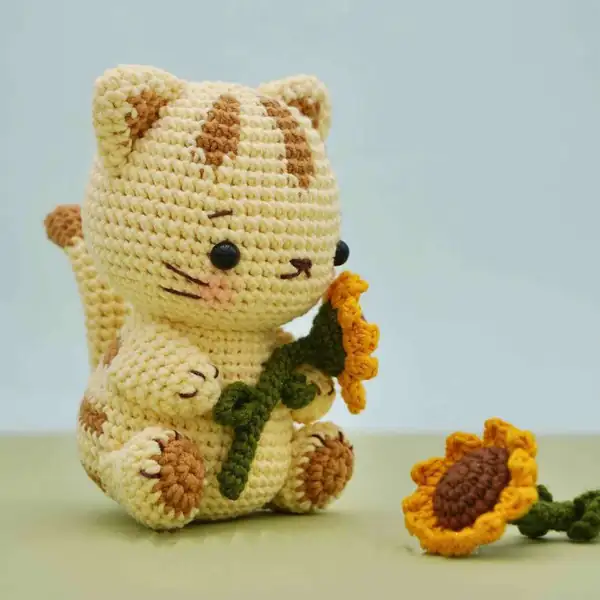
Sunny Kitty head close-up amigurumi in brown and cream
4.3Rating
24-36 HoursTime
IntermediateSkill
Highlights

What makes it special

Cute Companion

An adorable friend to cherish, handcrafted with love to bring comfort and joy for years to come.

Multi-Day Project

A multi-day project across multiple characters and flowers, designed for slow, thoughtful stitching and careful finishing to bring each piece to life.

Intermediate Level

This set suits crocheters who are comfortable with magic rings, increases and decreases, color changes, working in the round, and basic assembly of multiple parts into a single scene.

There is something special about shaping a soft friend from a ball of DK weight yarn, and The Cats and Flowers Amigurumi Pattern captures that magic perfectly. I designed two tiny cats—Sunny Kitty in warm brown and a second kitty in grey with white accents—so the pairing feels like a little garden visit you can cuddle. Their sweet bouquets are stitched into their tiny paws, turning a simple amigurumi set into a story you can tell every time you pick them up. The finished size is about 14 cm tall, compact enough to tuck on a bookshelf or peek from a bedside table. As you crochet, you’ll feel the rhythm of MR, SC, INC, DEC, and the subtle texture created by BLO and FLO interplays that give their fur a living, cuddly look.

About This The Cats and Flowers Amigurumi Pattern

From the moment you start a magic ring and slip into the first round of brown for Sunny Kitty’s head, you can feel the pattern guiding your hands toward a pair of charming companions. The Cats and Flowers Amigurumi Pattern uses a classic DK weight base with selective color changes to create the two distinct felines: Sunny Kitty with warm brown tones, a darker brown for shading, and pale grey accents that bring dimension to the ears and cheeks; plus white for eyes highlights and a blush of pink for tiny noses. Each cat’s body is built with simple SC stitches and gentle INC and DEC to shape the neck, rounded belly, and capped tail. The petals, stems, and blossoms are added as separate motifs that join during assembly, so you get a little floral arrangement that stays secure even when the figures are handled. I love how the BLO stitches frame the facial features, while FLO adds subtle texture on the side facing outward. The finished piece stands about 14 cm tall, a comforting size that cushions into a hug or perches on a shelf as a reminder of spring.

When you open The Cats and Flowers Amigurumi Pattern, you’ll find a clear road map that breaks the build into approachable steps without sacrificing character. Two cat bodies emerge from the same foundational motifs, each with its own color palette—Sunny Kitty in brown variations and a contrast cat in grey with white accents—so you’ll grow confidence as you switch colors and finish the features. The instruction set walks you through forming ears, little paws, and expressive faces using MR, SC, INC, DEC, and tiny invisible decreases that keep the joints clean and the seams tidy. You’ll attach flowers as separate motifs, using a simple chain and slip stitch sequence to create petals that nestle at the cats’ chests and paws. Assembly relies on pins, careful stuffing, and even the option of taping or wiring the tails for poseability, if you choose to add a little wire to Sunny Kitty’s tail. Finally, you’ll stitch the features with black and white yarn, insert safety eyes (8 mm each), and secure the noses with a touch of pink for a friendly, garden-ready expression.

Throughout the rounds, the pattern emphasizes color changes that stay neat and compact, so the seams stay nearly invisible on both cats. I encourage you to work some parts in BLO to emphasize the rounded cheeks and the torso, and switch to FLO for subtle surface texture around the ears and top of the head for depth. The flowers are stitched with simple SL ST chains and small SC petals, joined with a secure slip stitch to keep the bouquet anchored to the paws. When you stuff, aim for a firm but cushiony feel, ensuring the bellies are round and the limbs hold their shape without shifting. The instructions also cover finishing touches—how to weave in ends securely, how to position the safety eyes evenly, and how to soft-finish the flowers so they stay vibrant through regular play. By the end, you’ll see a duo that looks ready to step into a sunlit yard, carrying a tiny bouquet between them.

Because the pattern is written for DK weight yarn and a 2.5 mm hook, the scale is consistent across both cats, resulting in a cohesive duo that sits well on a child’s bed or a shelf display. The 14 cm height makes them portable for gift-giving or travel, while the separate flower motifs give you a satisfying moment of design control—as if you’re arranging a tiny bouquet in your own hands. The step-by-step flow keeps you moving from MR to final assembly, and the optional tail wires allow you to freeze a pose for photos or storytelling. With the included color codes and stitch abbreviations, it’s easy to substitute a shade here and there—remember to adjust the stuffing if you switch the size, so the overall balance remains steady. After finishing, you’ll not only own a charming pair of amigurumi cats, but a tiny, timeless reminder that gardens and friends can grow from the same ball of yarn.

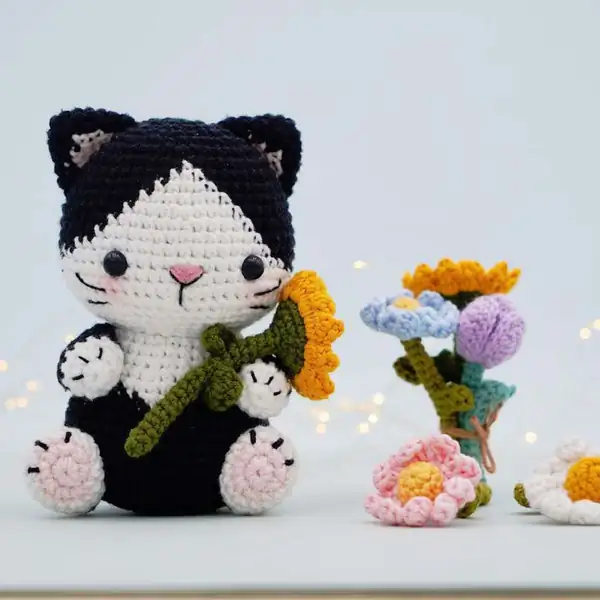
Bright yellow sunflower amigurumi with petals

Beyond the basics, this pattern invites you to personalize the scene these two amigurumi kitties inhabit. You can swap in a cooler grey for the second cat or tilt the white accents toward the chest to create a different facial expression, and you’ll still keep the same sweet silhouette thanks to the consistent measurements. The floral bouquet becomes your playground too—vary the petal shapes from round to pointed, alternate pink with white, or introduce a tiny yellow center for cheerful contrast. I often place the petals close to the paws so the cats appear as if they’re gently presenting the blooms, but you can also create a loose bouquet that sits between them. The build order was chosen to give you steady progress, with the flowers secured early enough to avoid shifting while you shape the cat bodies, yet flexible enough to let you pause and swap colors mid-project if you wish.

Travel-friendly and adjustable, the Cats and Flowers duo adapts as your skills grow. If you want a larger display piece, you can simply switch to a heavier DK or worsted yarn and a slightly larger hook, recalibrating stuffing to maintain balance. If you’re crocheting for a little one, you can opt for embroidery instead of safety eyes and a crocheted nose, so faces stay soft. I’ve included a few care tips in my notes so you can keep the stitching neat after hours of play: store them away from direct sunlight, rotate the two cats with the flowers every now and then to prevent color fading, and gently dust with a soft brush. The result is a timeless, hand-made friend that feels almost alive, as if the garden had wandered into your living room.

Stitches & Skills You'll Use

Stitch by stitch, the backbone of this pattern is a careful blend of classic amigurumi techniques and deliberate texture work. The cats’ heads begin with a MR followed by neat SC rounds that build a round face, while the ears are formed with short color swatches and small increases to create the pointed tops. I rely on INC and DEC in tight, evenly spaced intervals to sculpt the neck and shoulders without creating bulky seams, then switch between BLO and FLO to shape cheeks, brows, and the top of the head for depth. The floral parts are built with little chains and single crochets that mimic tiny petals, joined with a secure slip stitch to keep the bouquet anchored to the paws. For assembly, I mark join points with pins and position pieces before sewing; I use an invisible decrease technique in the limb connections to maintain a rounded, friendly look without visible gaps.

Face details are an exercise in stitching economy: dots of white for gleam in the eyes or outside highlight, and a tiny pink nose worked in two rounds for a soft, friendly expression. You’ll learn how to place safety eyes evenly and how to secure ends so nothing slips with play. Tight stuffing is crucial in a 14 cm figure, but you’ll want to leave a little give at the joints to avoid stiffness during posing, especially if you decide to wire the tails. The two cats are designed so one projects slightly forward with a paw reaching the bouquet, while the other leans into a gentle curve—two different silhouettes that keep the same proportions. Finally, the finishing touches—tiny whiskers you can embroider or crochet, and a light dusting of pink on noses—bring the pair to life and ensure that the scale reads as sweet and approachable rather than cartoonish.

Throughout the build, you’ll see stitch counts and color changes stated clearly, enabling you to check your progress as you go. I’ve kept the pattern readable with marginal notes for color-changes at the exact rounds where they occur, so you won’t lose track of which color comes next. The flowers require only minimal shaping, but the results are dramatically cumulative: a cluster of five to seven petals per flower, a slender stem, and a tiny leaf if you want extra greenery. If you’ve never used BLO before, this is a friendly place to learn, because the effect is subtle but unmistakable in the finished piece. By the end, you’ll recognize the simple elegance of the method: compact stitches, precise color shifts, and the sweet, sculpted forms that make The Cats and Flowers Amigurumi Pattern a standout project in the realm of 14 cm friends.

Why You'll Love This The Cats and Flowers Amigurumi Pattern

Choosing this pattern is about more than making something pretty; it’s about inviting a moment of mindful crafting that you can carry into any weekend project. The Cats and Flowers Amigurumi Pattern gives you a duo that tells a story—the sunny, brown Sunny Kitty and her grey companion—so you’ll feel a gentle sense of accomplishment as you see them grow from MR to the finished pair. The flowers act as a quiet celebration in yarn form, a pocket-sized bouquet you can adjust to highlight seasons or moods. With an intermediate level, you’ll gain confidence through the consistent round-by-round structure, but you’ll still have room to improvise color placement and shade with a deliberate touch. I love the tactile joy of the yarn sliding over the hook, the soft click of the stitch, and the moment when the eyes are set and the faces seem to blink to life. It’s the kind of project that sits nicely on a shelf while you chat with a friend or scan through a favorite podcast.

These little friends are made to be loved as gifts, to brighten a nursery, or to tag along for photo stories that show a garden coming indoors. The durability comes from clean joins, secure ends, and a careful assembly routine that keeps the limbs flexible enough to pose yet sturdy enough for daily cuddles. The finished pair measures approximately 14 cm tall, a practical size for travel or keepsakes, and the color coordination between main brown, dark brown, grey, black, white, and pink gives you a broad palette to play with. The design’s elements—two heads, two bodies, paired tails, and a petite bouquet—offer a satisfying arc of progress, so you’ll feel seen at every stage, not overwhelmed. I designed this pattern to be revisited: you can try new color stories, different flower shapes, or a second bouquet for variation, all while keeping the same beloved silhouette.

Beyond the fun of crochet, there’s a gentle storytelling aspect that makes these amigurumi feel special. When you wrap them in tissue for gifting or place them in a tiny crate for a friend, you’re sharing a handcrafted moment that respects the time and care you invested. The construction teaches patience, precision, and improvisation in equal measure, and the sense of pride that comes with finishing a two-cat scene with coordinated blooms is hard to beat. Whether you’re a collector of amigurumi or someone seeking a handmade centerpiece, this pattern offers a dependable path to a resilient, huggable pair. In short, The Cats and Flowers Amigurumi Pattern is a cozy, character-rich project that rewards focus and imagination in equal measure.

Colour & Yarn Inspiration

If you love playing with palettes, this pattern is your invitation to explore color theory in a tiny, tactile form. Start with Sunny Kitty’s main brown and the dark brown shading to create a cozy, sunlit fur tone; then pick a second for the other cat—something that reads as cool or warm depending on your mood. The flowers are a natural playground: choose pinks, whites, and greens for a classic garden look, or remix with peach, lavender, or sunny yellow to signal a seasonal vignette. The key is to keep a couple of anchors—the main brown, the grey, and the white—so your two characters feel related rather than completely mismatched. Changing the pink to red or peach can shift the personality of the bouquet from sweet to bold, and I encourage you to photograph your tester colors to compare before committing to a full knit. The pattern’s color-placement guides help you maintain harmony even as you test bolder combos.

Want a coastal or forest vibe? Consider muted blues and sage greens for the flowers, with a sandy-brown for Sunny Kitty’s fur and a darker chocolate for shadows. For a winter scene, swap the flowers for pale icy tones and lean on white and light grey accents to evoke snowfall. If you’d like more contrast, introduce a black nose and bound these details with a tiny satin stitch so the faces pop without losing the cuddly feel. Remember that color changes in crochet should be made at the end of a completed round to keep the color transitions neat and prevent loose yarn tails from showing on the surface.

Finally, you can craft themed versions: a Halloween pair with orange and black accents and a floral motif in emerald green, or a birthday set using bright candy-tone pinks and blues that make the little bouquet feel like confetti stepping from the page. The palette choices are limited only by your imagination, not by the pattern; you’ll still preserve the cats’ proportions and the flower placement, but you’ll create a new personality with each color choice. I recommend keeping a small swatch on hand to verify that material counts align with the intended shade, especially if you’re substituting brand or weight. The result is a vibrant, collectible duo whose hues echo your room decor, a child’s favorite cartoon palette, or a seasonal motif as you see fit.

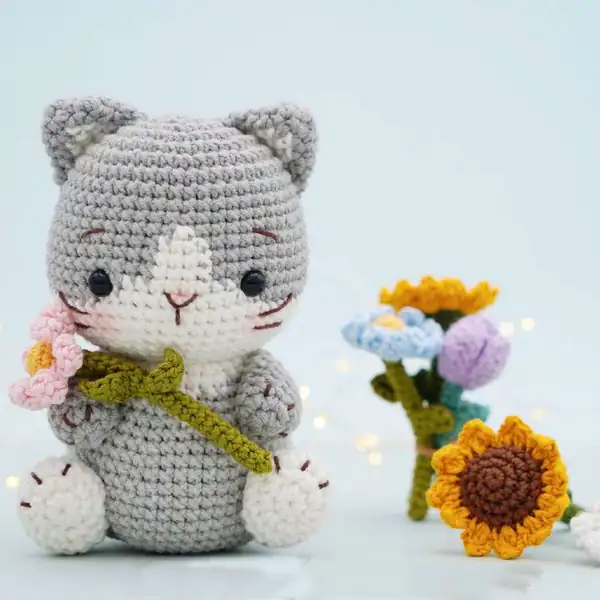
Group of cat and floral amigurumi pieces together

Switch Things Up

Ready to remix your approach? This section invites you to see The Cats and Flowers pattern not as a fixed recipe but as a springboard for creative play. Start with color swaps: give Sunny Kitty a cinnamonbrown and replace the grey cat with cream or taupe for a softer, sunset vibe; emphasize the flowers in a contrasting hue to make the bouquet pop. Changing the main yarn weight—slightly lighter or heavier—will shift the proportions, so I’ve included notes on adjusting the hook and stuffing to keep balance and pose. You can also tailor the facial expressions by altering the placement of eyes and the curve of the mouth; a small tweak here can produce a cat who looks shy, curious, or mischievous.

Next comes scale and texture. If you want a larger duo for a display shelf, swap to a heavier DK or light worsted and use a proportionally larger hook; maintain the same stitch density by adjusting stuffing. For a baby-friendly version, replace safety eyes with embroidered features and a tiny knitted or crochet nose, ensuring no small pieces detach during play. You can also experiment with fabric-safe sealant or eyes with a reduced size to soften the look while preserving the characters’ charm. The flowers can be redesigned as daisies, tulips, or little starbursts, and I encourage you to rearrange the bouquet layout so each cat holds a slightly different arrangement.

Finally, think about display and interaction. Create a tiny garden scene by adding a few tiny leaf shapes as separate motifs and mount the bouquet on a tiny stand near the cats, or have the two of them interact with a larger branch of blooms in a prop photo setup. If you’d like to push the technique further, try different stitch counts for hair texture or build small accessories such as hats or bells to give the cats a sense of personality. The beauty of this project lies in repetition: once you nail the basic shapes, you can apply the same rings of color, the same stacking of rounds, to craft new characters and a broader floral chorus that still looks harmonious with the original pattern.

Finally, I’ll remind you that using the same materials, you can extend this world into a trio or a small family of amigurumi—just keep scale in mind and document any adjustments you make. You’ll get a lot of mileage from keeping notes about which colors you swapped and how the stitch counts adjusted when you changed yarn weight. This pattern rewards curiosity: you learn to feel the fabric, judge stuffing density, and trust your eye when placing the eyes or composing the bouquet. If you’re teaching a crochet group or sharing the project with a friend, setting up a little ‘flower workshop’ around The Cats and Flowers can make progress joyful and collaborative. In the end, the changes you introduce will become part of the story your dolls tell, preserveable as a small, personal collection of garden-inspired friends.

Ways to Use & Gift It

These two amigurumi cats with their floral bouquet make delightful gifts for many occasions, and their compact size keeps them practical to ship or hand to a neighbor. They’re sturdy enough for a toddler to carry with supervision, yet delicate enough to become a cherished keepsake on a nursery shelf. The combination of Sunny Kitty’s warm brown tones and the soft grey companion gives you a universal palette that works well for baby showers, birthdays, or seasonal swaps—think springtime blossoms or winter florals in the same playful duo. The included safety eyes provide a friendly, approachable face, while the flowers add a charming, decorative touch that doubles as a tactile feature for little hands. Wrapped in tissue or placed in a small gift bag, these amigurumi invite warmth and storytelling to the moment of unwrapping, making the act of giving feel like sharing a tiny garden of joy.

Pair the two cats with a handmade card or a tiny crochet blanket to turn a DIY gift into a complete set, and you’ve got something that stands out on a cluttered coffee table or a nursery shelf. They’re also ideal as teacher gifts, neighbors’ treats, or congratulatory tokens for graduates who appreciate a touch of whimsy. If you’re giving to a child, you can customize the eyes to be embroidered or swap the safety eyes for safety secure alternatives; even so, the finished height remains ideal for cuddling without overwhelming a play area. Include a short care note that tells the recipient to spot-clean with a damp cloth and rough handling should be avoided, ensuring the colors stay bright for years to come. The result is a handmade, thoughtful present that communicates care and time taken, not merely a quick purchase.

Finally, you can adapt the bouquet color to reflect the recipient’s favorites or seasonality—pink blossoms for a spring birthday or yellow-green tones for a garden-themed holiday gift—giving you a flexible, ready-to-ship option that travels well in a gift bag or padded envelope.

Common Mistakes & How to Fix Them

Skipping stitch markers during color changes can throw off round counts; place a marker at the beginning of every round to stay aligned. Stuffing too firmly makes faces and limbs stiff; stuff gradually, shaping as you go and stopping to adjust. Not weaving in ends as you go can create loose threads that snag later; weave in as you finish each piece to keep everything neat. Rushing the color-change sections can cause uneven transitions; pause to tidy the yarns before moving on to the next section.

Maker's Notes

I fell in love with The Cats and Flowers Amigurumi Pattern the moment I imagined Sunny Kitty meeting a tiny bouquet. This intermediate project guides you through cheerful DK weight yarns, a magic ring, and carefully placed stitches that end up as a pair of curious cats about 14 cm tall. When you finish them, you'll have two sturdy little felines ready to perch on a shelf or accompany a child’s bedtime stories. I love how the floral accents bloom from simple petals sewn between whiskers and ears, turning yarn into a garden. The finished size, around 14 cm tall, makes them compact enough to tuck into a basket of gifts while still being expressive enough to hold a child's attention.

For materials, I stuck to DK weight yarn in a palette that mirrors a sunny brown kitty and her forest companions. You'll need Color A: Brown - 60 g, Color B: Dark Brown - 20-25 g, Color C: Grey - 40-60 g, Color D: Black - 10 g, Color E: White - 20 g, and Color F: Pink - 5-10 g to build the two cats and their blossoms. You'll need a 2.5 mm hook, a tapestry needle, scissors, stitch markers, and polyester stuffing to build the two little cats and their blooms. Optional wire or a pipe-cleaner can give you posable tails, while two safety eyes (8 mm each) bring life to Sunny Kitty and her companion. Pins for assembly help you arrange ears, faces, and blossoms before you sew everything together, keeping the forms neat as you go. I show the stitches in MR, SC, INC, DEC, BLO, FLO, SL ST, CH, and FO, so this pattern reads clearly for crafters who love precise amigurumi construction.

As you work through the rounds, the magic ring forms the core of each cat piece, and stiff stuffing preserves their plush poise. I explain how to execute invisible decreases where the body meets paws, and how to switch seamlessly to BLO for a rounded belly. The ears get tiny triangles and the eyes sit inside appropriately spaced rounds, while whiskers are stitched as fine lines to keep them crisp. The flowers are built with the same light touch, using small petals worked in pink or white and arranged on tiny green stems that tuck behind ears. Despite the piecework, the pattern remains approachable, and the gentle garden motif shines through.

I often gift these cats with a little bouquet so the recipient has a storybook moment as soon as they open the package. Because safety eyes are used here, I include a gentle reminder that you can substitute embroidered eyes for younger hands. The DK yarn keeps the surface soft yet sturdy, and the 14 cm height makes them perfect for shelf displays, nursery decor, or a companion on a desk. Care and storage are simple: keep dust away, lightly breathe them to reset shape, and store in a box with a few fragrant sachets to keep them fresh. In my workshop, I position Sunny Kitty beside a vase of faux blossoms, and the two of them seem to come alive as I sew the last stitch.

This The Cats and Flowers Amigurumi Pattern sits at an intermediate level, inviting you to enjoy 24 to 36 hours of mindful crocheting. The finished piece, ready to be admired on a shelf or shared as a thoughtful handmade gift, carries the warmth of a tiny garden in fabric and yarn. I designed the color map so you can reuse the technique to make variations—think different cat colors or new flower palettes—without changing the build. If you’re optimizing for search terms, think amigurumi, magic ring, DK weight, worsted weight siblings, and charming little flowers, all embodied in this single, beloved pattern. I hope you enjoy the moment of soft snuggles and the gentle pride that comes when your two cats and their blooms stand proudly at about 14 cm tall.

I tried a substitution: When substituting yarn weight or brand, the main effect is scale: using a sport weight or a lighter DK and a proportionally smaller hook will produce a more petite duo, while a heavier DK or worsted with a larger hook increases the height and width of the cats. To preserve the intended proportions, adjust stuffing density to keep the torsos and heads round, and recalculate the wing of the tail if you decide to add wire. If you swap the main brown for a lighter shade, you may want to deepen shading with a darker companion color to retain definition around the ears and cheeks. For the flowers, the same motif works across weights, but plan the chain length and petal counts to maintain a consistent bouquet silhouette. For eye safety and play, embroidery eyes instead of safety eyes is a smooth substitution for little hands, provided you adjust the nose and mouth proportions so the faces stay expressive. In practice, these substitutions maintain the spirit and charm of the pattern while expanding the material options you can use in a rainy-day crochet session.

The Cats and Flowers Amigurumi Pattern

From the moment you start a magic ring and slip into the first round of brown for Sunny Kitty’s head, you can feel the pattern guiding your hands toward a pair of charming companions. The Cats and Flowers Amigurumi Pattern uses a classic DK weight base with selective color changes to create the two distinct felines: Sunny Kitty with warm brown tones, a darker brown for shading, and pale grey accents that bring dimension to the ears and cheeks; plus white for eyes highlights and a blush of pink for tiny noses. Each cat’s body is built with simple SC stitches and gentle INC and DEC to shape the neck, rounded belly, and capped tail. The petals, stems, and blossoms are added as separate motifs that join during assembly, so you get a little floral arrangement that stays secure even when the figures are handled. I love how the BLO stitches frame the facial features, while FLO adds subtle texture on the side facing outward. The finished piece stands about 14 cm tall, a comforting size that cushions into a hug or perches on a shelf as a reminder of spring.

Intermediate 24-36 Hours
Pattern at a glance
Skill level
Intermediate
Time to make
24-36 Hours
Hook size
2.5 mm
Finished size
Approx. 14 cm tall
Gauge
Not guaranteed; approximate gauge from DK weight with 2.5 mm hook: ~10-12 sc x ~9-11 rows per 4" square
Yarn used
[Main color] 60-100 g; [Other colors] 10-60 g combined

Materials Needed

Main Fabric
  • 01
    DK weight yarn in multiple colors (main brown for Sunny Kitty), 60-100 g
  • 02
    Color A: Brown - 60 g
  • 03
    Color B: Dark Brown - 20-25 g
  • 04
    Color C: Grey - 40-60 g
  • 05
    Color D: Black - 10 g
  • 06
    Color E: White - 20 g
  • 07
    Color F: Pink - 5-10 g
Tools Required
  • 01
    Crochet hook size 2.5 mm (B/1)
  • 02
    Tapestry needle for weaving in ends
  • 03
    Scissors
  • 04
    Stitch markers
  • 05
    Polyester stuffing
  • 06
    Two safety eyes 8 mm (for each cat piece)
  • 07
    Pins for assembly
  • 08
    Optional wire or pipe-cleaner for posable tails

— Part 1 :

Round 1: sc 6 into a magic ring [6];
Round 2: inc in each st around [12];
Round 3: (inc in next st, sc in next st) repeat 6 times [16];
Round 4: sc in next st, inc in next st, (sc in next 2 st, inc in;

— Part 2 :

Round 1: sc 5 into a magic ring [5];
Round 20: sc in next 4 st, inc in next st [6];
Round 21: inc in each st around [12];
Round 22: (inc in next st, sc in next st) repeat 6 times [16];
Round 23: sc in next st, inc in next st, (sc in next 2 st, inc in next st) repeat 5 times, sc in;

— Part 3 :

Round 1: sc 8 into a magic ring [8];
Round 2: (inc in next st, sc in next 3 st) repeat 2 times [10];
Round 3: sc in each st around [10];

— Part 4 :

Round 1: sc 5 into a magic ring [5];
Round 21: inc in each st around [10];

— Part 5 :

Round 1: Ch 8, starting the 2nd ch from hook, inc, hdc in next ch, dc in next 3 ch, hdc in;
Round 2: sc in next st, inc in next st, sc in next 6 st, inc in next st, sc in next 6 st, inc in next;

— Part 6 :

Round 1: sc 5 into a magic ring [5];
Round 16: inc in each st around [10];
Round 17: (sc in next st, inc in next st) repeat 5 times [15];
Round 21: (sc in next st, dec) repeat 5 times [10];
Round 22: (sc in next 3 st, dec) repeat 2 times [8];

— Part 7 :

Round 1: sc 8 into a magic ring [8];
Round 2: inc in each st around [16];
Round 3: (sc in next st, inc in next st) repeat 8 times [24];
Round 4: (sc in next 2 st, inc in next st) repeat 3 times, (brown yarn: sc in next 2 st; dark;
Round 5: (sc in next 3 st, inc in next st) repeat 3 times, (brown yarn: sc in next 2 st; dark;
Round 6: sc in next st, inc in next st, (sc in next 4 st, inc in next st) repeat 3 times, (dark;
Round 9: sc in next 22 st; dark brown yarn: sc in next st; brown yarn: sc in next 4 st; dark;
Round 10: sc in next 28 st; dark brown yarn: sc in next st; brown yarn: sc in next 19 st [48];
Round 11: (sc in next 7 st, inc in next st) repeat 6 times [54];
Round 16: (sc in next 8 st, inc in next st) repeat 6 times [60];
Round 17: sc in each st around [60];
Round 18: (sc in next 8 st, dec) repeat 6 times [54];
Round 19: sc in next 3 st, dec, (sc in next 7 st, dec) repeat 5 times, sc in next 4 st [48];
Round 20: (sc in next 6 st, dec) repeat 6 times [42];
Round 21: sc in next 2 st, dec, (sc in next 5 st, dec) repeat 5 times, sc in next 3 st [36];
Round 22: (sc in next 4 st, dec) repeat 6 times [30];
Round 23: sc in next st, dec, (sc in next 3 st, dec) repeat 5 times, sc in next 2 st [24];
Round 24: sl st in each st around [24];
Round 25: (sc in next 2 st, inc in next st) repeat 8 times [32];
Round 26: sc in next 28 st; dark brown yarn: sc in next 4 st [32];
Round 27: sc in next 13 st; brown yarn: sc in next 15 st; dark brown yarn: sc in next 4 st;
Round 28: (sc in next 3 st, inc in next st) repeat 3 times, sc in next st; brown yarn: sc in;
Round 31: (sc in next 4 st, inc in next st) repeat 6 times, sc in next 4 st; dark brown yarn:;
Round 32: sc in next 21 st; brown yarn: sc in next 19 st; dark brown yarn: sc in next 8 st [48];
Round 33: sc in next 21 st; brown yarn: sc in next 27 st [48];
Round 34: (sc in next 11 st, inc in next st) repeat 4 times [52];
Round 35: sc in each st around [52];
Round 36: sc in next 44 st; dark brown yarn: sc in next 8 st [52];
Round 37: sc in next 21 st; brown yarn: sc in next 23 st; dark brown yarn: sc in next 8 st [52];
Round 38: sc in next 21 st; brown yarn: sc in next 31 st [52];
Round 39: (sc in next 11 st, dec) repeat 4 times [48];
Round 40: sc in each st around [48];
Round 41: (sc in next 4 st, dec) repeat 8 times [40];
Round 42: sc in next st, dec, (sc in next 3 st, dec) repeat 7 times, sc in next 2 st [32];
Round 43: (sc in next 2 st, dec) repeat 8 times [24];
Round 44: (sc in next st, dec) repeat 8 times [16];
Round 45: dec 8 times [8];

— Part 8 :

Round 1: sc 8 into a magic ring [8];
Round 2: (inc in next st, sc in next st) repeat 4 times [12];

— Part 9 :

Round 1: sc 8 into a magic ring [8];
Round 2: inc in each st around [16];
Round 3: sc in next st, inc in next st, sc in next 5 st, inc in next 2 st, sc in next 5 st, inc in;
Round 4: sc in each st around [20];
Round 5: sc in next 6 st, dec 4 times, sc in next 6 st [16];
Round 6: [sc in next 4 st, dec] repeat 2 times, sc in next 4 st [14];
Round 7: sc in next 6 st, dec, sc in next 6 st [13];
Round 8: sc in next 6 st, inc in next st, sc in next 6 st [14];

— Part 10 :

Round 1: sc 6 into a magic ring [6];
Round 2: (inc in next st, sc in next st) repeat 3 times [9];
Round 3: inc in next st, sc in next 2 st, inc in next st; dark brown yarn: sc in next st; brown;
Round 4: sc in next 5 st; dark brown yarn: sc in next 3 st; brown yarn: sc in next 4 st [12];
Round 5: sc in next 3 st, inc in next st, sc in next st; dark brown yarn: sc in next 2 st, inc in;
Round 6: sc in next 4 st, inc in next st, sc in next st; dark brown yarn: sc in next 3 st, inc in;

— Part 11 :

Round 1: sc 6 into a magic ring [6];
Round 2: (inc in next st, sc in next st) repeat 3 times [9];

— Part 12 :

Round 1: sc 8 into a magic ring [8];
Round 2: inc in each st around [16];
Round 3: (sc in next st, inc in next st) repeat 8 times [24];
Round 4: (sc in next 2 st, inc in next st) repeat 8 times [32];
Round 5: sc in next st, inc in next st, (sc in next 3 st, inc in next st) repeat 7 times, sc in;
Round 6: (sc in next 4 st, inc in next st) repeat 8 times [48];
Round 11: (sc in next 7 st, inc in next st) repeat 2 times, sc in next 7 st; white yarn: inc in;
Round 15: sc in next 22 st; white yarn: sc in next 8 st; grey yarn: sc in next 24 st [54];
Round 16: (sc in next 8 st, inc in next st) repeat 2 times, sc in next 2 st; white yarn: sc in;
Round 17: sc in each st around [60];
Round 18: (sc in next 8 st, dec) repeat 6 times [54];
Round 19: sc in next 3 st, dec, (sc in next 7 st, dec) repeat 5 times, sc in next 4 st [48];
Round 20: (sc in next 6 st, dec) repeat 6 times [42];
Round 21: sc in next 2 st, dec, (sc in next 5 st, dec) repeat 5 times, sc in next 3 st [36];
Round 22: (sc in next 4 st, dec) repeat 6 times [30];
Round 23: sc in next st, dec, (sc in next 3 st, dec) repeat 5 times, sc in next 2 st [24];
Round 24: sl st in each st around [24];
Round 25: (sc in next 2 st, inc in next st) repeat 8 times [32];
Round 26: white yarn: sc in next 20 st; grey yarn: sc in next 12 st [32];
Round 27: sc in next 14 st; white yarn: sc in next 4 st; grey yarn: sc in next 14 st [32];
Round 28: (sc in next 3 st, inc in next st) repeat 4 times; white yarn: sc in next 2 st; grey;
Round 29: sc in next 21 st; white yarn: sc in next st; grey yarn: sc in next 18 st [40];
Round 30: sc in each st around [40];
Round 31: (sc in next 4 st, inc in next st) repeat 8 times [48];
Round 34: (sc in next 11 st, inc in next st) repeat 4 times [52];
Round 39: (sc in next 11 st, dec) repeat 4 times [48];
Round 40: sc in each st around [48];
Round 41: (sc in next 4 st, dec) repeat 8 times [40];
Round 42: sc in next st, dec, (sc in next 3 st, dec) repeat 7 times, sc in next 2 st [32];
Round 43: (sc in next 2 st, dec) repeat 8 times [24];
Round 44: (sc in next st, dec) repeat 8 times [16];
Round 45: dec 8 times [8];

— Part 13 :

Round 1: sc 8 into a magic ring [8];
Round 2: (inc in next st, sc in next st) repeat 4 times [12];

— Part 14 :

Round 1: sc 8 into a magic ring [8];
Round 2: inc in each st around [16];
Round 3: sc in next st, inc in next st, sc in next 5 st, inc in next 2 st, sc in next 5 st, inc in;
Round 4: sc in each st around [20];
Round 5: sc in next 6 st, dec 4 times, sc in next 6 st [16];
Round 6: [sc in next 4 st, dec] repeat 2 times, sc in next 4 st [14];
Round 7: sc in next 6 st, dec, sc in next 6 st [13];
Round 8: sc in next 6 st, inc in next st, sc in next 6 st [14];

— Part 15 :

Round 1: sc 6 into a magic ring [6];
Round 2: (inc in next st, sc in next st) repeat 3 times [9];
Round 3: inc in next st, sc in next 2 st, inc in next st; white yarn: sc in next st; grey yarn: sc;
Round 4: sc in next 5 st; white yarn: sc in next 3 st; grey yarn: sc in next 4 st [12];
Round 5: sc in next 3 st, inc in next st, sc in next st; white yarn: sc in next 2 st, inc in next st;
Round 6: sc in next 4 st, inc in next st, sc in next st; white yarn: sc in next 3 st, inc in next st;

— Part 16 :

Round 1: sc 6 into a magic ring [6];
Round 2: (inc in next st, sc in next st) repeat 3 times [9];

— Part 17 :

Round 1: sc 8 into a magic ring [8];
Round 2: inc in each st around [16];
Round 3: (sc in next st, inc in next st) repeat 8 times [24];
Round 4: (sc in next 2 st, inc in next st) repeat 8 times [32];
Round 5: sc in next st, inc in next st, (sc in next 3 st, inc in next st) repeat 7 times, sc in;
Round 6: (sc in next 4 st, inc in next st) repeat 8 times [48];
Round 7: sc in next 23 st, white yarn: sc in next st; black yarn: sc in next 24 st [48];
Round 8: sc in next 22 st; white yarn: sc in next 3 st; black yarn: sc in next 23 st [48];
Round 9: sc in next 21 st; white yarn: sc in next 5 st; black yarn: sc in next 22 st [48];
Round 10: sc in next 20 st; white yarn: sc in next 7 st; black yarn: sc in next 21 st [48];
Round 11: (sc in next 7 st, inc in next st) repeat 2 times, sc in next 3 st; white yarn: sc in;
Round 12: sc in next 20 st; white yarn: sc in next 12 st; black yarn: sc in next 22 st [54];
Round 13: sc in next 19 st; white yarn: sc in next 14 st; black yarn: sc in next 21 st [54];
Round 14: sc in next 17 st; white yarn: sc in next 17 st; black yarn: sc in next 20 st [54];
Round 15: sc in next 15 st; white yarn: sc in next 21 st; black yarn: sc in next 18 st [54];
Round 16: sc in next 8 st, inc in next st, sc in next 4 st; white yarn: sc in next 4 st, inc in;
Round 17: sc in next 12 st; white yarn: sc in next 48 st [60];
Round 18: (sc in next 8 st, dec) repeat 6 times [54];
Round 19: sc in next 3 st, dec, (sc in next 7 st, dec) repeat 5 times, sc in next 4 st [48];
Round 20: (sc in next 6 st, dec) repeat 6 times [42];
Round 21: sc in next 2 st, dec, (sc in next 5 st, dec) repeat 5 times, sc in next 3 st [36];
Round 22: (sc in next 4 st, dec) repeat 6 times [30];
Round 23: sc in next st, dec, (sc in next 3 st, dec) repeat 5 times, sc in next 2 st [24];
Round 24: sl st in each st around [24];
Round 25: (sc in next 2 st, inc in next st) repeat 8 times [32];
Round 26: white yarn: sc in next 24 st; black yarn: sc in next 8 st [32];
Round 27: sc in next 11 st; white yarn: sc in next 11 st; black yarn: sc in next 10 st [32];
Round 28: (sc in next 3 st, inc in next st) repeat 3 times; white yarn: (sc in next 3 st, inc in;
Round 29: sc in next 17 st; white yarn: sc in next 6 st; black yarn: sc in next 17 st [40];
Round 30: sc in next 19 st; white yarn: sc in next 2 st; black yarn: sc in next 19 st [40];
Round 31: (sc in next 4 st, inc in next st) repeat 4 times; white yarn: sc in next st; black;
Round 34: (sc in next 11 st, inc in next st) repeat 4 times [52];
Round 39: (sc in next 11 st, dec) repeat 4 times [48];
Round 40: sc in each st around [48];
Round 41: (sc in next 4 st, dec) repeat 8 times [40];
Round 42: sc in next st, dec, (sc in next 3 st, dec) repeat 7 times, sc in next 2 st [32];
Round 43: (sc in next 2 st, dec) repeat 8 times [24];
Round 44: (sc in next st, dec) repeat 8 times [16];
Round 45: dec 8 times [8];

— Part 18 :

Round 1: sc 8 into a magic ring [8];
Round 2: (inc in next st, sc in next st) repeat 4 times [12];
Round 3: sc in each st around [12];

— Part 19 :

Round 1: sc 8 into a magic ring [8];
Round 2: inc in each st around [16];
Round 3: sc in next st, inc in next st, sc in next 5 st, inc in next 2 st, sc in next 5 st, inc in;
Round 4: sc in each st around [20];
Round 5: sc in next 6 st, dec 4 times, sc in next 6 st [16];
Round 6: [sc in next 4 st, dec] repeat 2 times, sc in next 4 st [14];
Round 7: sc in next 6 st, dec, sc in next 6 st [13];
Round 8: sc in next 6 st, inc in next st, sc in next 6 st [14];

— Part 20 :

Round 1: sc 6 into a magic ring [6];
Round 2: (inc in next st, sc in next st) repeat 3 times [9];
Round 3: inc in next st, sc in next 2 st, inc in next st; pink yarn: sc in next st; black yarn: sc;
Round 4: sc in next 5 st; pink yarn: sc in next 3 st; black yarn: sc in next 4 st [12];
Round 5: sc in next 3 st, inc in next st, sc in next st; pink yarn: sc in next 2 st, inc in next st;
Round 6: sc in next 4 st, inc in next st, sc in next st; pink yarn: sc in next 3 st, inc in next st;

— Part 21 :

Round 1: sc 6 into a magic ring [6];
Round 2: (inc in next st, sc in next st) repeat 3 times [9];

Assembly Instructions

  1. Position the ears on either side of the head between rounds 3 and 10 and sew in place.
  2. Position the arms on either side of the body, below the head, and sew in place using long tails.
  3. Position and sew the legs on either side of the body, ensuring even spacing and alignment.
  4. Position and sew the tail to the center back at the base of the body; tack a few rounds to secure.
  5. Insert the eyes between rounds 15 and 16, 8 stitches apart; embroider nose, whiskers, and cheeks as shown in photos.

Important Notes

  • Mark rounds clearly to avoid miscounts during color changes.
  • Stuff gradually and shape as you go to maintain smooth transitions between rounds.
  • Weave in every yarn end as you go to minimize finishing work later.
  • Keep tension consistent to avoid gaps between color changes and limb attachments.
  • Lay out all parts before sewing to ensure correct orientation and symmetry.

As you finish The Cats and Flowers Amigurumi Pattern, you’ll find yourself smiling at the way two little kitties hold a bouquet like a promise of spring. The design combines classic amigurumi technique with a playful floral theme, resulting in a pair that is both decorative and tactile. The 14 cm tall figures balance adorableness with practicality, making them ideal as gifts, desk companions, or nursery décor. I hope you savor each ring of the hook, each color change, and every tiny face that comes to life as you stitch. When you finally attach the safety eyes and tuck in the final ends, you’ll know this is more than a project; it’s a small celebration of patience, craft, and a garden’s worth of charm translated into yarn.
Good to know

You ask, we answer

The finished items vary; the Sunny Kitty pattern notes a roughly 14 cm tall figure with the materials listed, though exact size depends on yarn weight and tension.

Yes, you can, but it will affect final size and proportions. If you switch yarn weight, adjust your hook size and potentially the round counts to maintain the same silhouette.

This collection is best suited to an intermediate crocheter; you’ll handle magic rings, color changes, and careful assembly—some familiarity with amigurumi techniques helps greatly.

Expect a multi-day project; with multiple pieces to stitch, assemble, and finish, time ranges from roughly 24 to 36 hours, depending on pace and familiarity.

Daisy and tulip flower amigurumi with stems
Join 100k+ crocheters

Get new free patterns, stitch tips and exclusive content in your inbox.