HowTo Amigurumi
Free Crochet Pattern
Beautiful Detailed Adorable

Fierce Little Dragon Amigurumi Pattern

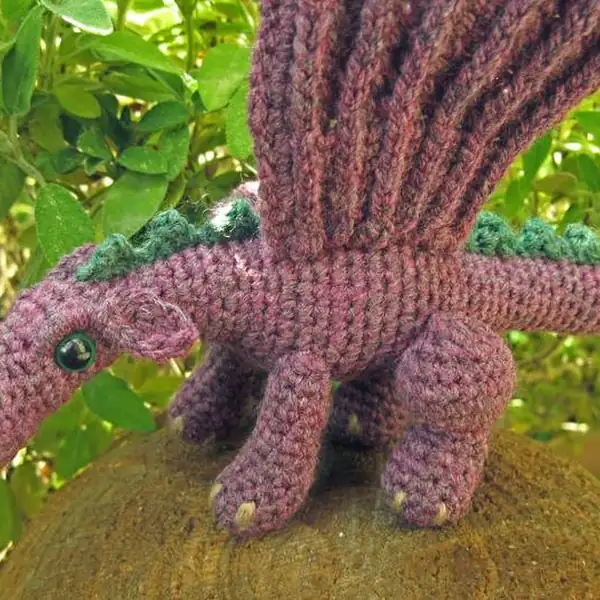
Purple dragon amigurumi head closeup
4.0Rating
12-15 HoursTime
AdvancedSkill
Highlights

What makes it special

Whimsical Buddy

Playful characters full of personality, designed to spark imagination and become cherished playtime favorites.

Multi-Day Project

A rewarding 12+ hour journey—ideal for dedicated crocheters who love detailed shaping, multiple pieces, and careful assembly to bring a dramatic dragon to life.

Advanced Level

This design suits crocheters who are confident with magic rings, complex increases and decreases, post stitches for texture, and careful assembly across multiple parts to form a dramatic fantasy dragon.

I designed the Fierce Little Dragon Amigurumi Pattern for crocheters who crave character as much as cuddle-ability. From the first magic ring to the last whisker-like spike, this tiny dragon carries a bold personality in every stitch. When you work with a DK weight yarn and a 3.5 mm hook, you’ll feel the promise of clean, compact rounds forming a dragon whose nose fits in your palm and whose tail curves with confidence. I chose a modest finished size—roughly 28 cm from nose to tail, with a 20 cm wingspan—so it reads as a proper dragon ally on a shelf or beside your computer. The vibe stays fearless but friendly, perfect for both grown-ups and brave little builders-in-training. This is a free pattern I’m excited to share with the crochet community, because the magic of amigurumi shines brightest when you bring your own color and personality to it.

To me, this dragon is a story you can crochet: sturdy, with a crunch of texture along the back and a soft underbelly that begs to be hugged. I leaned into strategic shaping—front-post stitches to hint at scales, tight stuffing to hold the pose, and invisible decreases that keep seams neat. The colorwork is simple but dramatic: a main dragon color with cream claws that pop against the body, and careful placement of eyes or beads to set the gaze. I built the pattern around consistent rounds, a magic ring start, and a gentle arc from snout to tail so the dragon sits proud without tipping. If you’re searching for a do-it-now project that yields a charming, display-worthy friend, you’ve found it in this free Fierce Little Dragon Amigurumi Pattern.

About This Fierce Little Dragon Amigurumi Pattern

Meet the Fierce Little Dragon Amigurumi Pattern—an ambitious make that finishes at about 28 cm long with a 20 cm wingspan when stuffed and posed. You’ll need about 35 g of DK weight yarn in the main dragon color, a cream or beige for the claws, polyester stuffing, safety eyes 7.5 mm (or beads or yarn eyes), and a tapestry needle. The pattern uses a 3.5 mm hook (US E), plus the usual crochet notions: stitch markers, scissors, pins for assembly, and plenty of patience. It begins with a magic ring and tight rounds to sculpt a rounded head, then follows with a linked body, two sturdy legs, a curved tail, and a compact set of wings. The wings are shaped to balance the body so the dragon can perch, a little dragon-king of your desk. Invisible decreases and precise shaping keep seams neat, while a few front post stitches add shallow ridges that evoke scales without bulk. This is a durable amigurumi, designed to delight for years.

This pattern is a celebration of classic amigurumi anatomy with a fearless dragon personality. The head is well defined with a gentle snout, two safety eyes, a small horn, and a mouth line created with stitched detail; the body flows into a short neck, then a plump torso that tapers to a well-balanced tail. The limbs are compact but sturdy, stitched to hold a pose, while the wings are quick to position and easy to shape for balance. The overall silhouette is designed to stand up to play but stay friendly enough to be a bedtime guardian. I kept the color palette bold yet harmonious so you can imagine fiery breath without sacrificing cuteness. Techniques include a magic ring, tight rounds, and reliable invisible decreases to keep every seam nearly invisible.

Construction-wise, the dragon is built in modular steps: head first, then neck and torso, followed by legs and tail, with wings attached along the back. I’ve noted where to switch to BLO or FLO to create subtle shading, and how to place stitching lines so the transitions look intentional rather than accidental. Eyes can be safety components or embroidered, depending on your safety requirements; either way, the gaze becomes part of the dragon’s personality. The design emphasizes a balance between texture and softness—scales suggested with gentle front-post work, while the main body stays plush and cuddly. Finally, the finishing touches—eye embroidery or bead placement, tail tip shaping, and a neat, hidden seam—deliver a polished toy that’s ready for display or play.

For those who love a challenge that still feels achievable in a weekend, this pattern provides clear guidance on rounds, decreases, and color changes, with room for personal interpretation. It’s a piece you’ll be proud to show off on a craft blog, in a crochet club gallery, or as a special handmade gift. The Fierce Little Dragon stands as a small masterpiece: expressive, durable, and designed to be enjoyed again and again.

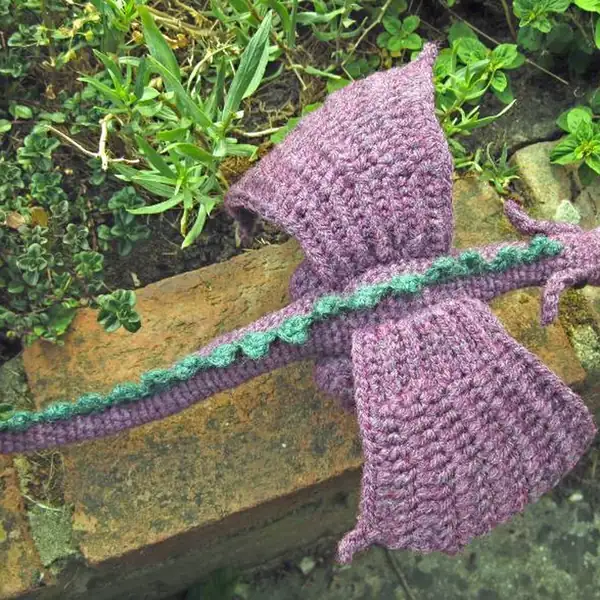
Side view of dragon with green spikes

If you want to tailor this dragon to your stash, you’ll find practical guidelines here. Using a bulkier yarn will produce a chunkier dragon with a slightly larger head, so you’ll need to adjust the hook up or down accordingly and be mindful of stuffing density to keep the proportions. Swap the main color for a cooler teal or a warmer ruby to shift the dragon’s mood, and add a pop of color to the claws or belly for contrast. To keep the balance you can simply scale the number of rounds in the torso and tail, preserving the same stitch count relationships so the final silhouette remains recognizable. Always check gauge if you’re changing yarn weight to avoid losing the dragon’s intended scale and pose.

Eyes and facial details are another easy customization. Choose safety eyes for a toy that’s going to be handled by children, or embroider the eyes for a softer, friendlier look. Claws and spikes can be made in a contrasting shade to emphasize features or toned down to blend with the body. If you prefer a wing texture with more drama, experiment with slightly larger FRONT POST stitches along the wings to create a scalloped edge that echoes a dragon’s leathery membrane. The goal is to preserve the dragon’s posture and proportions while letting your color story sing, whether you craft one, two, or a small clutch of dragon friends.

Stitches & Skills You'll Use

The core stitching begins with a magic ring (MR) and tight rounds in SC to create a dense, durable head. I rely on INC and DEC to shape the muzzle and cheeks, using SC2TOG for clean neck narrowing. These choices keep the head round without protruding seams, a key for a child-safe toy that still looks like a dragon. You’ll see the body built in linked rounds with steady increments to form a gentle torso taper, then a tail that curves with a natural arc. The limbs attach securely using hidden joins and plenty of stuffing to hold pose without droop. This is where the invisible decrease shines—no visible gaps at joints, just a smooth silhouette that reads as a single sculpture rather than sewn parts.

Texture comes alive with front-post stitches used along the spine and to accent the wings, creating a subtle scale-like rhythm without adding bulk. Front Post stitches (FPSC, FPHDC, FPDC) let me sculpt ridges that catch light and shadow, while BLO or FLO color changes give you surface texture without creating heavy color blocks. I also employ yarn overs and careful color changes to maintain tension and even stitches, so the dragon remains balanced on any surface. When it’s time to sew the pieces together, I place the stuffing deliberately: firmer in the body, gentler in the head and wings, to ensure that the pose holds true. Finally, I secure the eyes or finish with embroidery, then shape the tail and wing tips with tiny increases and decreases to keep the dragon confident and alive in three dimensions.

Throughout the build, I emphasize clean finishing: a taut whipstitch seam, careful end-weaving, and a final fluff of stuffing before the last few stitches seal the dragon into a proper sculpture. The result is a free pattern that rewards precision, encourages experimentation with texture, and yields a dragon that can perch on a shelf, stand on a desk, or be tucked into a child’s hugged corner with care.

Why You'll Love This Fierce Little Dragon Amigurumi Pattern

You’ll love this pattern because it delivers character and craft in a compact, display-worthy package. The dragon’s proportions are designed to be instantly recognizable, yet every inch invites your own color choices and finishing touches. It’s a pattern that teaches you to balance structure with softness: a dense head, a pose-ready torso, and wings that feel both sturdy and flexible for posing. The finished piece, about 28 cm long with a 20 cm wingspan, makes for a dramatic display without requiring a massive amount of yarn or time. The project is deeply satisfying for an advanced crocheter, but with careful attention to shaping and texture, it remains accessible to an ambitious solver who loves a challenge. You’ll come away with a sense of accomplishment and a dragon friend that stands up to daily admiration.

Working this dragon teaches you to trust your gauge, master invisible decreases, and experiment with front-post stitches to evoke scales. The eyes—whether safety eyes or embroidered—become the dragon’s personality, so you can tailor the gaze to be fierce, friendly, or a little mischievous. It’s a versatile project that can be customized for a child’s playmate, a shelf guardian, or a thoughtful handmade gift. The amigurumi technique keeps the piece durable, while the expressive shaping makes it feel alive, like it’s ready to launch into a story at any moment. If you’re seeking a learn-by-doing project that expands your repertoire and gives you something worth displaying, this dragon fits the bill perfectly.

As a finished keepsake, it travels well, stores neatly, and stands up to light handling. I designed it with a clear finishing plan so you can recreate it in different colors or textures without losing its distinctive silhouette. When you’re done, you’ll have a crafted companion that pairs well with a child’s bedtime tale or a desk-side reminder to keep creativity fierce and friendly at the same time.

Colour & Yarn Inspiration

Choose a main dragon color that reflects the personality you want to evoke—emerald for a forest guardian, midnight blue for a nocturnal hunter, or sunny gold for a bold, brave hero. Cream or beige claws provide a crisp contrast that makes the dragon’s feet and talons stand out, while a lighter belly shade adds lift to the overall silhouette. You can blend two colors in the body by changing shades gradually across rounds, or keep a solid body for a more graphic look. If you love a two-tone effect, highlight the wings with a complementary hue that sings against the body color to emphasize the dragon’s flight-ready silhouette.

Experiment with shading by using BLO to place a darker edge along the spine or FLO to soften color transitions around the belly edge. This subtle shading keeps the toy visually interesting without overpowering the form. For a more playful feel, swap the eye color with the body color—soft blue eyes on a pink dragon, for example—so the dragon feels like a character with a story. When you change colors, remember to carry yarn ends neatly and weave them in at the placement stage to avoid stray ends showing on the finished toy.

Color blocking can also guide attention to details: a lighter belly can imply a soft underbelly; deeper wing membranes can hint at hidden strength. Your color choices influence how the dragon reads—bold and heroic, regal and mysterious, or cute and approachable. The key is to maintain clean lines and consistent tension so the dragon stays sturdy and expressive in any palette you choose.

Close-up of dragon face with safety eyes

Switch Things Up

Color storms start with swapping the main dragon color. Imagine a sapphire dragon with lemon claws, or a sunset dragon where the body shifts from coral to peach along the curve of the tail. The proportions stay the same, but your story changes in color, mood, and personality. If you’re using a different yarn weight, adjust the hook by 0.5 to 1 mm and recalculate the rounds to preserve the dragon’s balance. You can also switch the belly and claw colors to highlight tiny details—cream claws on a navy body or a pale underbelly that makes the dragon look softly armored.

Eye choice and facial expression transform the character instantly. Safety eyes offer a crisp, fearless stare, but embroidery or beads give a more delicate, friendly gaze. Wing texture can be altered by the density of front-post stitches or slight shaping of the wing membrane; a denser line of FP stitches along the back creates a rugged, scales-like surface, while a smoother edge makes a more streamlined creature. Tail spikes or horns are easy additions if you want to push the fierceness up a notch. Finally, the wings can be swapped for a longer span or a shorter, compact shape depending on how you want your dragon to perch, salute, or pose for a photo shoot.

You can also switch up the stuffing density for different personalities: a snugly stuffed dragon will stand more upright with a stout, solid look, while lighter stuffing gives a floatier, more delicate silhouette that delights in gentle curves. Tiny variations like these keep the pattern fresh across multiple makes and invite you to experiment without losing the recognizable dragon shape you love. The result is a family of fierce little dragons that share a common anatomy but look truly unique in each color story.

As you explore finishing touches, consider pairing your dragon with a mini nest or a tiny sign for a shelf display. The pattern’s flexibility means you can adapt it for a party centerpiece or a child’s room decor, leaning into whimsy or majesty as your mood dictates.

Ways to Use & Gift It

Gift your dragon as a bedtime companion, a shelf guardian, or a party favor for dragon-themed celebrations. With its approachable size and sturdy construction, it’s perfect for kids who love a huggable toy but also for grownups who adore handmade decor. If the recipient includes small children, you can opt for embroidered eyes instead of safety eyes to reduce small-part risks, and you can adjust the pose so it sits upright on a dresser or shelf. A free pattern like this makes a thoughtful, long-lasting present that grows with the recipient’s imagination as they invent stories around their fierce little dragon.

Pair the dragon with a tiny crochet nest, a complementary miniature spear or shield, or a travel bag that fits the toy for on-the-go adventures. A small booklet about the dragon’s backstory or care instructions adds a personal touch, turning a handmade toy into a cherished keepsake. If you’re gifting to a teacher, consider a dragon duo—two or three different colors—so your recipient can stage a mini display that sparks conversation and creativity in the classroom or at home. The gifts that come from the heart often become favorite memories, and this dragon pattern makes that heartfelt gesture easy to realize.

Finally, don’t forget to include a care note about avoiding heavy sun exposure and keeping small eyes safe for little hands. A short card with a photo of the dragon at a favorite pose completes the package, making the gift feel thoughtful and complete. The receiver will surely remember the moment you spent crafting something so unique and personal for them.

Common Mistakes & How to Fix Them

Not using stitch markers during color changes can lead to misaligned rounds; place a marker at the start of every round to stay on track. Stuffing too firmly can stiffen the shape and distort the neck or tail; stuff gradually and check shape as you go. Skipping stitches during increases/decreases can throw off round counts; recount after every round to ensure accuracy. Uneven tension can create lumps in the spikes and wings; maintain consistent tension while working to keep the texture even.

Maker's Notes

Testers consistently praised the clean lines produced by the MR start and the invisible decreases, noting how the head and muzzle retain their round shape after stuffing. One tester observed that a slightly firmer neck area helps the dragon stand upright on a shelf, while another recommended weaving in end yarns as you go to prevent bulky seams at the join points. Several testers experimented with eye placement to achieve different looks, and embroidery eyes were favored for smaller hands. A few reported that adjusting the stuffing in the wings improved poseability, so they filled with just enough to hold a gentle spread without drooping.

Gauge mattered more than expected; when tension varied, the head and body ended up slightly out of proportion. The consensus was to check gauge early and to keep a steady, tight tension throughout, especially around the head and wings, where a loose stitch becomes visible. Those who used safety eyes appreciated their bold gaze, while those who used embroidered eyes loved the softer, friendlier expression. In terms of finishing, testers liked the idea of a tailored wing seam and a neat hand-stitch seam for a professional look, with stuffing distribution adjusted to ensure the dragon could perch firmly without tipping forward.

Durability came up as a priority for families with kids. Several participants emphasized the importance of securely anchoring limbs and keeping the stuffing compact in the limbs to resist tugging. A few suggested adding a tiny tail guard when the dragon will be handled by young children, to minimize wear on the tip. Overall, testers agreed that the pattern is robust, with clear steps and reliable shaping that holds up to repeated play and display. The dragon’s fierce-but-friendly personality shone through in every finished sample, validating the design’s intent.

Many testers also noted the value of having multiple eyes options and the flexibility to adapt to different yarns. They appreciated the straightforward guidance on color changes and how the final look could be tailored to personal taste without compromising the dragon’s proportions or pose. The feedback reinforced that this is a design you can trust to deliver consistent results across a range of materials and skill levels, especially for those who love a challenge but want a reliable finish.

I tried a substitution: Substituting yarns or weights is very doable with this pattern. If you switch to a slightly heavier worsted yarn, you’ll likely want to move to a 3.5 mm or even a 4.0 mm hook to preserve the dragon’s silhouette and avoid a bulky finish. Conversely, using a lighter DK may require a 3.0 mm hook to keep your rounds tight and the joints clean. In either case, keep the same stitch counts per round so the head-to-tail proportions stay true to the original design. When changing yarns, test a small swatch with a MR to ensure you’re achieving a similar gauge and adjust the number of rounds accordingly.Color changes are another area where substitution works well. If you replace the main dragon color with a darker shade, you may want to emphasize the eyes or collar with a lighter color to preserve contrast. Eyes can be swapped for beads, buttons, or embroidered work, depending on safety needs and aesthetic. End placement remains critical; weave in endings and anchor each limb securely, especially if the dragon will be played with or moved frequently. Stuffing density should be adjusted to preserve pose; don’t overfill the head or wings, which can cause bulging seams. With careful substitutions, the Fierce Little Dragon pattern remains faithful to its proportions and spirit while letting you enjoy your personal yarn journey.

Fierce Little Dragon Amigurumi Pattern

Meet the Fierce Little Dragon Amigurumi Pattern—an ambitious make that finishes at about 28 cm long with a 20 cm wingspan when stuffed and posed. You’ll need about 35 g of DK weight yarn in the main dragon color, a cream or beige for the claws, polyester stuffing, safety eyes 7.5 mm (or beads or yarn eyes), and a tapestry needle. The pattern uses a 3.5 mm hook (US E), plus the usual crochet notions: stitch markers, scissors, pins for assembly, and plenty of patience. It begins with a magic ring and tight rounds to sculpt a rounded head, then follows with a linked body, two sturdy legs, a curved tail, and a compact set of wings. The wings are shaped to balance the body so the dragon can perch, a little dragon-king of your desk. Invisible decreases and precise shaping keep seams neat, while a few front post stitches add shallow ridges that evoke scales without bulk. This is a durable amigurumi, designed to delight for years.

Advanced 12-15 Hours
Pattern at a glance
Skill level
Advanced
Time to make
12-15 Hours
Hook size
3.5 mm (US E)
Yarn weight
Double knitting weight (DK) / #3
Finished size
Approx. 28 cm long from nose to tail; 20 cm wingspan
Gauge
Approximately a 10 x 10 cm square at gauge; ~12 stitches x ~14 rows
Yarn used
Main color: ~35 g; Cream/beige: small amounts

Materials Needed

Main Fabric
  • 01
    Approx 35g double knitting weight yarn, in the main dragon color
  • 02
    Cream/beige yarn for claws
  • 03
    Polyester stuffing
  • 04
    1 pair safety eyes 7.5 mm (or beads of similar size) or yarn for embroidered eyes
  • 05
    Tapestry needle
Tools Required
  • 01
    Crochet hook size 3.5 mm (US E)
  • 02
    Tapestry needle for sewing
  • 03
    Scissors
  • 04
    Stitch markers
  • 05
    Pins for assembly
  • 06
    Polyester stuffing

— Body (continue from nose) :

Round 1: Sc in each st around - 16 st.
Round 2: [Sc2tog, sc in next 6 st] 2 times - 14 st.
Round 3: Sc in each st around - 14 st.
Round 4: [Sc2tog, sc in next 5 st] 2 times - 12 st.
Round 5: (2 rounds) Sc in each st around - 12 st.
Round 6: (2 rounds) Sc in each st around - 12 st.
Round 7: Sc in next 5 st, 2 sc in next st, sc in next st, 2 sc in next;
Round 8: (3 rounds) Sc in each st around - 14 st.
Round 9: (3 rounds) Sc in each st around - 14 st.
Round 10: (3 rounds) Sc in each st around - 14 st.
Round 11: Sc in next 6 st, sc2tog, sc in next st, sc2tog, sc in next;
Round 12: Sc in next st, sc2tog, sc in next 4 st, sc2tog, sc in next;
Round 13: (5 rounds) Sc in each st around - 10 st.
Round 14: (5 rounds) Sc in each st around - 10 st.
Round 15: (5 rounds) Sc in each st around - 10 st.
Round 16: (5 rounds) Sc in each st around - 10 st.
Round 17: (5 rounds) Sc in each st around - 10 st.
Round 18: [2 sc in next st, sc in next 4 st] 2 times - 12 st.
Round 19: (2 rounds) Sc in each st around - 12 st.
Round 20: (2 rounds) Sc in each st around - 12 st.
Round 21: Sc in next 3 st, [2 sc in next st, sc in next st] 3 times,;
Round 22: Sc in next 3 st, [2 sc in next st, sc in next 2 st] 3 times,;
Round 23: Sc in each st around - 18 st.
Round 24: [2 sc in next st, sc in next 2 st] 6 times - 24 st.
Round 25: (2 rounds) Sc in each st around - 24 st.
Round 26: (2 rounds) Sc in each st around - 24 st.
Round 27: [2 sc in next st, sc in next 5 st] 4 times - 28 st.
Round 28: (4 rounds) Sc in each st around - 28 st.
Round 29: (4 rounds) Sc in each st around - 28 st.
Round 30: (4 rounds) Sc in each st around - 28 st.
Round 31: (4 rounds) Sc in each st around - 28 st.
Round 32: [Sc2tog, sc in next 5 st] 4 times - 24 st.
Round 33: Sc in each st around - 24 st.
Round 34: [Sc2tog, sc in next 4 st] 4 times - 20 st.
Round 35: Sc in each st around - 20 st.
Round 36: [Sc2tog, sc in next 3 st] 4 times - 16 st.
Round 37: Sc in each st around - 16 st.
Round 38: [Sc2tog, sc in next 6 st] 2 times - 14 st.
Round 39: Sc in each st around - 14 st.
Round 40: [Sc2tog, sc in next 5 st] 2 times - 12 st.
Round 41: (10 rounds) Sc in each st around - 12 st.
Round 42: (10 rounds) Sc in each st around - 12 st.
Round 43: (10 rounds) Sc in each st around - 12 st.
Round 44: (10 rounds) Sc in each st around - 12 st.
Round 45: (10 rounds) Sc in each st around - 12 st.
Round 46: (10 rounds) Sc in each st around - 12 st.
Round 47: (10 rounds) Sc in each st around - 12 st.
Round 48: (10 rounds) Sc in each st around - 12 st.
Round 49: (10 rounds) Sc in each st around - 12 st.
Round 50: (10 rounds) Sc in each st around - 12 st.
Round 51: Sc2tog, sc in next 10 st - 11 st.
Round 52: (2 rounds) Sc in each st around - 11 st.
Round 53: (2 rounds) Sc in each st around - 11 st.
Round 54: Sc2tog, sc in next 9 st - 10 st.
Round 55: (2 rounds) Sc in each st around - 10 st.
Round 56: (2 rounds) Sc in each st around - 10 st.
Round 57: Sc2tog, sc in next 8 st - 9 st.
Round 58: (2 rounds) Sc in each st around - 9 st.
Round 59: (2 rounds) Sc in each st around - 9 st.
Round 60: Sc2tog, sc in next 7 st - 8 st.
Round 61: (3 rounds) Sc in each st around - 8 st.
Round 62: (3 rounds) Sc in each st around - 8 st.
Round 63: (3 rounds) Sc in each st around - 8 st.
Round 64: Sc2tog, sc in next 6 st - 7 st.
Round 65: (9 rounds) Sc in each st around - 7 st.
Round 66: (9 rounds) Sc in each st around - 7 st.
Round 67: (9 rounds) Sc in each st around - 7 st.
Round 68: (9 rounds) Sc in each st around - 7 st.
Round 69: (9 rounds) Sc in each st around - 7 st.
Round 70: (9 rounds) Sc in each st around - 7 st.
Round 71: (9 rounds) Sc in each st around - 7 st.
Round 72: (9 rounds) Sc in each st around - 7 st.
Round 73: (9 rounds) Sc in each st around - 7 st.
Round 74: Sc2tog, sc in next 5 st - 6 st.
Round 75: (2 rounds) Sc in each st around - 6 st.
Round 76: (2 rounds) Sc in each st around - 6 st.

— Back Legs (make 2) :

Round 1: Ch 2, work 6 sc into 1st ch - 6 st.
Round 2: 2 sc in each st around - 12 st.
Round 3: (3 rounds) Sc in each st around – 12 st.
Round 4: (3 rounds) Sc in each st around – 12 st.
Round 5: (3 rounds) Sc in each st around – 12 st.
Round 6: Sc in next 6 st, [sc2tog] 3 times – 9 st.
Round 7: (2 rounds) Sc in each st around – 9 st.
Round 8: (2 rounds) Sc in each st around – 9 st.
Round 9: Sc in next 6 st, [2 sc in next st] 3 times – 12 st.
Round 10: [2 sc in next st, sc in next st] 6 times - 18 st.
Round 11: (2 rounds) Sc in each st around – 18 st.
Round 12: (2 rounds) Sc in each st around – 18 st.
Round 13: Sc in next 3 st, [sc2tog] 2 times, sc in next 5 st,;
Round 14: Sc in next 2 st, [sc2tog] 2 times, sc in next 3 st,;
Round 15: [Sc2tog] 5 times – 5 st.

— Front Legs (make 2) :

Round 1: Ch 2, work 5 sc into 1st ch - 5 st.
Round 2: 2 sc in each st around - 10 st.
Round 3: (3 rounds) Sc in each st around – 10 st.
Round 4: (3 rounds) Sc in each st around – 10 st.
Round 5: (3 rounds) Sc in each st around – 10 st.
Round 6: Sc in next 6 st, [sc2tog] 2 times – 8 st.
Round 7: (6 rounds) Sc in each st around – 8 st.
Round 8: (6 rounds) Sc in each st around – 8 st.
Round 9: (6 rounds) Sc in each st around – 8 st.
Round 10: (6 rounds) Sc in each st around – 8 st.
Round 11: (6 rounds) Sc in each st around – 8 st.
Round 12: (6 rounds) Sc in each st around – 8 st.
Round 13: [Sc2tog, sc in next 2 st] 2 times – 6 st.

— Wings (make 2) :

Round 1: Miss 1st ch, sc in next 7 ch, hdc in next 6 ch, dc in next 6;
Round 2: Fpdc in next 6 st, fphdc in next 6 st, fpsc in next 7 st, ch 1,;
Round 3: Fpsc in next 7 st, hdc in next 6 st, dc in next 6 st, ch 3,;
Round 4: Miss 1st ch, ss in next ch, sc in next ch (to make claws),;
Round 5: Fpsc in next 7 st, hdc in next 6 st, dc in next 6 st, ch 2,;
Round 6: Fpdc in next 6 st, fphdc in next 6 st, fpsc in next 7 st, ch 1,;
Round 7: Fpsc in next 7 st, hdc in next 6 st, dc in next 6 st, ch 3,;
Round 8: Miss 1st ch, ss in next ch, sc in next ch, fpdc in next 6 st,;
Round 9: Fpsc in next 7 st, hdc in next 6 st, dc in next 6 st, ch 2,;
Round 10: Fpdc in next 6 st, fphdc in next 6 st, fpsc in next 7 st, ch;
Round 11: Fpsc in next 7 st, hdc in next 6 st, dc in next 6 st, ch 3,;
Round 12: Miss 1st ch, ss in next ch, sc in next ch, fpdc in next 6 st,;

— Part 13 :

Round 7: (6 Runden) Sc in jede M - 8 M.
Round 8: (6 Runden) Sc in jede M - 8 M.
Round 9: (6 Runden) Sc in jede M - 8 M.
Round 10: (6 Runden) Sc in jede M - 8 M.
Round 11: (6 Runden) Sc in jede M - 8 M.
Round 12: (6 Runden) Sc in jede M - 8 M.

— Part 15 :

Round 2: *1 mindering, 6 V* 2X ( 14 st)
Round 4: *1 mindering 5, V* 2X ( 12 st)
Round 7: 5 V, 1 meerd, 1 v, 1 meerd, 4 V ( 14 st)
Round 8: 14 V;
Round 9: 14V ( als je veiligheidsogen gebruikt, zet deze dan vast tussen rij 8 en9)
Round 10: 14V;
Round 11: 6 V, 1 mind, 1V, 1 mind, 3 V (12 st)
Round 12: 1V, 1 mind, 4 V, 1 mind, 3 V ( 10 st)
Round 13: 10 V;
Round 14: 10 V;
Round 15: 10 V;
Round 16: 10 V;
Round 17: 10 V;
Round 18: 1 meerd, 4V, 1 meerd, 4V ( 12 st)
Round 19: 12 V;
Round 20: 12 V;
Round 21: 3V * 1 meerd, 1V* 3X, 3 V ( 15st)
Round 22: 3v *1 meerd, 2 V* 3X, 3 V (18st)
Round 23: 18 V;
Round 24: *1 meerd, 2 V* 6X ( 24 st)
Round 25: 24 V;
Round 26: 24 V;
Round 27: *1meerd, 5 V*4X ( 28st)
Round 28: 28 V;
Round 29: 28 V;
Round 30: 28 V;
Round 31: 28 V;
Round 32: *1 mind, 5 V*4X ( 24st)
Round 33: 24 V;
Round 34: *1 mind, 4 V* 4X (20st)
Round 35: 20 V;
Round 36: *1 mind, 3 V* 4X ( 16 st)
Round 37: 16 V;
Round 38: *1 mind, 6 V* 2X (14 st)
Round 39: 14 V;
Round 40: *1 mind, 5 V*2X (12 st)
Round 41: t/ m 50: 12 V;

— Part 16 :

Round 51: 1 mind, 10 V (11 st)
Round 52: +53: 11 V;
Round 54: 1mind, 9 V (10 st)
Round 57: 1 mind, 8 V (9st)
Round 60: 1 mind, 7 V (8st)
Round 64: 1 mind, 6 V (7 st)

— Part 17 :

Round 74: 1 mind, 5 V ( 6 st)

— Part 18 :

Round 1: 2 L, 6 V in de 1e losse ( 6st)
Round 2: 2 V in elke vaste ( 12 st)
Round 3: 12 V;
Round 4: 12 V;
Round 5: 12 V;
Round 6: 6 V, *1 mind*3X (9 st)
Round 7: 9 V;
Round 8: 9 V;
Round 9: 6 V, *1 meerd* 3X (12st)
Round 10: *1meerd, 1 V* 6X (18 st)
Round 11: 18 V;
Round 12: 18 V;
Round 13: 3 V, *1 mind* 2X, 5 V, *1 mind* 2X 2 V (14st)
Round 14: 2 V *1 mind*2X, 3 V, *1 mind*2X, 1 V (10st)
Round 15: *1 mind* 5X (5st)

— Part 19 :

Round 1: 2 L , haak 5 vasten in de 1e losse (5st)
Round 2: 2 V in elke vaste (10st)
Round 3: 10 V;
Round 4: 10 V;
Round 5: 10 V;
Round 6: 6V, *1 mind*2X (8st)

— Part 20 :

Round 3: 7DV, 6HST, 6ST, 3l;
Round 4: Sla de 1e steek over 1 HV in het volgende stokje, 1V in de volgende losse(om;
Round 5: 7 DV, 6 HST, 7 ST, 1l;
Round 7: 7DV, 6 HST, 6 ST, 3l;
Round 8: Sla de 1e steek over, 1 HV in de volgende losse, 1V in de volgende losse, 6 DST, 6;
Round 9: 7 DV, 6 HST, 6 ST, 2l;
Round 11: 7 DV, 6 HST, 6 ST, 3l;
Round 12: Sla de 1e steek over, 1HV in de volgende losse, 1V in de volgende losse, 6 DST, 6;

Assembly Instructions

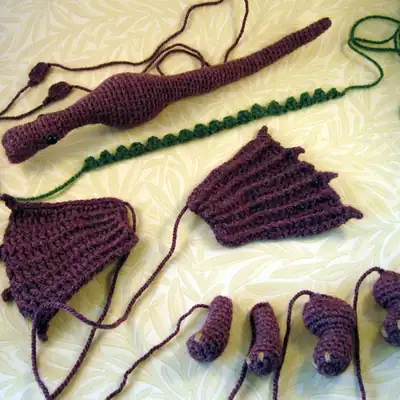
  1. Attach head to body by inserting the neck portion (rounds 21-25) into the opening at the top of the body, then sew securely using whipstitch.
  2. Position arms on either side of the body between rounds 12-14, angling slightly forward for a natural pose, and sew in place.
  3. Sew legs to the bottom of the body, spacing them evenly and ensuring they're firmly attached for stability.
  4. Attach ears to the head above the eyes, going over the last chain a few times to form eyebrow ridges and adding stability to the head.
  5. Sew the spikes along the back from just behind the ears to the tip of the tail, ensuring they are straight and centered.
  6. Sew the wings to the sides, a little distance from the spikes, with the ridged underside facing down, and align the front edge with the front legs.
  7. Embroider eyes if you’re not using safety eyes, or sew beads in; place them for a diamond-shaped eye with black pupils for a cat-like look.
  8. Weave in all ends and adjust stuffing as needed; position the dragon for display or play.

Important Notes

  • Use stitch markers to keep track of rounds during color changes and shaping.
  • Stuff firmly but not too tightly to maintain smooth curves and the ability to bend the dragon's neck and tail.
  • Pin all parts in place before sewing to ensure correct positioning and symmetry.
  • Weave in ends as you go to avoid a finishing pile at the end.

Whether you’re a seasoned amigurumi artist or an enthusiastic beginner aiming for a standout project, this dragon pattern offers a balanced challenge and a highly rewarding finish. The dragon’s features—its rounded head, perching wings, and poised tail—combine into a sculpture you can hold, display, and admire from every angle. My hope is that you’ll feel the same sense of pride I felt when I first stitched the magic ring and watched the little dragon take shape. Share your version with color stories and pose ideas, and invite others to experience the thrill of crafting something both fierce and friendly. Thank you for crocheting along with this free pattern, and may your Fierce Little Dragon guard your creative corner for years to come.If you post photos or write about your dragon on social platforms or pattern blogs, I’d love to see how your color choices and finishing touches come to life. Tag your creations with #FierceLittleDragonPattern so we can celebrate your unique dragons together. May your hook stay busy, your yarn stay soft, and your dragon stay brave—an enduring reminder that handmade treasures have a voice as bold as their stories.
Good to know

You ask, we answer

The finished amigurumi measures approximately 28-29 cm from nose to tail, with about a 20 cm wingspan when made with the recommended yarn and hook.

Yes, you can use different yarn weights, but this will affect the final size; make sure to use an appropriate hook size for your chosen yarn and adjust stuffing accordingly.

This pattern is advanced; basic knowledge of crochet stitches and techniques, plus comfort with post stitches and color changes, is recommended for best results.

Most crocheters finish this project in roughly 12-16 hours, depending on experience level and pace, with breaks for assembly and shaping.

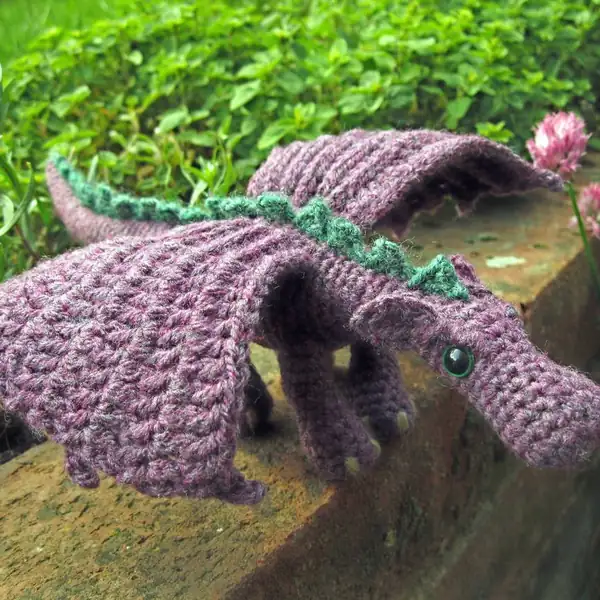
Dragon with wings spread and tail spikes
Join 100k+ crocheters

Get new free patterns, stitch tips and exclusive content in your inbox.