Crochetologist
Free Crochet Pattern
Beautiful Detailed Adorable

The Nutcracker Amigurumi Pattern

Nutcracker amigurumi head with colorful hat
4.7Rating
10-12 HoursTime
IntermediateSkill
Highlights

What makes it special

Made with Love

An adorable friend to cherish, handcrafted with love to bring comfort and joy for years to come.

Slow & Steady

A 10-12 hour journey—great for savoring each color swap, shaping every limb, and assembling the candy-striped wonder that stands proudly on display.

Intermediate Level

This project suits makers who enjoy working in the round with color changes, careful seamwork, and a thoughtful assembly process. It blends basic amigurumi foundations with multiple small components and facial features, presenting a manageable challenge for confident beginners ready to advance beyond simple motifs. The work rewards consistent tension, precise color transitions, and careful placement of facial details, all while keeping the core technique accessible to most crocheters.

Step into a season-bright crafting moment with a Nutcracker friend that stands proudly in candy stripes and a festive hat. This pattern invites a maker to slow the pace, savor the cadence of rounds, and watch color-blocked segments take shape one by one. The finished figure becomes a small, welcoming ritual: a handmade gift that carries warmth and whimsy through the holidays and beyond. The work embraces a rhythm of simple stitches, patient color shifts, and careful attaching of tiny accessories so the Nutcracker holds its cheerful stance with confidence.

Whether nestled beside a mug of something warm, perched on a mantel, or gifted to someone who loves nostalgic charm, this amigurumi asks for steady hands and a curious heart. The project guides the crafter to balance fullness with sculpted form, to manage multiple color shifts, and to weave the starting tail and yarn ends neatly into the back of the seamline. The result is a keepsake that reads as playful yet thoughtful, a small sentinel of holiday cheer that invites smiles and conversation as soon as it appears on display.

About This The Nutcracker Amigurumi Pattern

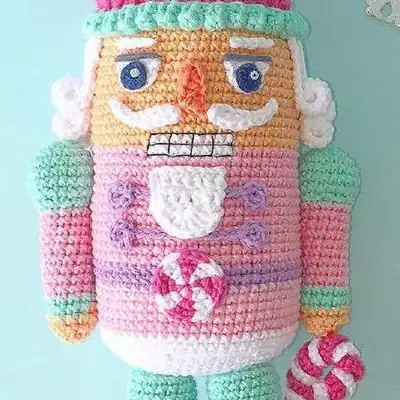
The Nutcracker Amigurumi Pattern yields a tall, candy-striped figure wearing a jaunty hat. The torso is crafted first as a soft, rounded core, followed by legs, arms, and a smiling face built around that center. Color-blocking plays a central role, with careful seamwork to ensure a polished, plush finish. Each element—hat, beard, nose, eyes, and a candy cane prop—adds personality and narrative, transforming a simple toy into a holiday character with presence.

Guidance covers choosing vibrant cotton yarns, shifting palettes between sections, and using invisible decreases and mindful increases to shape the torso, limbs, and face. The construction remains modular: parts are crocheted separately and joined with secure seams and subtle embellishments to create a life-like stance. The finished piece stands sturdy for display and gentle play, with a friendly expression suitable for both kids and adults. Facial feature placement is discussed to offer options for wide grins or more reserved smiles, depending on mood.

Workflows include techniques such as working in the back loops to give a textured edge on the hat, practicing stripe changes with confidence, and weaving tails through rounds to create a clean surface. The final look invites a touch of glue at lightweight accessory attachments for durability while preserving the core stitching. This section underscores craft as a joyful conversation between color, form, and character.

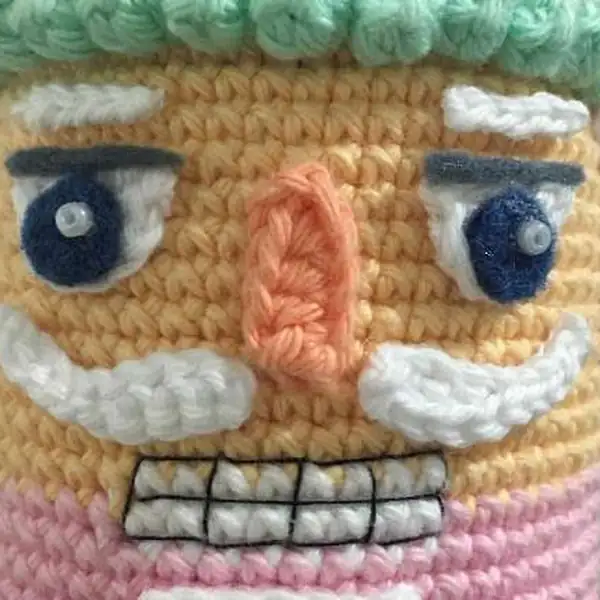
Close-up of Nutcracker face with beard

In addition to the main figure, the pattern includes a cupcake-style base and a candy-cane prop that reinforce the whimsical theme, enabling re-imagining the Nutcracker as a desk companion or shelf sentinel. The design stays approachable yet satisfying, rewarding careful colorwork and steady hands while encouraging experimentation with color orders and facial expressions that stay true to the Nutcracker silhouette.

Behind the main figure, a small cupcake-style stand offers a charming base that elevates display options, while the candy-cane prop can be swapped for a simple drum or scepter for seasonal storytelling in a desk-drawer diorama. The instructions emphasize careful planning of color-order transitions so each block reads cleanly against the next, and they offer ideas for posing the face to convey mischief, kindness, or resolve, depending on the mood chosen.

Stitches & Skills You'll Use

Stitch spotlight centers on magic ring beginnings, color-changes at defined rounds, back-loop texture for the hat’s edging, and neat seamwork for facial features. You’ll use SC, DC, INC, DEC, and occasional HDC in a pattern that transitions through multiple color blocks with precision. Invisible decreases shape the torso and limbs, while the beard and mustache are created with short color intervals and slip-stitch detailing. The eyes combine felt elements and tiny bead accents to avoid safety eyes, then are glued into place for expressiveness. The candy cane accessory requires a careful mix of color-twist techniques and small-scalar decreases to achieve the curved cylindrical look. Finally, assembly relies on secure whipstitch seams and careful placement for balanced presentation.

You’ll also encounter back-loop-only rounds to emphasize the candy-striped motif on various parts, and you’ll learn a finishing sequence that blends embroidery with surface details, ensuring the facial features sit neatly on the head rather than floating in space. The hat’s crown uses post-stitching techniques to achieve a lofty, rounded finish, while the base remains sturdily attached through a series of deliberate slip stitches. This set of stitches is a compact study in ensuring roundness stays even across sections, so that when you set the Nutcracker upright, it sits with confidence and charm.

Beginners should remember to place markers and stuff gradually—this reduces distortion as you add color changes and ensures the final shape holds well when the piece stands on its base. The artistry here is in the small moments: one quick color swap, a subtle seam, a tiny eye placement, all of which come together to form a character that feels alive and ready to star in a family holiday story.

Why You'll Love This The Nutcracker Amigurumi Pattern

This pattern balances tradition and whimsy, inviting a maker to explore candy-bright palettes while preserving the classic Nutcracker silhouette. The result is a figure that reads as festive yet approachable, with straightforward construction and room for playful accessories.

Crafting the hat puff and beard texture relies on simple stitches that knit together with smooth color transitions. The plan rewards thoughtful placement of features and careful attachment of the candy-cane prop, producing a toy that reads as lively rather than glossy. The end product is sturdy enough for display and soft enough for gentle handling, making it a memorable gift and a cheerful seasonal accent.

Colour & Yarn Inspiration

Color ideas encourage swapping the candy stripes for seasonal palettes—red and emerald for Christmas, turquoise and white for winter wonder, or peach and cream for a warm sunrise look. Try a denim blue base with ivory beard for a cool-toned, modern feel that still reads holiday classic.

Yarn substitution can open new textures: a DK weight with a slightly larger hook yields a softer, fluffier result, while a sport-weight with a smaller hook preserves crisp stitch definition. The same pattern shines when balancing saturation with a touch of metallic or variegated yarn for depth and sparkle. When selecting colors, plan contrasts between the base, stripes, hat, and beard so each area remains visually distinct without feeling busy.

Colorful Nutcracker full-body crochet in festive stripes

Switch Things Up

With a flexible approach, this pattern invites a maker to adapt scale, palette, and accessories to suit a room’s decor or a gift recipient’s tastes. A heavier cotton or bulkier yarn can produce a chunkier Nutcracker, while the hook size is adjusted proportionally to preserve stitch density and the roundness of the forms. The candy-cane prop can be swapped for a miniature drum, scepter, or other festive prop to tell a new story without changing the core silhouette.

Ear position, beard fullness, and hat height offer opportunities to craft a small family of Nutcrackers, each with a distinct personality but sharing the same fundamental structure. When experimenting with color sequences, plan ahead to keep the transitions crisp and even, so the stripes stay legible and balanced across the entire figure. The facial features remain the focal point, so keep eyes and mouth alignment consistent with the chosen expression for maximum charm.

Small accessories such as holly leaves, bells, or snowflakes can be added as decorative touches. If used, secure them with a dab of fabric adhesive or invisible stitching to preserve a clean surface. Display ideas include elevating the figure on a pedestal or cupcake stand to create a festive focal point during gatherings, while ensuring the base stays steady on varied surfaces. Keeping leftovers organized with a color palette card allows recreating or adapting future Nutcrackers with the same vibe and craftsmanship.

Finished cheeks may feature subtle embroidery or tiny blush for warmth, provided the surface remains smooth and the stitches don’t create bulk at the seam lines. Consider gifting this Nutcracker as a table centerpiece or a memory-bearing decoration that travels well when packed in tissue and placed in a sturdy box. The project rewards careful planning, thoughtful color planning, and an eye for proportion across parts so the end result feels cohesive and friendly.

In practice, the pattern supports a range of yarn choices while maintaining the familiar silhouette. Subtle texture differences can enhance the hat’s edge, the beard’s fuzziness, or the coat’s stripe crispness without altering the basic construction. The design encourages mindful progress rather than rushing to the finish; the story emerges as color, form, and character align stitch after stitch.

Ways to Use & Gift It

Gift idea: present this Nutcracker as a centerpiece for a holiday table, paired with a small jar of hot cocoa mix and a candy cane wrapper. The recipient will love its bright colors and the cozy yarn texture, a reminder of festive evenings spent crafting together. Include a note describing the piece as a handcrafted symbol of seasonal warmth, with care instructions that help it keep its shape over time.

Gift idea: create a mini-series of Nutcrackers in varying color schemes to form a family of characters that can line a windowsill or mantle. Each one tells a different story through color and facial expression, turning your crochet time into a cherished tradition. Package the set in a decorative box with a simple care guide, and add a small fabric tab or tag to indicate the pattern and yarn type used for future recreations.

Common Mistakes & How to Fix Them

Rushing the assembly without marking and pinning components first, leading to misaligned facial features or uneven limbs. Over-tightening the foundation chain or initial rounds, creating stiffness in the neck and base area that makes the figure lean or tip. Skipping markers or test-fitting before final stitching, which increases distortion when color changes occur around the head and torso. Applying too much glue to delicate accessories, causing stiffness or ooze that impairs surface softness.

Maker's Notes

When testing, a 100% cotton DK with a 2.0 mm hook offered a smooth, tight fabric that held its shape well through assembly. The project clocked in around eleven hours for a complete Nutcracker, with additional time spent on facial embroidery and base attachment. Notable observations included the importance of maintaining steady tension around color changes to avoid gaps at seam lines, and the benefit of gradually stuffing to preserve round shapes as layers were added. The candy-cane prop introduced extra weight that influenced balance; if the base feels light, a small amount of internal support can help the figure stand upright without tipping.

For beginners, pinning and test-fitting before final sewing makes alignment of the face more predictable, reducing frustration when sewing on features. Markers are essential for keeping limbs aligned in symmetry, especially when the pattern calls for multiple color blocks that shift the visual balance. When using lightweight adhesives for accessories, a minimal amount is best to prevent stiffness that might interfere with soft fabric feel. The end result remains charming and durable, suitable for display and gentle play in households with children.

I tried a substitution: Substituting a lighter sport-weight yarn shifted the silhouette by about 1 cm shorter; adjusting the hook size to 1.8 mm preserved proportions and stitch density. When replacing with a heavier yarn, increasing the hook to 2.2 mm helped maintain the same overall shape and roundness, while careful stuffing and seam alignment kept the piece robust. The felt eye detailing remained effective across substitutions, though glue bonding varied slightly with material weight. The texture of the beard and hat edge changed subtly with each yarn choice, but the overall silhouette and articulation stayed faithful to the original design. Substitutions are feasible when proportions are checked early and gauge is verified before assembly. For color-blocks, ensure the transitions remain clean by using clear start and end points for each color, and consider testing a short swatch to confirm how the chosen yarn behaves when changing colors at the end of rounds. The structure of the Nutcracker remains the same, so the exterior shape and articulation stay intact as long as stuffing is balanced and seams are secure. The candy-cane prop remains a decorative accent rather than a load-bearing element, so its weight should be light enough to avoid destabilizing the figure.

The Nutcracker Amigurumi Pattern

Free Nutcracker amigurumi crochet pattern with step-by-step rounds, materials, and finishing tips. Easy-to-follow for intermediate crocheters. Start today!

Intermediate 10-12 Hours
Pattern at a glance
Skill level
Intermediate
Time to make
10-12 Hours
Hook size
2.0 mm (B/1)
Yarn weight
Cotton DK / #3
Finished size
Approx. 25-30 cm tall / 9-12 in tall
Gauge
4 stitches x 4 rows = 1 inch using 2.0 mm hook
Yarn used
Main color 350-500 g total; secondary colors 50-150 g combined

Materials Needed

Main Fabric
  • 01
    100% Cotton yarn (colors from picture or preferred) and Polyester stuffing
Tools Required
  • 01
    Crochet hook size 2.0 mm
  • 02
    Scissors
  • 03
    Yarn needle for sewing and weaving in ends
  • 04
    Black embroidery thread for teeth detailing
  • 05
    Embroidery needle
  • 06
    Glue for attaching small parts
  • 07
    Felt fabric for eye detailing

— The Nutcracker (2.0Mm Hook) :

Round 1: 6sc into magic ring (left 6)
Round 2: 2 sc in each stitch (left 12)
Round 3: 1 sc, 2 sc in next st (left 18)
Round 4: 2 sc, 2 sc in next st (left 24)
Round 5: 3 sc, 2 sc in next st (left 30)
Round 6: 4 sc, 2 sc in next st (left 36)
Round 7: 5 sc, 2 sc in next st (left 42)
Round 8: 6 sc, 2 sc in next st (left 48)
Round 9: 7 sc, 2 sc in next st (left 54)
Round 10: 8 sc, 2 sc in next st (left 60)
Round 11: on back loops: 60 sc (left 60)
Round 12: 60 sc (left 60)
Round 13: 60 sc (left 60)
Round 14: 60 sc (left 60)
Round 15: 60 sc (left 60)
Round 16: 60 sc (left 60)
Round 17: 60 sc (left 60)
Round 18: 60 sc (left 60)
Round 19: 60 sc (left 60)
Round 20: 60 sc (left 60)
Round 21: 60 sc (left 60)
Round 22: 26 sc, change to white and 8 sc, change to nude and finish (left 60) change to Pink;
Round 23: 26 sc, change to white and 8 sc, change again to pink and finish (left 60)
Round 24: 60 sc in pink (left 60) change to lilac;
Round 25: 60 sc in pink (left 60) change to lilac;
Round 26: 60 sc in pink (left 60) change to lilac;
Round 27: 60 sc in pink (left 60) change to lilac;
Round 28: 60 sc in pink (left 60) change to lilac;
Round 29: 60 sc in pink (left 60) change to lilac;
Round 30: 60 sc in pink (left 60) change to lilac;
Round 31: 60 sc in pink (left 60) change to lilac;
Round 32: 60 sc in pink (left 60) change to lilac;
Round 33: 60 sc in pink (left 60) change to lilac;
Round 34: 60 sc in pink (left 60) change to lilac;
Round 35: 60 sc in lilac (left 60) change to pink;
Round 36: 60 sc in lilac (left 60) change to pink;
Round 37: 60 sc in Pink (left 60) change to White;
Round 38: 60 sc in Pink (left 60) change to White;
Round 39: 60 sc in Pink (left 60) change to White;
Round 40: 60 sc in Pink (left 60) change to White;
Round 41: 60 sc in Pink (left 60) change to White;
Round 42: 60 sc in White (left 60)
Round 43: 60 sc in White (left 60)
Round 44: on back loops 8 sc, 1 dec (left 54)
Round 45: 7 sc, 1 dec (left 48)
Round 46: 6 sc, 1 dec (left 42)
Round 47: 5 sc, 1 dec (left 36)
Round 48: 4 sc, 1 dec (left 30)
Round 49: 3 sc, 1 dec (left 24)
Round 50: 2 sc, 1 dec (left 18)
Round 51: 1 sc, 1 dec (left 12) leave a long piece of yarn and close. LEGS (MAKE 2) start with green;

— Body :

Round 1: 6sc into magic ring (left 6)
Round 2: 2sc in each stitch around (left 12)
Round 3: 1 sc, 2 sc in next st (left 18)
Round 4: 18 sc on back loops (left 18)
Round 5: 18 sc (left 18) change to lilac;
Round 6: 18 sc (left 18) change to lilac;
Round 7: 18 sc (left 18) change to lilac;
Round 8: 18 sc (left 18) change to lilac;
Round 9: 18 sc (left 18) change to lilac;
Round 10: 18 sc (left 18) leave a long piece of yarn to sew ARMS;
Round 11: 18 sc (left 18) leave a long piece of yarn to sew ARMS;
Round 12: 18 sc (left 18) leave a long piece of yarn to sew ARMS;
Round 13: 18 sc (left 18) leave a long piece of yarn to sew ARMS;
Round 14: 18 sc (left 18) leave a long piece of yarn to sew ARMS;
Round 15: 18 sc (left 18) leave a long piece of yarn to sew ARMS;
Round 16: 18 sc (left 18) leave a long piece of yarn to sew ARMS;

— Arms :

Round 1: 6sc into magic ring (left 6)
Round 2: 2 sc in each stitch (left 12)
Round 3: 1 sc, 2 sc in next st (left 18)
Round 4: 2 sc, 2 sc in next st (left 24)
Round 5: 24 sc (left 24)
Round 6: 24 sc (left 24)
Round 7: 2 sc, 1 dec (left 18)
Round 8: 1 sc, 1 dec (left 12) change to Pink;
Round 9: 12 sc (left 12) change to green;
Round 10: 12 sc (left 12) change to green;
Round 11: 12 sc (left 12) change to green;
Round 12: 12 sc (left 12) change to green;
Round 13: 12 sc (left 12) change to green;
Round 14: 12 sc (left 12) change to green;
Round 15: 12 sc (left 12) change to green;
Round 16: 12 sc (left 12) change to green;
Round 17: 12 sc (left 12) change to green;
Round 18: 12 sc (left 12) change to nude;
Round 19: 12 sc (left 12) change to nude;

— Base :

Round 18: 12 sc (left 12)
Round 19: 12 sc (left 12)
Round 20: 12 sc (left 12)
Round 21: dec all row (left 6) hide the yarn with needle and cut it GREEN BASE FOR CUPCAKE;

— Green Base For Cupcake :

Round 1: On back loops from top of the head, work 1 pop corn stitch (hdc), 1 hdc. BUTTONS (MAKE 2)

— Buttons (Make 2) :

Round 1: 6 sc on magic ring, chain 13, “go up” with 1 chain and 6sc on chain 13. Finish with slip stitch and attach to body with glue.

— Cupcake Hat :

Round 1: Insert your hook in the last round of the head (just before the back loop round) and sc all round (like pictures).
Round 2: Dc all round. 3-8. Work all rounds with the “front and back post” double crochet stitch. Leave a long piece of yarn to sew with glace. Cupcake glace;

— Legs :

Round 1: Chain 15 (start with White)
Round 2: Chain 1 to go up, 1 dec, 13 sc and 1 inc on last stitch;
Round 3: Chain 1 to go up, on back loops: 1 inc, 13 sc and 1 dec (change to Pink)
Round 4: Chain 1 to go up, on front loops: 1 dec, 13 sc and 1 inc on last stitch;
Round 5: Chain 1 to go up, on back loops: 1 inc, 13 sc and 1 dec (change to white)

— Cherry For Cupcake :

Round 1: 6sc into magic ring (left 6)
Round 2: 2sc in each stitch around (left 12)
Round 3: 1 sc, 2 sc in next st (left 18)
Round 4: 18 sc (left 18)
Round 5: 18 sc (left 18)
Round 6: 1 sc, 1 dec (left 12) 7. Now stuff it and attach it with glue to the glace FEET (MAKE 2)

— Feet (Make 2) :

Round 1: 6sc into magic ring (left 6)
Round 2: Instead of continuing the round, “go up” with one chain and 2sc in each stitch (left 12)
Round 3: Chain 1 to “go up” and 12 sc (left 12) You can sew the pieces to the boots or attach them with glue. CANDY BUCKLE;
Round 4: Chain 1 to “go up” and 12 sc (left 12) You can sew the pieces to the boots or attach them with glue. CANDY BUCKLE;
Round 5: Chain 1 to “go up” and 12 sc (left 12) You can sew the pieces to the boots or attach them with glue. CANDY BUCKLE;
Round 6: Chain 1 to “go up” and 12 sc (left 12) You can sew the pieces to the boots or attach them with glue. CANDY BUCKLE;
Round 7: Chain 1 to “go up” and 12 sc (left 12) You can sew the pieces to the boots or attach them with glue. CANDY BUCKLE;

— Candy Buckle :

Round 1: Into magic ring, 8 sc (one pink, one White)
Round 2: 2 sc in each stitch (Pink in Pink, White in White)
Round 3: In White 1sc, 1sc/ in Pink 2 sc in first stitch, 1 sc. BEARD;

— Beard :

Round 1: Chain 7 and dc on each chain (left 7)
Round 2: 7 dc (left 7)
Round 3: In chain nr.4, 7 dc and slip stitch in chain nr. 7 CANDY CANE;

— Candy Cane :

Round 1: Using White, chain 25 and 3 sc in each stitch, curls will appear inmediately;
Round 2: Using Pink, chain 25 and 3 sc in each stitch, curls will appear inmediately;

— Hair-Wig :

Round 1: Chain 15 and hdc in each stitch, DO NOT CUT THE YARN;
Round 2: Now chain 20 and hdc in each stitch repeat this 15 times;
Round 3: For last “hair”, chain 15 and hdc in each stitch. Attach the wig with glue;

— Eyes (Make 2) :

Round 1: White part: Chain 3. On chain nr. 3, 4 chains and trc on chains 2 and 1. Cut the thread and hide, attach to the face with glue.
Round 3: Finally cut two more pieces of gray felt fabric to be the eyelids. EYEBROWS Chain 4 and cut the yarn, attach them with glue MUSTACHE;

— Mustache :

Round 1: Chain 8;
Round 2: Sc in the first 3 stitches and slip stitch on the rest THEETH DETAILS I embroidered the teeth so they look better …;

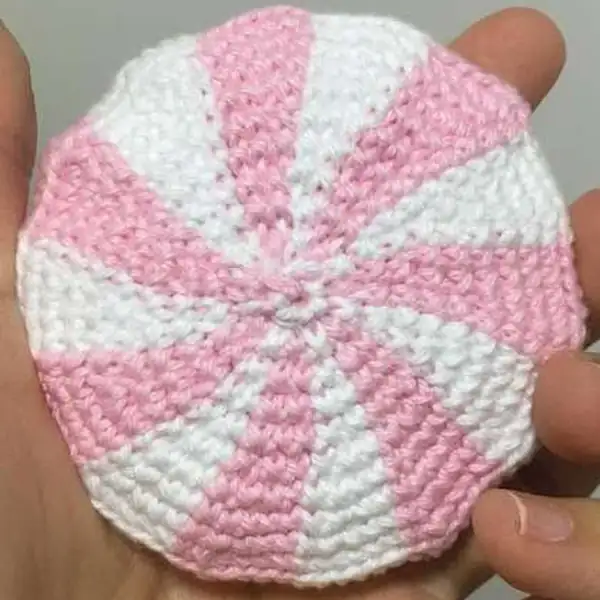
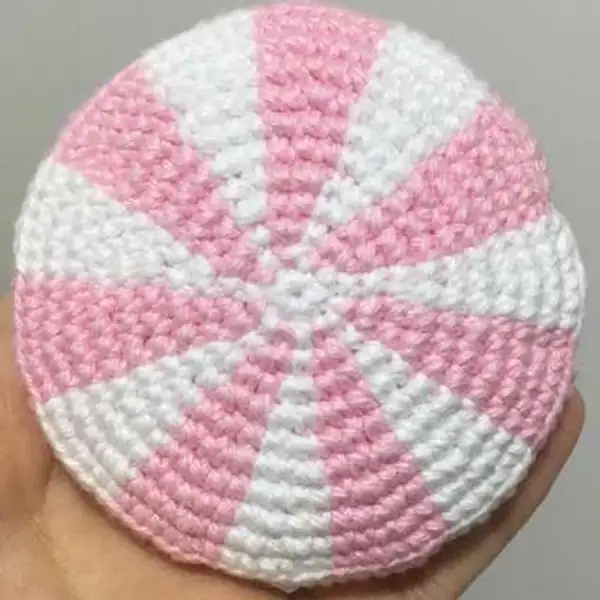
— Candy Base :

Round 1: 7sc into magic ring (start with white)
Round 2: 1 sc pink and 1sc white in same st, repeat all round (left 14)
Round 3: 2 pink sc in pink st, 1 white sc in white st (left 21) Use white in white stitches, pink in pink st;
Round 4: 1 sc pink, 1 sc pink, 2 sc in white st (left 28)
Round 5: 1 increase pink, 1 sc Pink, 1 sc White, 1 sc White;
Round 6: 1 Sc Pink, 1 sc Pink, 1 sc Pink, 1 sc White, increase White;
Round 7: 1 Sc Pink, 1 sc Pink, increase Pink, 1 sc White, 1 sc White, increase White;
Round 8: 1 Sc Pink, inc pink, 1 sc Pink, 1 sc Pink, 1 sc White in next 4 stitches;
Round 9: 1 Sc Pink in next 5 st, 1 sc White, inc White, 1 sc White, 1 sc White;
Round 10: 1 Sc Pink in next 3 st, inc Pink, 1 sc Pink, 1 sc White in next 3 st, inc White, 1 sc White;
Round 11: 1 Sc Pink in next 4 st, inc Pink, 1 sc Pink, 1 sc White in next 6 st;
Round 12: On back loops: 1 sc Pink in next 7 st, 1 sc White in next 6 st;
Round 13: 1 sc Pink in next 7 st, 1 sc White in next 6 st;
Round 14: 1 sc Pink in next 7 st, 1 sc White in next 6 st;
Round 15: On back loops: 1 Sc Pink in next 5 st, dec Pink, 1 sc White in next 6 st;
Round 16: 1 Sc Pink in next 3 st, dec Pink, 1 sc Pink, 1 sc White in next 3 st, dec White, 1 sc White;
Round 17: 1sc Pink in next 5 st, 1 sc White in next 2 st, dec White, 1sc White;
Round 18: 1sc Pink in next 2 st, dec Pink, 1 sc Pink, 1 sc White in next 4 st;
Round 19: 1sc Pink in next 2 st, dec Pink,1 sc White in next 2 st, dec White;
Round 20: 1sc Pink in next 3 st, 1 sc White, dec White;
Round 21: dec Pink, 1 sc Pink, 1 sc White, 1 sc White;
Round 22: 1sc Pink in next 2 st, dec White;
Round 23: dec Pink,1 sc White and close;

Assembly Instructions

  1. Stuff each piece firmly before closing.
  2. Pin all parts in place and check the proportions against the photos.
  3. Sew parts on securely with matching yarn.
  4. Weave in all ends and shape the finished piece.

Important Notes

  • Maintain a consistent tension throughout to keep the round shapes even as colors change. Uneven tension can result in slight gaps at seam lines or an uneven stance.
  • Stuff gradually and check alignment frequently as you add limbs and facial features. This prevents distortion when attaching the final elements.
  • Use the starting tail to weave in yarn ends cleanly along the back seams for a tidy interior, and avoid loose ends at the surface that can snag during display.
  • Store leftovers with a color palette swatch card to facilitate recreating or adapting future Nutcrackers with the same vibe and craftsmanship.

This Nutcracker amigurumi pattern offers a joyful holiday project with a friendly, collectible companion at its heart. The colorful palette, bold stripes, and playful hat spark imagination and warmth for gift-giving or display. May your crocheting sessions be full of delight and your finished friend bring smiles to all who meet it.
Good to know

You ask, we answer

The Nutcracker stands about 25-30 cm tall when crocheted with the recommended yarn and hook; exact height varies with yarn weight, tension, and how firmly the piece is stuffed. Substituting heavier yarn or a smaller hook can increase density and slightly alter height, while lighter yarn with a larger hook will tend to reduce overall size.

Yes, but final size and texture will shift. If you change yarn weight, adjust the hook size to maintain similar stitch density and shape, and allow for the possibility of slightly different color-block proportions. Keep an eye on balance between torso, head, and limbs as you adapt the scale.

This pattern is best suited to an Advanced Beginner or Intermediate crocheter. It requires comfort with basic crocheting in rounds, color changes, simple increases and decreases, and careful assembly of multiple parts with facial features. Familiarity with sewing parts together and stuffing gradually helps achieve a polished result.

Most crocheters complete the Nutcracker in roughly 10-12 hours, though pace varies with experience, chosen color palette, and how thoroughly facial features are embroidered. Allow extra time for assembly and patience when positioning tiny elements like eyes and mouth to achieve the desired expression.

No safety eyes are used. Eyes are created with felt pieces glued in place and optional tiny beads for added sparkle. If preferred, you can embroider the eyes with dark thread or use small stitched dots for a subtler look.

Secure all seams with a whipstitch, stuff evenly before closing, weave in the starting tail and yarn ends, and glue lightweight accessories to minimize shifting during handling. Consider a light coat of fabric glue to anchor the candy-cane prop and beard edges if a firmer surface is desired.

Nutcracker candy-cane prop and base
Join 100k+ crocheters

Get new free patterns, stitch tips and exclusive content in your inbox.