HowTo Amigurumi
Free Crochet Pattern
Beautiful Detailed Adorable

Furniture Living Room Amigurumi Pattern

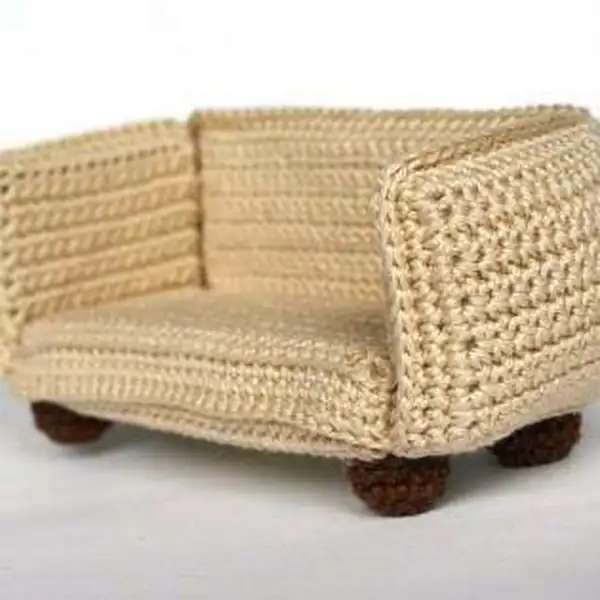
Beige sofa with cushions in a tiny crochet living room
4.4Rating
40-60 HoursTime
AdvancedSkill
Highlights

What makes it special

Cozy Accent

This crochet furniture set adds a warm, handmade touch to any shelf or dollhouse, turning small items into a complete home display.

Multi-Day Project

A rewarding 40-60 hour journey—perfect for dedicated crafters who love detailed, multi-piece builds and finishing touches.

Advanced Level

This project suits experienced crocheters who enjoy multi-part builds, careful shaping, color changes, working in the round, and precise seaming to create a cohesive miniature living room scene.

Step into a cozy corner and imagine a miniature living room that you crochet into existence. This Furniture Living Room Amigurumi Pattern invites you to shape a tiny sofa, a coffee table, a lamp, and a matching rug, all perched on a small shelf so you can enjoy the scene daily. I designed it with an attention to proportion: the sofa stands about 9 cm tall, the coffee table about 7 cm, and the lamp around 8 cm, each piece crafted with careful shaping and color shifts. Working with worsted weight yarn (#4) keeps the seams clean and the scale consistent, while the magic ring foundation gives you a flawless start. As you stitch, you’ll notice how the textures come alive through BLO and FLO work, creating subtle depth that reads as real upholstery and wood grain.

I love the way a handmade furniture scene brightens a shelf and sparks conversations with guests. The pattern is listed at an Advanced level, but the joy comes from watching the room build up, one round at a time, with precision stitches and a mindful approach to stuffing and framing. When I assemble the sofa, coffee table, lamp, and rug, I use small cardboard supports to maintain crisp edges, then bind the pieces together into a cozy miniature living room you can pose and re-arrange. The result is a cheerful, tactile vignette that fits on a small shelf, yet feels complete and inviting. Whether you’re gifting it or keeping it, this tiny furniture set is a reminder that big warmth can come from tiny yarn stitches.

About This Furniture Living Room Amigurumi Pattern

From the first loop of the MR to the last slip stitch, this Furniture Living Room Amigurumi Pattern is a fully realized micro-scene designed to test your technique while rewarding your patience. The complete set includes a sofa, a coffee table, a lamp, a rug, and a few tiny accessories, all built on internal supports fashioned from cardboard for stiffness and standing height. I chose DK / #3 weight yarn in sand or beige as the main shell to mimic warm wood tones, with olive green for cushions and accent pieces, light brown for legs and table tops, and small touches of black, white, gold, and purple to bring the room to life. Each piece is worked in clear rounds with the MR, then shaped with careful INCs and DECs to achieve rounded arms, a plump cushion, and a polished tabletop edge. The finished scene is compact enough to sit on a shelf yet expressive enough to invite close study of the stitches, such as BLO for the sofa’s seams and FLO for the rug’s texture. Take time to stuff evenly and pin while sewing, because the magic lies in balance between firmness and softness across all the little parts.

Designing this pattern started with the idea of a tiny, believable living room that could be crocheted in stages rather than in one sitting. You’ll crochet a sofa with a firm back and rounded arms, a coffee table with a beveled edge, and a lamp that holds its shape with a light bulb accent you create from a ring of yellow and a tiny pink shade. The rug adds depth with a purple center and a few subtle stitches of russet and white to simulate a woven pile. I specified Cardboard sheets for internal supports so the pieces stand independently while remaining light enough to lift and reposition. With the stitch palette in mind, the pattern uses MR, SC, INC, DEC, BLO, FLO, CH, and SL ST to achieve curves and crisp edges. Following the included assembly notes, you’ll attach the sofa and table to a base that I designed to prevent wobble, then finish with tiny upholstery details and a glossy tabletop.

To keep the scale consistent, I sized every component to fit the same 9 cm sofa height and 7 cm coffee table height, so your scene reads as a cohesive unit. I’m transparent about materials and show color placement using olive greens for cushions, light browns for wooden features, and cream or white highlights for highlights and tiny tech details like a lamp shade’s seam. The finishing work relies on precise joining techniques, invisible DEC shaping, and careful stuffing that preserves the sofa’s seat shape while giving the lamp a gentle glow. You’ll also learn how to adapt the pattern to different rooms by swapping colorways, adding or omitting accents, or substituting the rug’s geometry to suit a baby’s nursery or a modern study. Best of all, the pattern includes tips for maintaining upright edges when storing your mini furniture on a shelf.

Because this is an Advanced project, I included troubleshooting thoughts and optional variations that can stretch your skills without breaking the rhythm of the build. You’ll practice building a structured inner frame with lightweight cardboard, then transform it into a soft outer shell that holds shape reliably during display. The instructions emphasize consistent tension, correct stitch counts, and strategic stuffing so the sofa’s back remains tall while the coffee table stays flat and the lamp can perch securely on its base. The result is not just a set of pieces, but a printable micro-scene that you’ll be proud to exhibit alongside other amigurumi or miniatures. Finally, I’ve included close-up photos and reference diagrams to help you visualize each step as you crochet every round toward a finished living room you can treasure.

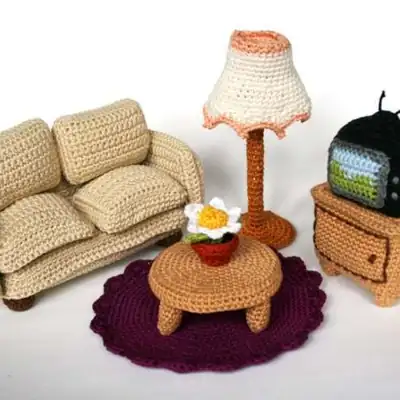
Crochet lamp beside a small TV stand

Early on, I knew this pattern would welcome color storytelling as much as structural craft. The sofa’s height, the lamp’s shade, and the rug’s pile demand meticulous shaping, so I break the build into repeatable sections that you can batch together on your worktable. You’ll notice how the olive green cushions are shaped with gentle increases to create a pillowy seat, while the beige body of the sofa relies on subtle increases and decreases that echo real furniture curves. I also include notes on yarn selection and tension so you can preserve the clean edges even as you stuff the pieces; the MDF or cardboard supports help the frame stay upright while you stitch the upholstery over. Cross-stitch style details and tiny buttons or a switch face on the lamp become accessible through small, smart color pops—think russet for warmth and a touch of black for the lamp base.

To customize, I outline several palette options that stay true to the furniture vibe: sand-colored main shells, olive greens for cushions, and light browns for legs or table edges. The guide covers different ways to attach the pieces so that you can pose them in a shelf vignette, a corner of a kid’s playroom, or a studio setup. You’ll learn invisible decreases for smoother sofa arms, how to reinforce the lamp neck with a short internal stem, and how to blend rug texture with a few rounds of FLO stitches to imply depth. This section closes with a long list of troubleshooting tips gathered from my tests—edge curling, stuffing density, and the occasional mis-count—so you can keep moving without losing momentum. The overall aim is to offer a flexible, robust pattern that can scale up or down depending on the mood of your room scene.

Stitches & Skills You'll Use

Stitches you’ll use include MR, SC, INC, DEC, BLO, FLO, CH, and SL ST, each chosen to honor the furniture’s curves while keeping the finished pieces sturdy. I start with a snug MR to anchor the sofa back and the coffee table top, then work rounds that bend gently into arms and legs. BLO is my friend for seam lines along the sofa where upholstery folds over a cushion, and FLO keeps the rug's surface lively without bulk. As you assemble, you’ll pin the parts to a cardboard frame to hold the sofa’s upright back and the table’s bevelled edges while you sew. I also detail how to stuff evenly so the sofa seat holds shape without becoming glassy or flat.

Each piece gets its own construction rhythm, so the lamp neck is slim yet stable, and the rug shows a shallow pile with color pops of purple and russet. You’ll see how the coffee table relies on a flat top and a slightly rounded lip that catches light in a tiny knit highlight. Color placement is deliberate: the sand-beige shell is the stage, green accents offer contrast, and black details bring tiny realism. The tips section explains how to avoid stiff joints by softening the stuffing at the edges while keeping interior supports intact. The section offers a quick reference for aligning edges and maintaining symmetry across all three pieces, so your shelf scene looks polished from every angle.

Finally, I invite you to experiment with textiles and scale, since this real-life mini living room is a playground for your stitches. Try substituting a lighter or darker beige for the sofa body to morph the mood from cozy cottage to modern calm. A slightly taller lamp or a wider rug can be achieved by widening the base or adjusting the rounds in the ring, all while preserving the same 9 cm sofa height. If you want a tabletop scene for a desk, you can swap the rug for a small square placemat and create a tiny plant pot from leftover scraps. With patience, you’ll have a room that feels like a living thing, not just a collection of shapes.

Why You'll Love This Furniture Living Room Amigurumi Pattern

Why you’ll fall for this pattern is not just the finish but the rhythm of building a miniature room that feels inhabited. The sequence invites you to plan color, texture, and proportion, learning to keep every piece within a common scale as you crochet. I’ve structured the steps so that the sofa’s arm curves, the coffee table’s edge, and the lamp’s shade all emerge from the same technique loop count, which makes the project feel cohesive. The use of cardboard internal supports teaches you how to shape without collapsing edges, then you sew the outer shells to hide the structure. There’s a gentle romance to transforming yarn into a homey vignette that you can dust off, display, and rearrange.

Beyond aesthetics, this pattern deepens your amigurumi craft by exercising precise stitches, tension control, and intuitive stuffing. You’ll gain confidence with MR starting stitches, invisible decreases, and careful color changes that create believable cushions and lamps. This is the kind of project that rewards patience: the further you push the details, the more it reads as real furniture rather than a toy. I also include a measurement note that the finished sofa stands around 9 cm tall, a consistent base for the other pieces. As you complete the scene, you’ll see your shelf turn into a tiny showroom.

Finally, this is a chance to personalize your space: choose a palette that echoes your living room, office, or nursery and still keep the same shapes. The result is a compact, high-impact display that photographs well and makes for an engaging teaching piece for crochet groups. Your friends will notice the careful edge work, the stuffed cushions, and the clean join lines that hide all seams. If you’re sharing the pattern online, this is the kind of project that garners comments about technique and color theory as much as about cuteness. I hope you’ll treasure the practice as much as the finished scene.

Colour & Yarn Inspiration

Color can shift mood as much as scale, so I encourage you to play with warm sand beige paired with olive cushions for a rustic living room vibe. If you want a brighter contemporary look, swap beige for cream and introduce a pale grey rug with a hint of gold thread. The lamp’s shade can glow in soft pink or lemon highlights to suggest different light temperatures and ambiance. I also point out how to use small bits of yellow and white to model highlights along the furniture’s edges. Remember to keep the strands tidy on the underside so the final piece sits neatly on the shelf.

You might try a coastal palette—sand, seafoam, and pale blue—so the sofa reads as a seaside retreat in miniature. Alternatively, a woodland scheme with olive greens, browns, and russet accents evokes a cozy cabin desk corner. The rug can become a bold anchor by choosing a purple shade or a golden hue to create contrast against the neutral sofa. I’ve seen crafters populate the scene with tiny white or cream details to simulate ceramics or a lamp base glaze. These color choices keep the piece harmonious while inviting you to customize for a specific room or gift recipient.

Layering color is also a technique; a lighter thread carried along the edge can simulate highlights and give the sofa a tailored, high-end look. When you switch colorways, be mindful of contrast, ensuring the olive greens still read as cushions while beige remains the body. If your goal is a high-contrast vignette, consider pairing black details sparingly to avoid overpowering the softness of the yarn. The result is a mini living room that photographs well and becomes a signature piece in your crochet gallery. I hope these ideas spark your creativity and push you to explore color relationships beyond the first orange accent.

All pieces arranged together in a miniature living room

Switch Things Up

Want to spin this furniture scene into multiple decor vibes? Switchthingsup starts with swapping colorways and altering scale while keeping the same structural core. I encourage you to test a seaside palette—sand, cream, pale blue—for a breezy coastal vibe, or go rainforest with olive greens, moss, and a warm tan to mimic wood. By adjusting the rug color and lamp shade, you can transform the mood from cozy cottage to mid-century modern. The pattern’s internal supports stay the same, but you’ll learn to alter the join points so the sofa still sits straight when you place the lamp on the table. I also share build order tips so you can split the project into weekend sessions without losing track of rounds or stitch counts.

Another switch is material: you can swap DK to light worsted or even cotton yarn for a different texture, taking care to recheck gauge and final dimensions. If you want a flatter surface for a contemporary look, reduce stuffing density and use crisper edges with tighter tension on the sofa back and arm. Looking for a more tactile rug? Add a tiny bobble or slub detail with a different color in a few FLO rounds. You can also build this pattern as a mini diorama by omitting some accessories and substituting a plant pot or a tiny book on the coffee table. The goal is to give you the confidence to customize while maintaining the structural integrity of the original design.

Consider presenting the pieces as a modular set: the sofa and table on a shared base, with the lamp attached by a discreet cord to suggest a plugged-in vibe. If you’re teaching a crochet workshop, these steps help you demonstrate how a few basic stitches combine into a complete scene. I’ve included photo cues and stitch-count tips to help you guide learners through each round, from MR to the final FO. Finally, you can experiment with scale by adding or removing cushions and adjusting the table height to create ensembles that fit different shelf widths. With patience, you’ll have a room that feels like a living thing, not just shapes.

Ultimately, switchthis up so the project matches your home’s personality or a gift recipient’s taste, and you’ll discover that a small amigurumi room can tell a big story. The pattern remains anchored in the same geometry: 9 cm sofa, 7 cm coffee table, 8 cm lamp, all built on cardboard supports. That consistency is what makes variations feel accessible rather than intimidating, so you can experiment safely. Whether you alternate colors, textures, or even swap the rug’s motif for a weave-inspired cross-stitch look, you’ll still be crocheting a believable living room. I can’t wait to see the scenes you create on your shelves.

Ways to Use & Gift It

Give this pattern as a tangible gift to a friend who loves handmade decor or to a crocheter who enjoys a challenging build. Printed instructions become a welcome keepsake, and you can tuck a few yarn scraps and a tiny needle into the package to inspire the recipient. I like to present it with a small, finished sample of the sofa or lamp so the recipient can see the texture and scale at a glance. A gift bundle might include a mini clipboard for a quick reference to the MR, INC, and DEC steps, plus a tiny ruler to remind them of the 9 cm sofa height. This is also a thoughtful housewarming present when paired with a tiny shelf or bookcase accessory.

Consider gifting the pattern along with a mini starter kit: beige DK yarn, olive green for cushions, and a coordinating rug shade. If you include a simple pattern card with color suggestions for a few different rooms, you give the recipient permission to personalize. A note about care—spot clean gently and avoid excessive tension on the assembled pieces—helps the new crafter protect the tiny furniture. Packaging ideas include a clear box that can be reused as a display base for the finished set. The act of giving becomes an opportunity to celebrate patience, precision, and the joy of a fully realized mini home scene.

I also love making gift-ready instructions feel motivational, with a short project timeline and a few before-and-after photos to spark excitement. If you know the recipient’s decor, tailor the rug color or sofa shade to match their space, turning a single project into a personalized décor piece. Your message can emphasize that this is not just a toy but a craft that develops spatial awareness, tension control, and a deep appreciation for texture. Ready-to-frame photos of the finished furniture bring the charm full circle and give the recipient something to admire while they crochet their next project. With a little planning, a free pattern becomes an heirloom that another maker will treasure.

Common Mistakes & How to Fix Them

Incorrect tension during stuffing can create a lumpy appearance; stuff gradually in small amounts and periodically pause to smooth the shape for even density. Skipping a round marker or miscounting increases can cause misalignment between parts; use a stitch marker at every change and count stitches after each round before moving on. Improper color changes can leave visible yarn tails; carry the unused color along the inside of the work as you switch colors and weave tails in as you go. Sewing parts together with uneven seams can distort the final silhouette; pinch and pin each join first, then secure with uniform whipstitching and stretch gently to keep symmetry. Underfill cushions or overfill furniture parts; check the density by pressing lightly; aim for a plush yet resilient shape that holds its form without sagging. Forgetting to weave in ends can create stray threads; finish each piece by weaving all yarn tails securely into nearby stitches.

Maker's Notes

This Furniture Living Room Amigurumi Pattern invites you to build a tiny, cozy scene that sits proudly on a small shelf. From the sofa to the lamp, every piece is crafted with care using the magic ring and a reliable mix of stitches. The project is advanced and realistically takes 40-60 hours, rewarding patience with a finished micro room you can hold in your hands. The color story centers on sand or beige as the main fabric, with olive green accents, a light brown table, and a pop of purple for the rug. I love how the different textures come together: the crisp silhouettes, the cozy stuffing, and the tiny stitches that give each piece character.

Sofa stands about 9 cm tall, the coffee table about 7 cm high, and the lamp around 8 cm tall, creating a balanced little scene. The main yarn is worsted weight in sand/beige for the main fabric, with totals around 300-600 g overall. Accent colors include olive green (60-120 g) and light brown (40-80 g), with smaller touches of black for details. I use cardboard sheets to create internal supports, then wrap them with fiberfill and secure with the specified stitches. We start each piece using MR, then shape with SC, INC, DEC, BLO, and FLO to achieve the character of each furniture element, before joining with SL ST.

The assembly order mirrors a lived-in scene: sofa first, then the coffee table, lamp, and finally the rug. Invisible seams are avoided by matching stitches along the edges and using BLO or FLO joins where appropriate so the silhouette stays clean. The rug can be an accent in purple or your preferred color, with optional russet or white highlights to suggest pile and texture. I pin pieces, test-fit on the tiny shelf, and adjust with a stitch marker to maintain RS and WS alignment. Attention to proportional accuracy ensures the sofa's 9 cm height harmonizes with the 7 cm table and 8 cm lamp for a cohesive vignette.

Careful stuffing is key: polyester fiberfill is gently packed to maintain rounded shapes without lumps. The finished trio sits neatly on a small shelf, with the sofa's curves shaped by deliberate INC and DEC moves and the lamp built as a slim cylinder. Cardboard supports keep the coffee table flat and stable, while the rug's purple accent anchors the scene visually. Details like the lamp shade and sofa cushions use small amounts of black, white, or yellow to suggest depth and texture. This is a true amigurumi home decor project, perfect for seasoned crocheters who enjoy challenging stitches and precise assembly.

As I build this scene, I visualize a cozy corner you can rearrange for display, photos, or gifting. The color story—sand sofa, olive accents, and a purple rug—creates contrast while staying harmonious in a compact footprint. While the time investment is significant, the payoff is a complete, portable living room vignette you can display anywhere. Crocheters will appreciate the clear staging, from MR starting rounds to careful SL ST joins that keep edges tidy. If you publish or share, this pattern adapts well to variations, inviting readers to personalize colorways and proportions without losing the core furniture feel.

I tried a substitution: When substitution becomes necessary, I recommend staying within the same weight family and close color family to preserve scale. If you don’t have sand/beige on hand, a similar warm tan yields a believable sofa body, but you may adjust one extra round to keep the height consistent. If olive green is unavailable, try a muted sage or moss green and compensate by adding a light highlight on the cushions for depth. The internal cardboard frames are adaptable, so you can vary the stiffness by trimming or reinforcing where needed. The substitutions should preserve the furniture’s silhouette and the coordinated color balance that makes the room readable at a glance.In terms of fiber content, you can switch from a straight DK to a soft acrylic blend with a similar gauge, keeping in mind that different fibers may produce slightly tighter or looser stitches. I tested cotton blends for a breezier texture, which can be perfect for hot climates or little hands, but plan for a bit more care when sewing the panels. If you opt for a smaller hook size, your final dimensions will shrink; if you go larger, you’ll gain volume and may need more stuffing to maintain the sofa’s seat. Ultimately, substitutions should preserve the furniture’s silhouette and the coordinated color balance that makes the room readable at a glance.

Furniture Living Room Amigurumi Pattern

From the first loop of the MR to the last slip stitch, this Furniture Living Room Amigurumi Pattern is a fully realized micro-scene designed to test your technique while rewarding your patience. The complete set includes a sofa, a coffee table, a lamp, a rug, and a few tiny accessories, all built on internal supports fashioned from cardboard for stiffness and standing height. I chose DK / #3 weight yarn in sand or beige as the main shell to mimic warm wood tones, with olive green for cushions and accent pieces, light brown for legs and table tops, and small touches of black, white, gold, and purple to bring the room to life. Each piece is worked in clear rounds with the MR, then shaped with careful INCs and DECs to achieve rounded arms, a plump cushion, and a polished tabletop edge. The finished scene is compact enough to sit on a shelf yet expressive enough to invite close study of the stitches, such as BLO for the sofa’s seams and FLO for the rug’s texture. Take time to stuff evenly and pin while sewing, because the magic lies in balance between firmness and softness across all the little parts.

Advanced 40-60 Hours
Pattern at a glance
Skill level
Advanced
Time to make
40-60 Hours
Hook size
2.5 mm
Yarn weight
DK / #3
Finished size
Approximate dimensions per piece; sofa ~9 cm tall; coffee table ~7 cm high; lamp ~8 cm tall; complete scene fits on a small shelf
Gauge
Not critical for display pieces; gauge roughly 12 x 12 cm per 4x4 cm swatch with DK yarn and 2.5 mm hook
Yarn used
Colorful palette may require 350-700 g total depending on color distribution

Materials Needed

Main Fabric
  • 01
    Worsted weight yarn (#4) in sand/beige (main color) – approximately 300-600 g total
  • 02
    Olive green (#395) – 60-120 g
  • 03
    Light brown (#179) – 40-80 g
  • 04
    Black (#110) – small amount for details
  • 05
    Purple (#128) – used for rug accents or carpet
  • 06
    Small amounts of russet (#388), white (#106), pink (#401), gold (#383), cream (#105), yellow (#208), dark grey (#242), light blue (#173), and orange (#411) for details and contrasting features
  • 07
    Cardboard sheets for internal supports
  • 08
    Fiberfill stuffing
Tools Required
  • 01
    Crochet hook size 2.5mm
  • 02
    Scissors
  • 03
    Tapestry needle
  • 04
    Yarn needle for sewing
  • 05
    Stitch markers
  • 06
    Polyester stuffing
  • 07
    Cardboard pieces for structure
  • 08
    Pins for assembly

— Bottom :

Round 1: 14 sc;
Round 2: 14 sc;
Round 3: 14 sc;
Round 4: 14 sc;
Round 5: 14 sc;
Round 6: 14 sc;
Round 7: 14 sc;
Round 8: 14 sc;
Round 9: 14 sc;
Round 10: 14 sc;
Round 11: 14 sc;
Round 12: 14 sc;
Round 13: 14 sc;
Round 14: 14 sc;
Round 15: Continue crocheting a row of sc along the work;
Round 16: 60 sc, into the back loops only.
Round 17: 60 sc;

— Back :

Round 1: 15 sc;
Round 2: 15 sc;
Round 3: 15 sc;
Round 4: 15 sc;
Round 5: 15 sc;
Round 6: 15 sc;
Round 7: 15 sc;
Round 8: 15 sc;
Round 9: 15 sc;
Round 10: 15 sc;
Round 11: 15 sc;
Round 12: 15 sc;
Round 13: 15 sc;
Round 14: 15 sc;
Round 15: 15 sc;
Round 16: 15 sc;
Round 17: 15 sc;
Round 18: 15 sc;
Round 19: 15 sc;
Round 20: 15 sc;
Round 21: 15 sc;
Round 22: 15 sc;
Round 23: 15 sc;
Round 24: 15 sc;
Round 25: 15 sc;
Round 26: 15 sc;
Round 27: 15 sc;
Round 28: 15 sc;
Round 29: 15 sc;
Round 30: 15 sc;
Round 31: Continue crocheting a row of sc along the work as follows: 28 sc along the side down, 3 sc at;
Round 32: 94 sc, into the back loops only.
Round 33: 94 sc;

— Side :

Round 1: 14 sc;
Round 2: 14 sc;
Round 3: 14 sc;
Round 4: 14 sc;
Round 5: 14 sc;
Round 6: 14 sc;
Round 7: 14 sc;
Round 8: 14 sc;
Round 9: 14 sc;
Round 10: 14 sc;
Round 11: 14 sc;
Round 12: 14 sc;
Round 13: 4 sc, leave the rest of the st unworked.
Round 14: 4 sc;
Round 15: 4 sc;
Round 16: 4 sc;
Round 17: 4 sc;
Round 18: 4 sc;
Round 19: 3 sc, 2 sc into the last sc (= 5 sc)
Round 20: 5 sc;
Round 21: 4 sc, 2 sc into the last sc (= 6 sc)
Round 22: 2 sc into the 1st sc, 5 sc (= 7 sc)
Round 23: 6 sc, 2 sc into the last sc (= 8 sc)
Round 24: 8 sc;
Round 25: 8 sc;
Round 26: 8 sc;
Round 27: 8 sc;
Round 28: 8 sc;
Round 29: 6 sc, sc 2 st together (= 7 sc)
Round 30: sc 2 st together, 5 sc (= 6 sc)
Round 31: Continue crocheting a row of sc along the work as follows: 28 sc along the back down, 3 sc at;
Round 32: 97 sc;

— Legs :

Round 1: 6 sc into the 1st ch or into the magic ring, 1 sl into the;
Round 2: 2 sc in every sc (= 12 sc)

— Bottom :

Round 1: 30 sc;
Round 2: 30 sc;
Round 3: 30 sc;
Round 4: 30 sc;
Round 5: 30 sc;
Round 6: 30 sc;
Round 7: 30 sc;
Round 8: 30 sc;
Round 9: 30 sc;
Round 10: 30 sc;
Round 11: 30 sc;
Round 12: 30 sc;
Round 13: 30 sc;
Round 14: 30 sc;
Round 15: Continue crocheting a row of sc along the work as follows: 12 sc along the side, 3 sc at the;
Round 16: 92 sc, into the back loops only.
Round 17: 92 sc;

— Back :

Round 1: 30 sc;
Round 2: 30 sc;
Round 3: 30 sc;
Round 4: 30 sc;
Round 5: 30 sc;
Round 6: 30 sc;
Round 7: 30 sc;
Round 8: 30 sc;
Round 9: 30 sc;
Round 10: 30 sc;
Round 11: 30 sc;
Round 12: 30 sc;
Round 13: 30 sc;
Round 14: 30 sc;
Round 15: Continue crocheting a row of sc along the work as follows: 12 sc along the side, 3 sc at the;

— Side :

Round 1: 14 sc;
Round 2: 14 sc;
Round 3: 14 sc;
Round 4: 14 sc;
Round 5: 14 sc;
Round 6: 14 sc;
Round 7: 14 sc;
Round 8: 14 sc;
Round 9: 14 sc;
Round 10: 14 sc;
Round 11: 14 sc;
Round 12: 14 sc;
Round 13: Continue crocheting a row of sc along the work as follows: 10 sc along the side, 3 sc at the;
Round 14: 56 sc;

— Back Cushion (2 times) :

Round 1: 14 sc;
Round 2: 14 sc;
Round 3: 14 sc;
Round 4: 14 sc;
Round 5: 14 sc;
Round 6: 14 sc;
Round 7: 14 sc;
Round 8: 14 sc;
Round 9: 14 sc;
Round 10: 14 sc;
Round 11: Continue crocheting a row of sc along the work as follows: 8 sc along the side, 3 sc at the;
Round 12: 52 sc, into the back loops only.
Round 13: 52 sc;

— Table top :

Round 1: 6 sc into the 1st ch or into the magic ring, 1 sl;
Round 2: 2 sc in every sc (= 12 sc)
Round 3: 2 sc in every 2nd sc (= 18 sc)
Round 4: 6 times (1 sc, 2 sc into the next sc, 1 sc) (= 24 sc)
Round 5: 2 sc in every 4th sc (= 30 sc)
Round 6: 6 times (2 sc, 2 sc into the next sc, 2 sc) (= 36 sc)
Round 7: 2 sc in every 6th sc (= 42 sc)
Round 8: 6 times (3 sc, 2 sc into the next sc, 3 sc) (= 48 sc)
Round 9: 2 sc in every 8th sc (= 54 sc)
Round 10: 6 times (4 sc, 2 sc into the next sc, 4 sc) (= 60 sc)
Round 11: 60 sc, into the back loops only.

— Legs :

Round 1: 6 sc into the 1st ch or into the magic ring, 1 sl into the 1st sc (= 6 sc)
Round 2: 2 sc in every 3rd sc (= 8 sc)
Round 3: 8 sc;
Round 4: 8 sc;
Round 5: 8 sc;
Round 6: 8 sc;
Round 7: 8 sc;

— Flower :

Round 1: 6 sc into the 1st ch or into the magic ring, 1 sl into the 1st sc (= 6 sc)
Round 2: 2 sc in every sc (= 12 sc)
Round 3: 12 sc, into the back loops only.
Round 4: 12 sc;
Round 5: 2 sc in every 2nd sc (= 18 sc)
Round 6: 18 sc, into the front loops only.
Round 9: Sc the st together with the remaining loops of round 6;
Round 10: Sc every 2nd and 3rd st together (= 12 sc)
Round 11: 6 times (sc 2 st together) (= 6 sc)
Round 12: 6 sc;
Round 13: 6 sc, into the back loops only.
Round 14: 6 sc;
Round 15: 2 sc in every sc (= 12 sc)
Round 16: 12 sc, into the back loops only.
Round 17: 6 times (sc 2 st together) (= 6 sc)

— Leaves :

Round 1: 2 sc into the loops, leave the remaining ch 4oops unworked.
Round 2: 2 times (2 sc into the next sc) (= 4 sc)
Round 3: 2 times (sc 2 st together) (= 2 sc)
Round 4: sc 2 st together (= 1 sc)

— Petals :

Round 1: * 1 sc, ch 3, (1 sc, 1 hdc) into this ch, 1 sc, repeat from * another 5 times, end with 1 sl instead of;

— Carpet :

Round 1: 6 sc into the 1st ch or into the magic ring, 1 sl into the 1st sc (= 6 sc)
Round 2: 2 sc in every sc (= 12 sc)
Round 3: 2 sc in every 2nd sc (= 18 sc)
Round 4: 6 times (1 sc, 2 sc into the next sc, 1 sc) (= 24 sc)
Round 5: 2 sc in every 4th sc (= 30 sc)
Round 6: 6 times (2 sc, 2 sc into the next sc, 2 sc)
Round 7: 2 sc in every 6th sc (= 42 sc)
Round 8: 6 times (3 sc, 2 sc into the next sc, 3 sc)
Round 9: 2 sc in every 8th sc (= 54 sc)
Round 10: 6 times (4 sc, 2 sc into the next sc, 4 sc)
Round 11: 2 sc in every 10th sc (= 66 sc)
Round 12: 6 times (5 sc, 2 sc into the next sc, 5 sc)
Round 13: 2 sc in every 12th sc (= 78 sc)
Round 14: 6 times (6 sc, 2 sc into the next sc, 6 sc) (= 84 sc)
Round 15: 2 sc in every 14th sc (= 90 sc)
Round 16: 6 times (7 sc, 2 sc into the next sc, 7 sc) (= 96 sc)
Round 17: 2 sc in every 16th sc (= 102 sc)
Round 18: 6 times (8 sc, 2 sc into the next sc, 8 sc) (= 108 sc)
Round 19: 18 times (1 sc, skip 2 sc, 5 dc into the 3rd sc, skip 2 sc)

— Bottom :

Round 1: 6 sc into the 1st ch or into the magic ring, 1 sl into the;
Round 2: 2 sc in every sc (= 12 sc)
Round 3: 2 sc in every 2nd sc (= 18 sc)
Round 4: 6 times (1 sc, 2 sc into the next sc, 1 sc) (= 24 sc)
Round 5: 2 sc in every 4th sc (= 30 sc)
Round 6: 6 times (2 sc, 2 sc into the next sc, 2 sc) (= 36 sc)

— Lamp foot :

Round 1: 30 sc;
Round 2: Sc every 4th and 5th st together (= 24 sc)
Round 5: 6 times (1 sc, sc 2 st together, 1 sc) (= 18 sc)
Round 8: Sc every 2nd and 3rd st together (= 12 sc)
Round 11: 6 times (sc 2 st together) (= 6 sc)
Round 12: 6 sc, into the back loops only.

— Part 17 :

Round 1: 6 sc into the loops.
Round 2: 6 sc, stuff while crocheting.
Round 3: 6 sc, stuff while crocheting.
Round 4: 6 sc, stuff while crocheting.
Round 5: 6 sc, stuff while crocheting.
Round 6: 6 sc, stuff while crocheting.
Round 7: 6 sc, stuff while crocheting.
Round 8: 6 sc, stuff while crocheting.
Round 9: 6 sc, stuff while crocheting.
Round 10: 6 sc, stuff while crocheting.
Round 11: 6 sc, stuff while crocheting.
Round 12: 6 sc, stuff while crocheting.
Round 13: 6 sc, stuff while crocheting.
Round 14: 6 sc, stuff while crocheting.
Round 15: 6 sc, stuff while crocheting.
Round 16: 6 sc, stuff while crocheting.
Round 17: 6 sc, stuff while crocheting.
Round 18: 6 sc, stuff while crocheting.
Round 19: 6 sc, stuff while crocheting.
Round 20: 6 sc, stuff while crocheting.
Round 21: 6 sc, stuff while crocheting.
Round 22: 6 sc, stuff while crocheting.
Round 23: 2 sc in every sc (= 12 sc)
Round 24: 2 sc in every 2nd sc (= 18 sc)
Round 25: 6 times (1 sc, 2 sc into the next sc, 1 sc) (= 24 sc)
Round 26: 2 sc into the 4th sc (= 30 sc)
Round 27: 6 times (2 sc, 2 sc into the next sc, 2 sc) (= 36 sc)
Round 28: Place the bottom against the work and sc the st together with a row of sc, making 2 sc in every;

— Lampshade :

Round 1: Make 30 sc along the loops.
Round 2: 30 sc, into the back loops only.
Round 3: 30 sc, into the back loops only.
Round 4: 30 sc;
Round 5: 30 sc;
Round 6: 30 sc;
Round 7: 30 sc;
Round 8: 30 sc;
Round 9: 6 times (2 sc, 2 sc into the next sc, 2 sc) (= 36 sc)
Round 12: 2 sc in every 6th sc (= 42 sc)
Round 15: 7 times (1 sc, skip 2 sc, 5 dc into the 3rd sc, skip 2 sc)
Round 16: 1 sc into the 3rd sc from the needle, 1 sc, * (1 sc, ch 4, 1 sc into the 4th ch from the needle, 1 sc)

— Tv :

Round 1: 12 sc;
Round 2: 12 sc;
Round 3: 12 sc;
Round 4: 12 sc;
Round 5: 12 sc;
Round 6: 12 sc;
Round 7: 12 sc;
Round 8: 12 sc;
Round 9: Make a row of sc around the work as follows: 6 sc along the side, 3 sc at the corner, 10 sc along the;
Round 10: 44 sc, into the back loops only.
Round 11: 44 sc;
Round 12: 44 sc;
Round 13: 44 sc;
Round 14: 44 sc;
Round 15: 44 sc;
Round 16: 44 sc;
Round 17: 44 sc;
Round 18: 44 sc;
Round 19: 42 sc, leave the last 2 st unworked. This is now the beginning of the round.
Round 20: Sc into the back loops only: sc 3 st together, 6 sc, sc 3 st together, 10 sc, sc 3 st together,;
Round 21: sc 3 st together, 4 sc, sc 3 st together, 8 sc, sc 3 st together, 4 sc, sc 3 st together, 8 sc (= 28 sc)
Round 22: sc 3 st together, 2 sc, sc 3 st together, 6 sc, sc 3 st together, 2 sc, sc 3 st together, 6 sc (= 20 sc)
Round 23: 2 times (sc 3 st together), 4 sc, 2 times (sc 3 st together), 4 sc (= 12 sc)
Round 24: 6 times (sc 2 st together) (= 6 sc)

— Part 20 :

Round 3: 4 sc, continue with light blue; 2 sc, continue with green; 3 sc, continue with light blue; 1 sc;
Round 4: 7 sc, continue with green; 2 sc, continue with light blue; 1 sc;
Round 6: Make a row of sc around the work as follows: 5 sc;

— Antenna :

Round 1: 6 sc into the 1st ch or into the magic ring, 1 sl into;
Round 2: 2 sc in every sc (= 12 sc)
Round 3: 12 sc;

— Top :

Round 1: 16 sc;
Round 2: 16 sc;
Round 3: 16 sc;
Round 4: 16 sc;
Round 5: 16 sc;
Round 6: 16 sc;
Round 7: 16 sc;
Round 8: 16 sc;
Round 9: 16 sc;
Round 10: 16 sc;
Round 11: 16 sc;
Round 12: 16 sc;
Round 13: Make a row of sc around the work as follows: 10 sc;
Round 14: 60 sc, into the back loops only.
Round 15: 60 sc;
Round 16: 60 sc;
Round 17: 60 sc;
Round 18: 60 sc;
Round 19: 60 sc;
Round 20: 60 sc;
Round 21: 60 sc;
Round 22: 60 sc;
Round 23: 60 sc;
Round 24: 60 sc;
Round 25: 60 sc;
Round 26: 60 sc;

— Legs :

Round 1: 6 sc into the 1st ch or into the magic ring, 1 sl into the 1st sc (= 6 sc)
Round 2: 2 sc in every 2nd sc (= 9 sc)
Round 3: 9 sc;

— Plant in pot :

Round 1: 6 sc into the 1st ch or into the magic ring, 1 sl into the 1st sc;
Round 2: 2 sc in every sc (= 12 sc)
Round 3: 2 sc in every 2nd sc (= 18 sc)
Round 4: 6 times (1 sc, 2 sc into the next sc, 1 sc) (= 24 sc)
Round 5: 24 sc, into the back loops only.
Round 6: 24 sc;
Round 7: 24 sc;
Round 8: 24 sc;
Round 9: 2 sc in every 4th sc (= 30 sc)
Round 10: 30 sc;
Round 11: 30 sc;
Round 12: 30 sc;
Round 13: 6 times (2 sc, 2 sc into the next sc, 2 sc) (= 36 sc)
Round 14: 36 sc, into the front loops only.
Round 19: 36 sc;
Round 20: Sc the st together with the remaining loops of round 13 at the inside of the flowerpot (= 36 sc)
Round 21: 6 times (2 sc, sc 2 st together, 2 sc) (= 30 sc)
Round 22: Sc every 4th and 5th st together (= 24 sc)
Round 23: 6 times (1 sc, sc 2 st together, 1 sc) (= 18 sc)
Round 24: Sc every 2nd and 3rd st together (= 12 sc)
Round 25: 6 times (sc 2 st together) (= 6 sc)
Round 26: Sc every 2nd and 3rd st together (= 4 sc)
Round 27: 4 sc;
Round 28: 4 sc;
Round 29: 4 sc;
Round 30: 4 sc;
Round 31: 4 sc;
Round 32: 4 sc, into the back loops only.
Round 33: 4 sc;
Round 34: 4 sc;
Round 35: 4 sc;
Round 36: 4 sc, into the back loops only.
Round 37: 4 sc;
Round 38: 4 sc;
Round 39: 4 sc;
Round 40: 4 sc, into the back loops only.

— Part 25 :

Round 1: Make 2 sc into the loops, leave the other 2 loops unworked.
Round 2: Ch 1, turn around, 2 sc;
Round 3: Ch 1, turn around, 2 times (2 sc into the next sc) (= 4 sc)
Round 4: Ch 1, turn around, 2 sc into the 1st sc, 2 sc, 2 sc into the last sc (= 6 sc)
Round 7: Ch 1, turn around, sc 2 st together, 2 sc, sc 2 st together (= 4 sc)
Round 8: Ch 1, turn around, 2 times (sc 2 st together) (= 2 sc)
Round 9: Ch 1, turn around, sc 2 st together (= 1 sc)

— Wood stove :

Round 1: 6 sc into the 1st ch or into the magic ring, 1 sl into the 1st sc (= 6 sc)
Round 2: 2 sc in every sc (= 12 sc)
Round 3: 2 sc in every 2nd sc (= 18 sc)
Round 4: 6 times (1 sc, 2 sc into the next sc, 1 sc) (= 24 sc)
Round 5: 2 sc in every 4th sc (= 30 sc)
Round 6: 6 times (2 sc, 2 sc into the next sc, 2 sc) (= 36 sc)
Round 7: 2 sc in every 6th sc (= 42 sc)
Round 8: 6 times (3 sc, 2 sc into the next sc, 3 sc) (= 48 sc)
Round 9: 6 times (3 sc, sc 2 st together, 3 sc), into the back loops only (= 42 sc)
Round 10: Sc every 6th and 7th st together (= 36 sc)
Round 11: 36 sc, into the back loops only.
Round 12: 36 sc;
Round 13: 36 sc;
Round 14: 36 sc;
Round 15: 36 sc;
Round 16: 36 sc;
Round 17: 36 sc;
Round 18: 36 sc;
Round 19: 36 sc;
Round 20: 36 sc;
Round 21: 36 sc;
Round 22: 36 sc;
Round 23: 36 sc;
Round 24: 36 sc;
Round 25: 6 times (2 sc, sc 2 st together, 2 sc), into the back loops only (= 30 sc)
Round 26: 30 sc;
Round 27: Sc every 4th and 5th st together (= 24 sc)
Round 28: 6 times (1 sc, sc 2 st together, 1 sc) (= 18 sc)
Round 29: Sc every 2nd and 3rd st together (= 12 sc)
Round 30: 6 times (sc 2 st together) (= 6 sc)

— Part 27 :

Round 1: 9 sc;
Round 2: 5 sc with orange, 1 sc with yellow, 3 sc with orange.
Round 3: 3 sc with orange, 1 sc with yellow, 5 sc with orange.
Round 4: 1 sc with yellow, 3 sc with orange, 3 sc with yellow, 2 sc with orange.
Round 5: 2 sc with orange, 4 sc with yellow, 1 sc with orange, 2 sc with yellow.
Round 6: 9 sc with yellow.
Round 7: Make with orange a row of sc around the work as follows: 5 sc along the side down, 3 sc at the;
Round 8: 3 sc into the 1st yellow sc of round 6, 7 sc, 3 sc into the last yellow sc of round 6, 6 sc, 2 sc into the;

— Stove pipe :

Round 1: 6 sc into the 1st ch or into the magic ring, 1 sl into;
Round 2: 2 sc in every sc (= 12 sc)
Round 3: 12 sc into the back loops.
Round 4: 12 sc;
Round 5: 12 sc;
Round 6: 12 sc;
Round 7: 12 sc;
Round 8: 12 sc;
Round 9: 12 sc;
Round 10: 12 sc;
Round 11: 12 sc;
Round 12: 12 sc;
Round 13: 12 sc;
Round 14: 12 sc;
Round 15: 2 sc, 4 sl, 2 sc, 4 dc;
Round 16: 2 sc, 4 sl, 2 sc, 4 dc;
Round 17: 2 sc, 4 sl, 2 sc, 4 dc;
Round 18: 2 sc, 4 sl, 2 sc, 4 dc;

— Basket :

Round 1: 6 sc into the 1st ch or into the magic ring, 1 sl into the 1st sc (= 6 sc)
Round 2: 2 sc in every sc (= 12 sc)
Round 3: 2 sc in every 2nd sc (= 18 sc)
Round 4: 6 times (1 sc, 2 sc into the next sc, 1 sc) (= 24 sc)
Round 5: 2 sc in every 4th sc (= 30 sc)
Round 6: 30 sc, into the back loops only.
Round 9: 6 times (2 sc, 2 sc into the next sc, 2 sc) (= 36 sc)
Round 12: 2 sc in every 6th sc (= 42 sc)
Round 13: 42 sc in Crab stitch: instead of working from right to;

— Large log :

Round 1: 6 sc into the 1st ch or into the magic ring, 1 sl into the 1st sc (= 6 sc)
Round 2: * (1 sc, 1 dc) into the next sc, (1 dc, 1 sc) into the next sc, repeat from * another 2 times (= 12 sc)
Round 3: 12 sc, into the back loops only.
Round 4: 12 sc;
Round 5: 12 sc;
Round 6: 12 sc;
Round 7: 12 sc;
Round 8: 12 sc;
Round 9: 12 sc;
Round 10: 12 sc;
Round 11: 12 sc;
Round 12: 1 sc, don’t complete the round. From now on this is the beginning of the round.
Round 13: Sc into the back loops only: 1 sc, sc 3 st together, 1 sc, sc 3 st together, 1 sc, sc 3 st together;

— Bark :

Round 1: 9 sc;
Round 2: ch 1, turn around, 9 sc;
Round 3: ch 1, turn around, 9 sc;
Round 4: ch 1, turn around, 9 sc;
Round 5: Make a row of sc around the work as follows: 3 sc along the side, 3 sc at the corner, 7 sc along the;

— Small log (2 times) :

Round 1: 6 sc into the 1st ch or into the magic ring, 1 sl into the 1st sc (= 6 sc)
Round 2: 6 sc, into the back loops only.
Round 3: 6 sc, stuff while crocheting the log.
Round 4: 6 sc, stuff while crocheting the log.
Round 5: 6 sc, stuff while crocheting the log.
Round 6: 6 sc, stuff while crocheting the log.
Round 7: 6 sc, stuff while crocheting the log.
Round 8: 6 sc, stuff while crocheting the log.
Round 9: 6 sc, stuff while crocheting the log.
Round 10: 6 sc, stuff while crocheting the log.
Round 11: 6 sc, stuff while crocheting the log.

— Bark :

Round 1: 9 sc;
Round 2: ch 1, turn around, 9 sc;
Round 3: ch 1, turn around, 9 sc;
Round 4: ch 1, turn around, 9 sc;
Round 5: ch 1, turn around, 9 sc;
Round 6: ch 1, turn around, 9 sc;
Round 7: ch 1, turn around, 9 sc;
Round 8: ch 1, turn around, 9 sc;
Round 9: ch 1, turn around, 9 sc;

Assembly Instructions

  1. Attach the arm chair to the couch by aligning the bottom rounds with the couch seat and sewing securely along the base.
  2. Position cushions on the arm chair and sew in place, ensuring even distribution for a natural look.
  3. Sew the back to the seat along the top edge, using a whipstitch to maintain a neat seam.
  4. Place the legs evenly under the arm chair base and sew firmly for stability.
  5. Add the coffee table to the scene by gluing or sewing the cardboard supports between the tabletop and the bottom, then attach to the couch area.

Important Notes

  • Always mark the starting point of each round with a stitch marker to prevent miscounting during increases and decreases.
  • Stuff each part lightly as you go to avoid lumps and to preserve shape during assembly.
  • Weave in every yarn tail securely before final assembly.
  • Block parts if necessary to keep sharp edges and straight lines for a clean finish.
  • Test fit pieces before final sewing to ensure proper alignment and balance.

To close, imagine placing your finished mini living room on a small shelf and stepping back to admire the balance of form and color. The sofa stands about 9 cm tall, the coffee table 7 cm high, and the lamp 8 cm tall, with the rug’s purple accents grounding the scene. I’ve designed the pieces to be structurally sound, using internal cardboard supports and careful stuffing so they hold their shape when you adjust the arrangement. Begin with the sofa and table placed on a shared base, then add the lamp and rug; you’ll appreciate how the color blocking and stitch textures read as real furniture from a few feet away.
Good to know

You ask, we answer

The finished pieces vary by part, but the sofa sits around 9 cm tall, with other furniture proportions following the same scale when using the recommended yarn and hook.

Yes. Choose colors that fit your space or a favorite theme. Substituting colors changes the overall look, but the construction remains the same; use any DK/sport weight yarn and adjust hook size if needed.

This pattern is advanced due to its multiple components and precise assembly. Beginners may enjoy it with patience and by focusing on one piece at a time, building familiarity with round work and stuffing.

With steady progress, expect multiple sessions spanning several days; plan for 24-40 hours total depending on your pace and the level of detail you want to achieve.

Safety eyes are optional; you can embroider eyes with dark yarn or use tiny felt dots as an alternative, depending on your comfort level with embroidery.

You can scale down by using thinner yarn and a smaller hook; expect proportional reductions in size and possibly yarn consumption, and adjust stuffing accordingly.

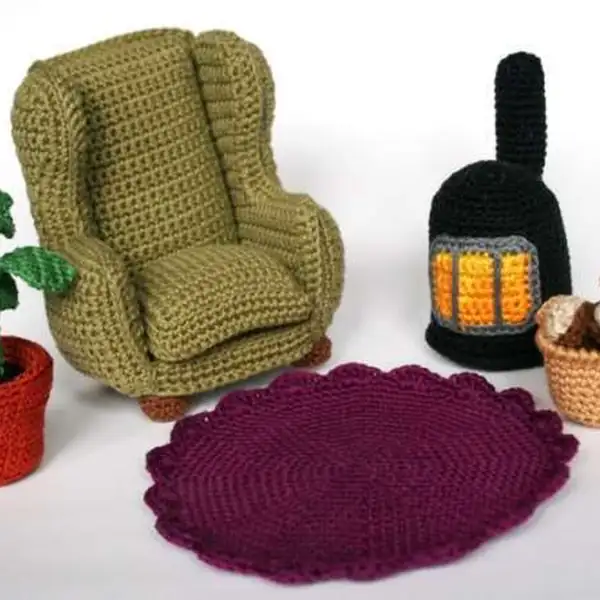
Flower pot and coffee table in crochet
Join 100k+ crocheters

Get new free patterns, stitch tips and exclusive content in your inbox.