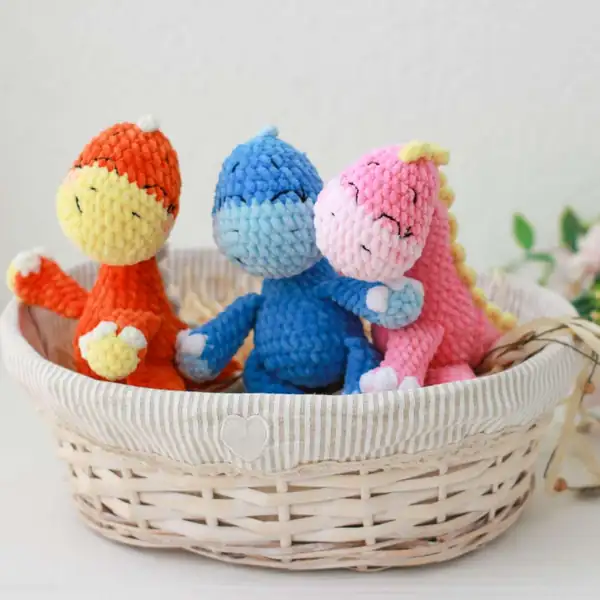
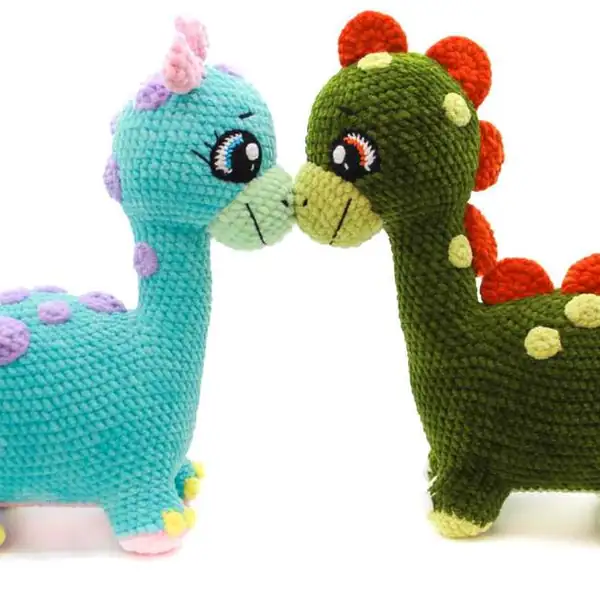
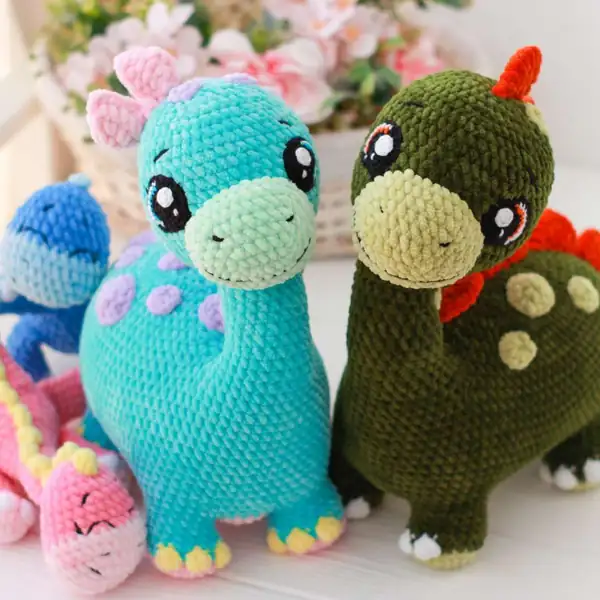
Make a cheerful Dino Family with our free crochet amigurumi pattern. Includes complete round-by-round instructions, materials, and assembly tips. Start crocheting today!
— Part 1 :
Round 1: 6 SC in MR;
Round 2: 2 rounds 6 SC;
Round 3: 2 rounds 6 SC;
Round 4: 2 SC, 2 INC, 2 SC (8);
Round 5: DEC, SC, 2 INC, SC, DEC (8);
Round 6: 3 SC, 2 INC, 3 SC (10);
Round 7: DEC, 2 SC, 2 INC, 2 SC, DEC (10);
Round 8: 4 SC, 2 INC, 4 SC (12);
Round 9: DEC, 3 SC, 2 INC, 3 SC, DEC (12);
Round 10: 3 SC, (SC, INC)*3, 3 SC (15);
Round 11: 15 SC;
Round 12: 3 SC, (2 SC, INC)*3, 3 SC (18);
Round 13: 18 SC; - if the beginning of the round shifts strongly to the right, then work a shifting stitch (align the beginning of the round (stitch marker) in the middle);
Round 14: 3 SC, (3 SC, INC)*3, 3 SC (21);
Round 15: 21 SC;
Round 16: 3 SC, (4 SC, INC)*3, 3 SC (24);
— Part 2 :
Round 1: 7 SC in MR;
Round 2: 7 INC (14);
Round 3: (SC, INC)*7 (21);
Round 4: BLO: 7 SC, (change color to white, PS, change color to dark green, 2 SC)*3, 5 SC (21);
Round 5: 5 SC, (DEC, 2 SC)*2, DEC, 6 SC (18);
Round 6: 3 rounds 18 SC; - fix and cut the thread.
Round 7: 3 rounds 18 SC; - fix and cut the thread.
Round 8: 3 rounds 18 SC; - fix and cut the thread.
— Body-Head :
Foundation: Chain 23; work in spiral (without a turning CH and SS) as in all amigurumi toys (oval- shape detail);
Round 1: start in the 2nd chain from the hook: 21 SC, 3 SC into the last chain from the hook, on the other side: 20 SC, INC (46);
Round 2: INC, 20 SC, 3 INC, 20 SC, 2 INC (52);
Round 3: SC, INC, 20 SC, (SC, INC)*3, 20 SC, (SC, INC)*2 (58);
Round 4: 3 SC, 6 SC with the leg, 11 SC, 6 SC with the leg, 6 SC, 6 SC with the leg, 11 SC, 6 SC with the leg, 3 SC (58);
Round 5: 3 SC, 12 SC on the outer leg contour, 11 SC, 12 SC on the outer leg contour, 6 SC, 12 SC on the outer leg contour, 11 SC, 12 SC on the outer leg contour, 3 SC (82);
Round 6: 3 rounds 82 SC; - in Round 9 the tail is attached; - mark the area of tail attaching: 6 SC xactly in the middle behind, between the legs; - move stitch marker (red) in the next SC from the left marker of the tail attaching area; stitch marker tail attachment area the area of the gap that can be worked as a DEC with light green yarn on the inner side of the leg;
Round 7: 3 rounds 82 SC; - in Round 9 the tail is attached; - mark the area of tail attaching: 6 SC xactly in the middle behind, between the legs; - move stitch marker (red) in the next SC from the left marker of the tail attaching area; stitch marker tail attachment area the area of the gap that can be worked as a DEC with light green yarn on the inner side of the leg;
Round 8: 3 rounds 82 SC; - in Round 9 the tail is attached; - mark the area of tail attaching: 6 SC xactly in the middle behind, between the legs; - move stitch marker (red) in the next SC from the left marker of the tail attaching area; stitch marker tail attachment area the area of the gap that can be worked as a DEC with light green yarn on the inner side of the leg;
Round 9: 76 SC, 6 SC with the tail (82);
Round 10: 76 SC, 18 SC on the outer tail contour (94);
Round 11: 2 rounds 94 SC;
Round 12: 2 rounds 94 SC;
Round 13: 76 SC, (DEC, 6 SC)*2, DEC (91);
Round 14: 91 SC;
Round 15: 76 SC, DEC, 5 SC, DEC, 4 SC, DEC (88);
Round 16: 88 SC;
Round 17: 76 SC, (DEC, 3 SC)*2, DEC (85);
Round 18: 85 SC;
Round 19: 76 SC, DEC, 2 SC, DEC, SC, DEC (82);
Round 20: 6 SC, DEC, 24 SC, 6 CH, skip 18 SC (neck area with markers), 22 SC, DEC, 6 SC, DEC (61+6 CH);
Round 21: 5 SC, DEC, 24 SC, 6 SC on the chain, 21 SC, DEC, 5 SC, DEC (64);
Round 22: 5 SC, DEC, 11 SC, (5 SC, DEC)*3, 11 SC, (5 SC, DEC)*2 (58);
Round 23: 4 SC, DEC, 11 SC, (4 SC, DEC)*3, 11 SC, (4 SC, DEC)*2 (52);
Round 24: 3 SC, DEC, 11 SC, (3 SC, DEC)*3, 11 SC, (3 SC, DEC)*2 (46);
Round 25: 2 SC, DEC, 11 SC, (2 SC, DEC)*3, 11 SC, (2 SC, DEC)*2 (40);
Round 26: SC, DEC, 11 SC, (SC, DEC)*3, 11 SC, (SC, DEC)*2 (34);
Round 27: 17 DEC (17);
Round 28: 8 DEC, don’t work the last SC (9);
— Part 4 :
Round 20: 18 SC on the body, SC in the loop-transition from body to chain, 6 SC on the chain, SC in the loop-transition from body to chain (26);
Round 21: 16 SC, 5 DEC (21);
Round 22: 12 rounds 21 SC (for a girl I work 11 rounds); - cut a square of sintepon/synthetic insulation of one and a half neck lenght; - wrap a tube and fix it with a fabric patch; - stuff well the area of neck base and insert the sintepon tube into the neck so that it goes slightly below the neck and goes beyond the last round of the neck about half the length of the future head; - stuff additionally the area around the tube so that the neck and its base are tightly stuffed and keep the future head well; - sintepon can be replaced by fleece or felt; - if you made a toy of semi-cotton yarn, then a wire frame insulated with a fabric patch can be inserted into the neck;
Round 23: 12 rounds 21 SC (for a girl I work 11 rounds); - cut a square of sintepon/synthetic insulation of one and a half neck lenght; - wrap a tube and fix it with a fabric patch; - stuff well the area of neck base and insert the sintepon tube into the neck so that it goes slightly below the neck and goes beyond the last round of the neck about half the length of the future head; - stuff additionally the area around the tube so that the neck and its base are tightly stuffed and keep the future head well; - sintepon can be replaced by fleece or felt; - if you made a toy of semi-cotton yarn, then a wire frame insulated with a fabric patch can be inserted into the neck;
Round 24: 12 rounds 21 SC (for a girl I work 11 rounds); - cut a square of sintepon/synthetic insulation of one and a half neck lenght; - wrap a tube and fix it with a fabric patch; - stuff well the area of neck base and insert the sintepon tube into the neck so that it goes slightly below the neck and goes beyond the last round of the neck about half the length of the future head; - stuff additionally the area around the tube so that the neck and its base are tightly stuffed and keep the future head well; - sintepon can be replaced by fleece or felt; - if you made a toy of semi-cotton yarn, then a wire frame insulated with a fabric patch can be inserted into the neck;
Round 25: 12 rounds 21 SC (for a girl I work 11 rounds); - cut a square of sintepon/synthetic insulation of one and a half neck lenght; - wrap a tube and fix it with a fabric patch; - stuff well the area of neck base and insert the sintepon tube into the neck so that it goes slightly below the neck and goes beyond the last round of the neck about half the length of the future head; - stuff additionally the area around the tube so that the neck and its base are tightly stuffed and keep the future head well; - sintepon can be replaced by fleece or felt; - if you made a toy of semi-cotton yarn, then a wire frame insulated with a fabric patch can be inserted into the neck;
Round 26: 12 rounds 21 SC (for a girl I work 11 rounds); - cut a square of sintepon/synthetic insulation of one and a half neck lenght; - wrap a tube and fix it with a fabric patch; - stuff well the area of neck base and insert the sintepon tube into the neck so that it goes slightly below the neck and goes beyond the last round of the neck about half the length of the future head; - stuff additionally the area around the tube so that the neck and its base are tightly stuffed and keep the future head well; - sintepon can be replaced by fleece or felt; - if you made a toy of semi-cotton yarn, then a wire frame insulated with a fabric patch can be inserted into the neck;
Round 27: 12 rounds 21 SC (for a girl I work 11 rounds); - cut a square of sintepon/synthetic insulation of one and a half neck lenght; - wrap a tube and fix it with a fabric patch; - stuff well the area of neck base and insert the sintepon tube into the neck so that it goes slightly below the neck and goes beyond the last round of the neck about half the length of the future head; - stuff additionally the area around the tube so that the neck and its base are tightly stuffed and keep the future head well; - sintepon can be replaced by fleece or felt; - if you made a toy of semi-cotton yarn, then a wire frame insulated with a fabric patch can be inserted into the neck;
Round 28: 12 rounds 21 SC (for a girl I work 11 rounds); - cut a square of sintepon/synthetic insulation of one and a half neck lenght; - wrap a tube and fix it with a fabric patch; - stuff well the area of neck base and insert the sintepon tube into the neck so that it goes slightly below the neck and goes beyond the last round of the neck about half the length of the future head; - stuff additionally the area around the tube so that the neck and its base are tightly stuffed and keep the future head well; - sintepon can be replaced by fleece or felt; - if you made a toy of semi-cotton yarn, then a wire frame insulated with a fabric patch can be inserted into the neck;
Round 29: 12 rounds 21 SC (for a girl I work 11 rounds); - cut a square of sintepon/synthetic insulation of one and a half neck lenght; - wrap a tube and fix it with a fabric patch; - stuff well the area of neck base and insert the sintepon tube into the neck so that it goes slightly below the neck and goes beyond the last round of the neck about half the length of the future head; - stuff additionally the area around the tube so that the neck and its base are tightly stuffed and keep the future head well; - sintepon can be replaced by fleece or felt; - if you made a toy of semi-cotton yarn, then a wire frame insulated with a fabric patch can be inserted into the neck;
Round 30: 12 rounds 21 SC (for a girl I work 11 rounds); - cut a square of sintepon/synthetic insulation of one and a half neck lenght; - wrap a tube and fix it with a fabric patch; - stuff well the area of neck base and insert the sintepon tube into the neck so that it goes slightly below the neck and goes beyond the last round of the neck about half the length of the future head; - stuff additionally the area around the tube so that the neck and its base are tightly stuffed and keep the future head well; - sintepon can be replaced by fleece or felt; - if you made a toy of semi-cotton yarn, then a wire frame insulated with a fabric patch can be inserted into the neck;
Round 31: 12 rounds 21 SC (for a girl I work 11 rounds); - cut a square of sintepon/synthetic insulation of one and a half neck lenght; - wrap a tube and fix it with a fabric patch; - stuff well the area of neck base and insert the sintepon tube into the neck so that it goes slightly below the neck and goes beyond the last round of the neck about half the length of the future head; - stuff additionally the area around the tube so that the neck and its base are tightly stuffed and keep the future head well; - sintepon can be replaced by fleece or felt; - if you made a toy of semi-cotton yarn, then a wire frame insulated with a fabric patch can be inserted into the neck;
Round 32: 12 rounds 21 SC (for a girl I work 11 rounds); - cut a square of sintepon/synthetic insulation of one and a half neck lenght; - wrap a tube and fix it with a fabric patch; - stuff well the area of neck base and insert the sintepon tube into the neck so that it goes slightly below the neck and goes beyond the last round of the neck about half the length of the future head; - stuff additionally the area around the tube so that the neck and its base are tightly stuffed and keep the future head well; - sintepon can be replaced by fleece or felt; - if you made a toy of semi-cotton yarn, then a wire frame insulated with a fabric patch can be inserted into the neck;
Round 33: 12 rounds 21 SC (for a girl I work 11 rounds); - cut a square of sintepon/synthetic insulation of one and a half neck lenght; - wrap a tube and fix it with a fabric patch; - stuff well the area of neck base and insert the sintepon tube into the neck so that it goes slightly below the neck and goes beyond the last round of the neck about half the length of the future head; - stuff additionally the area around the tube so that the neck and its base are tightly stuffed and keep the future head well; - sintepon can be replaced by fleece or felt; - if you made a toy of semi-cotton yarn, then a wire frame insulated with a fabric patch can be inserted into the neck;
Round 34: 4 SC, 12 INC, 5 SC (33);
Round 35: 4 SC, (SC, INC)*12, 5 SC (45);
Round 36: 17 SC, (2 SC, INC)*3, 19 SC (48);
Round 37: 12 rounds 48 SC; - stuff well the area of transition from the neck to the head, continue stuffing in the process;
Round 38: 12 rounds 48 SC; - stuff well the area of transition from the neck to the head, continue stuffing in the process;
Round 39: 12 rounds 48 SC; - stuff well the area of transition from the neck to the head, continue stuffing in the process;
Round 40: 12 rounds 48 SC; - stuff well the area of transition from the neck to the head, continue stuffing in the process;
Round 41: 12 rounds 48 SC; - stuff well the area of transition from the neck to the head, continue stuffing in the process;
Round 42: 12 rounds 48 SC; - stuff well the area of transition from the neck to the head, continue stuffing in the process;
Round 43: 12 rounds 48 SC; - stuff well the area of transition from the neck to the head, continue stuffing in the process;
Round 44: 12 rounds 48 SC; - stuff well the area of transition from the neck to the head, continue stuffing in the process;
Round 45: 12 rounds 48 SC; - stuff well the area of transition from the neck to the head, continue stuffing in the process;
Round 46: 12 rounds 48 SC; - stuff well the area of transition from the neck to the head, continue stuffing in the process;
Round 47: 12 rounds 48 SC; - stuff well the area of transition from the neck to the head, continue stuffing in the process;
Round 48: 12 rounds 48 SC; - stuff well the area of transition from the neck to the head, continue stuffing in the process;
Round 49: (6 SC, DEC)*6 (42);
Round 50: (5 SC, DEC)*6 (36);
Round 51: (4 SC, DEC)*6 (30);
Round 52: (3 SC, DEC)*6 (24);
Round 53: (2 SC, DEC)*6 (18);
Round 54: (SC, DEC)*6 (12);
Round 55: 6 DEC (6);
— Muzzle :
Foundation: Chain 6; - work in spiral (without a turning CH and SS);
Round 1: start in the 2nd chain from the hook: 4 SC, 3 SC into the last chain from the hook, on the other side: 3 SC, INC (12);
Round 2: INC, 3 SC, 3 INC, 3 SC, 2 INC (18);
Round 3: SC, INC, 3 SC, (SC, INC)*3, 3 SC, (SC, INC)*2 (24);
Round 4: 2 SC, INC, 3 SC, (2 SC, INC)*3, 3 SC, (2 SC, INC)*2 (30);
Round 5: 3 SC, INC, 3 SC, (3 SC, INC)*3, 3 SC, (3 SC, INC)*2 (36);
Round 6: 2 rounds 36 SC; - fix the thread and leave a long end to sew; - stuff the detail; - sew it in the area of Rounds 34-42.
Round 7: 2 rounds 36 SC; - fix the thread and leave a long end to sew; - stuff the detail; - sew it in the area of Rounds 34-42.
— Eyes :
Round 1: 6 SC in MR;
Round 2: 6 INC (12);
Round 3: (SC, INC)*6 (18);
Round 4: (2 SC, INC)*4, change color to orange, DON’T cut the black thread, (2 SC, INC)*2 (24);
— Spikes :
Foundation: Chain 2;
Round 1: start in the 2nd chain from the hook: 5 SC;
Round 2: SC, INC, 3 SC in one St, INC, SC (9);
Round 3: 2 SC, INC, SC, 3 SC in one St, SC, INC, 2 SC (12);
— Large :
Round 1: 6 SC in MR.
— Large :
Round 1: 8 SC in MR.
— Large :
Round 1: 6 SC in MR;
Round 2: 6 INC (12);
— Bow for a girl :
Round 1: 6 SC in MR;
Round 2: 6 INC (12);
Round 3: 12 SC;
— Bottom legs :
Round 1: 7 SC in MR;
Round 2: 7 INC (14);
Round 3: BLO: 4 SC, (change color to white, PS, change color to pink, SC)*3, 4 SC (14);
Round 4: (3 SC, DEC)*2, 4 SC (12);
Round 5: 5 rounds 12 SC; - if required, work additional 1-2 SC or loose 1-2 SC, when folding in half the middle PS is in the middle;
Round 6: 5 rounds 12 SC; - if required, work additional 1-2 SC or loose 1-2 SC, when folding in half the middle PS is in the middle;
Round 7: 5 rounds 12 SC; - if required, work additional 1-2 SC or loose 1-2 SC, when folding in half the middle PS is in the middle;
Round 8: 5 rounds 12 SC; - if required, work additional 1-2 SC or loose 1-2 SC, when folding in half the middle PS is in the middle;
Round 9: 5 rounds 12 SC; - if required, work additional 1-2 SC or loose 1-2 SC, when folding in half the middle PS is in the middle;
Round 10: 5 rounds 12 SC; - if required, work additional 1-2 SC or loose 1-2 SC, when folding in half the middle PS is in the middle;
— Upper legs :
Round 1: 6 SC in MR;
Round 2: 6 INC (12);
Round 3: BLO: 3 SC, (change color to white, PS, change color to pink, SC)*3, 3 SC (12);
Round 4: 2 SC, (DEC, 3 SC)*2 (10);
Round 5: 5 rounds 10 SC;
Round 6: 5 rounds 10 SC;
Round 7: 5 rounds 10 SC;
Round 8: 5 rounds 10 SC;
Round 9: 5 rounds 10 SC;
Round 10: 5 rounds 10 SC;
— Tail :
Round 1: 6 SC in MR;
Round 2: 2 rounds 6 SC;
Round 3: 2 rounds 6 SC;
Round 4: 3 INC, 3 SC (9);
Round 5: 9 SC; - move stitch marker 2 SC to the left;
Round 6: 3 INC, 6 SC (12);
Round 7: (SC, INC)*3, 6 SC (15);
Round 8: (2 SC, INC)*3, 6 SC (18);
Round 9: (3 SC, INC)*3, 6 SC (21);
— Body :
Round 1: 8 SC in MR;
Round 2: 8 INC (16);
Round 3: (SC, INC)*8 (24);
Round 4: (2 SC, INC)*8 (32);
Round 5: 5 SC, 6 SC with the leg, 10 SC, 6 SC with the leg, 5 SC (32);
Round 6: (6 SC, DEC)*4 (28);
Round 7: 28 SC;
Round 8: (5 SC, DEC)*4 (24);
Round 9: 5 SC, 5 SC with the leg, 4 SC, 5 SC with the leg, 5 SC (24);
Round 10: (4 SC, DEC)*4 (20);
Round 11: 20 SC;
Round 12: (3 SC, DEC)*4 (16);
Round 13: 16 SC;
Round 14: (2 SC, DEC)*4 (12);
Round 15: 6 rounds 12 SC; - work several additional SC to the side of the neck;
Round 16: 6 rounds 12 SC; - work several additional SC to the side of the neck;
Round 17: 6 rounds 12 SC; - work several additional SC to the side of the neck;
Round 18: 6 rounds 12 SC; - work several additional SC to the side of the neck;
Round 19: 6 rounds 12 SC; - work several additional SC to the side of the neck;
Round 20: 6 rounds 12 SC; - work several additional SC to the side of the neck;
— Head :
Foundation: Chain 6; - work in spiral (without a turning CH and SS) as in all amigurumi toys (oval-shape detail);
Round 1: start in the 2nd chain from the hook: 4 SC, 3 SC into the last chain from the hook, on the other side: 3 SC, INC (12);
Round 2: INC, 3 SC, 3 INC, 3 SC, 2 INC (18);
Round 3: SC, INC, 3 SC, (SC, INC)*3, 3 SC, (SC, INC)*2 (24);
Round 4: 2 SC, INC, 3 SC, (2 SC, INC)*3, 3 SC, (2 SC, INC)*2 (30);
Round 5: 2 rounds 30 SC; - change color to pink;
Round 6: 2 rounds 30 SC; - change color to pink;
Round 7: (DEC, 13 SC)*2 (28);
Round 8: 28 SC;
Round 9: (DEC, 12 SC)*2 (26);
Round 10: 26 SC;
Round 11: (DEC, 11 SC)*2 (24);
Round 13: (SC, DEC)*6 (12);
Round 14: 6 DEC (6);
This playful Dino Family amigurumi pattern invites you into a tiny world of textured delight. It balances simple rounds with a few color swaps to create a family that feels vivid and alive. The end result is a set of soft, huggable dinos ready for stories, gifting, or shelf display.