Crochetologist
Free Crochet Pattern
Beautiful Detailed Adorable

Cupid Whale Amigurumi Pattern

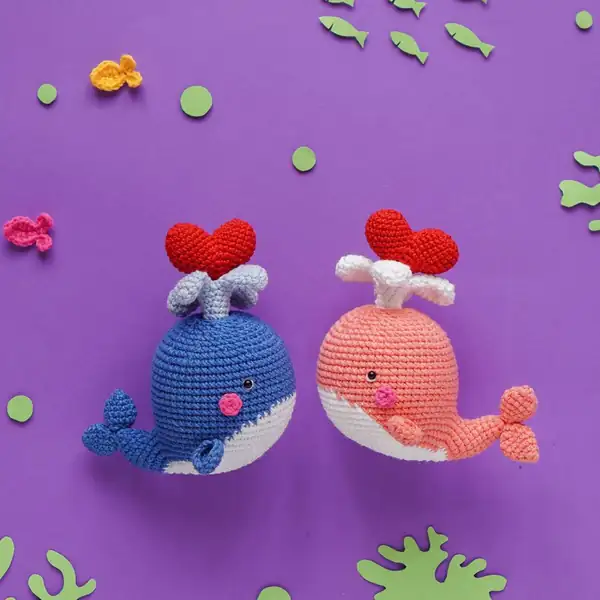
Cupid Whale amigurumi in white and blue with heart accents
4.6Rating
8-10 HoursTime
IntermediateSkill
Highlights

What makes it special

Made with Love

An adorable friend to cherish, handcrafted with love to bring comfort and joy for years to come.

All-Day Adventure

Requires 8-10 hours, ideal for a full day of immersive crocheting.

Intermediate Level

This project suits crocheters who are comfortable working in the round, switching colors, and executing basic shaping with invisible decreases, plus careful seaming to attach the face and fins. The build prioritizes steady rhythm over complex stitches, making it accessible to intermediate beginners who have completed a few simple amigurumi pieces and are ready to tackle color changes with confidence.

Love at first cuddle—Cupid Whale is a small amigurumi you can cradle like a heart in tiny hands. This crocheted creature pairs a round, friendly body with a heart-topped crown, turning a simple toy into a comforting companion for a nursery shelf or a child’s bedtime ritual. The project walks a careful line between playful charm and thoughtful construction, inviting a maker to celebrate finishing a toy that’s soft, durable, and ready for long hugs.

Designed for makers who relish a steady rhythm of rounds and color changes, Cupid Whale rewards patience with a finished piece that feels cohesive and professional. The body’s curvature stays approachable through incremental shaping, while the crown adds whimsy without complicating assembly. It’s a gift with a personal touch—something you crafted stitch by stitch—perfect for celebrating a new arrival, a birthday, or a moment of creative self-expression in a craft room that loves detail.

About This Cupid Whale Amigurumi Pattern

This pattern yields a Cupid Whale with a rounded, cuddly torso, a crown topped with a heart motif, and gentle facial features. The whale is built from distinct sections—the body, the tail, the fins, and the cheeks—then joined and finished with careful seaming to maintain neat joints across crown and body pieces. The technique mix focuses on basic in-the-round stitches, controlled color changes, and precise attention to placement during assembly. The color changes are integrated into the rounds rather than added as separate blocks, which helps the piece read as a singular creature rather than a stitched collage.

The construction emphasizes a continuous spiral body approach, with increases kept evenly spaced and decreases worked at the same rate to maintain symmetry. The starting method uses a foundation chain or a starting tail approach, depending on the crocheter’s preference, with a secure loop to anchor the first round. Eyes and mouth are conveyed through simple embroidery or tiny stitched details; safety eyes can be used if the maker favors a traditional eyes-on-face look, though embroidery keeps the surface soft and baby-safe. The cheeks are soft rounds sewn into position to create a gentle, friendly smile that complements the heart motif on the crown. The fins are mounted with a straightforward seam, and the tail is shaped through ordinary increases and decreases to achieve a balanced silhouette that remains sturdy under handling.
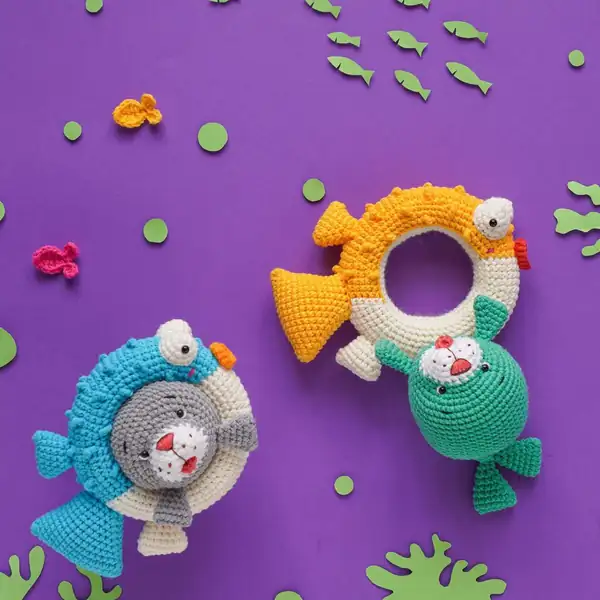
Close-up of whale head and cheeks

What makes Cupid Whale distinctive is the way the heart motif on the crown ties into the overall design without complicating the pattern. The steps emphasize reliable counting and consistent rhythm, enabling crocheters with solid basic skills to progress with confidence even if color changes are new to them. While the pattern includes a few moments of detailing—such as a small cheek patch or a subtle mouth line—the core build remains straightforward: a continuous, crocheted body joined to limbs with clean seams and a simple, charming expression that reads as wholesome rather than fussy. The pattern is designed to accommodate customization through color choices, scale adjustments, or the addition of tiny props, all while preserving the fundamental roundness of the body and the buoyant feel of the creature.

The finished toy is well-suited for gifting to a child, but it also serves as a cute decorative piece for a nursery or a seaside-themed room. The approach is forgiving for beginners who can gradually weave in tails and secure the joints as they go, while giving more experienced crocheters a satisfying project that yields a polished result. The heart motif can be adapted to reflect the recipient’s personality through color pairing, and the crown can be simplified or enhanced with a few extra stitches if desired, provided the changes stay consistent across both sides of the crown to preserve balance.
Stitches & Skills You'll Use

Gauge and fabric feel are the backbone of a well-balanced Cupid Whale. Take time to knit a swatch or estimate fabric density by crocheting a 2" x 2" sampler in the chosen yarn and comparing it to the pattern’s stitch density; operate with a 2.5 mm or similar hook for typical DK yarns, and adjust if your swatch reads looser or tighter than expected. When you begin the body, keep the rounds consistent with a gentle, even tension to avoid gaps at color-change transitions. Use a color-change technique that minimizes ends: carry the new color to the start of the round and secure the previous color tail neatly at the end of the round, then weave tails away from the surface so the finish remains smooth.

For assembly, align the crown clearly with the body’s centerline before attaching; ensure the heart motif is centered and visible from the front. When attaching fins and tail, use a tight slip-stitch seam or a small number of single crochet stitches to secure each limb to avoid wobble during play. Weave tails to the back before final stitching to minimize bulk on the surface and to keep the look cohesive from the front. When adding cheeks, place them evenly and align approximate facial symmetry by counting stitches around the face—this helps achieve a balanced, friendly expression that reads well at a glance.

Color changes should occur at stable points within rounds to preserve round continuity; plan ahead by marking the color-change boundary on the working piece, then finishing the round with the new color ready for the next stitch, so there’s no visible laddering or gaps at join points. If you choose to embroider eyes or mouth, keep the embroidery tight and set it with a light layer of clear-drying fabric glue to prevent movement during play. Finally, when stuffing, insert gradually and test the silhouette frequently—an overstuffed head or a slack tail can alter the intended proportions and undermine the overall balance of the figure.

Why You'll Love This Cupid Whale Amigurumi Pattern

The charm of Cupid Whale comes from the simple geometry of a rounded body paired with a playful heart motif. The proportions give a plush, huggable feel that translates well from toy to décor, and soft yarn choices create a surface that’s soothing to touch. Color options dramatically shift the character—soft pastels present a gentle, nursery-friendly vibe, while brighter primaries render a cheerful, energetic companion for playtime. The crown with a heart detail adds a whimsical focal point that remains child-safe and visually appealing from across a room.

The pattern also works as a confidence-builder for a crocheter: rounds build predictably, color changes are straightforward, and the final assembly, though careful, unfolds as a logical sequence rather than a ladder of tricky tasks. It invites personalization—think of matching color choices with a wall display or pairing with a crocheted sea-scene backdrop to set a whimsical stage for the toy. The result is a keepsake that feels homemade and thoughtful, a tangible expression of care that travels well as a gift and endures through daily use.

Colour & Yarn Inspiration

Classic two-color schemes—white body with blue accents—offer a clean, modern look that suits most nurseries. For a more whimsical vibe, consider coral and turquoise, or soft pinks and lavenders for a delicate, pastel aesthetic. A monochrome body with a bold eye or mouth detail can be dramatic when paired with a subtle blue outline along the belly for depth. When substituting colors, keep the main color stable to preserve the silhouette, and reserve accent colors for the crown, cheeks, or fins to maintain balance across the piece.

Using a slightly lighter or darker shade for the fins creates gentle highlights and shadows that give the plush surface a sense of depth without altering scale. A variegated DK can add texture and visual interest without requiring additional pattern changes, as long as the color transitions occur within the same approximate color family. If a color pool is limited, you can swap in a coordinating yarn with similar weight and feel, then adjust the hook size slightly to maintain stitch density and the toy’s overall heft. The goal is to preserve the roundness of the body while letting color play a supporting role in the character’s expression.

Whale accessories and finished display

Switch Things Up

The Cupid Whale is exceptionally adaptable for customization without changing the core pattern. Start by reordering colors to craft a different mood: soft pastels for a nursery friend, or bright, primary hues to create a bold aquatic companion. A lighter DK weight can soften the silhouette; a variegated DK offers gentle stripe-like shading that reads as natural variation rather than a pattern seam. If durability is a priority for a toy that will be handled often, consider a slightly firmer stuffing and a snug neck seam to help the head stay aligned with the body during play.

Details can be added without complicating the build: embroidery for a tiny smile, small highlights on the cheeks, or a dotted sparkle in the eyes—all of which stay close to the surface and are easy to secure. A miniature scarf in a contrasting color can be attached with a neat seam and a single knot to keep it in place through cuddle sessions. Consider swapping the color of the crown or heart motif to reflect a recipient’s favorite color, or add a small prop such as a crocheted sea toy or a tiny shell for added storytelling opportunities.

For longevity, a light sealant on surface details can help reduce fuzzing at high-use points, and using a gentle fabric-safe adhesive on small facial features can prevent loss during rough play or machine washing in baby-friendly cycles if the yarns permit. If you want to alter the pose, you can adjust the tail’s shape during assembly by adding a few extra stitches to create a slight lift, while keeping the overall proportions intact. Finally, seek consistent, patient progress—this pattern rewards careful attention to rounds, transitions, and seam alignment more than rushed execution.

Ways to Use & Gift It

Gift Cupid Whale as a first birthday keepsake or as a comforting nursery friend for a newborn. The soft texture and approachable size invite little hands to explore without rough edges, making it a safe and thoughtful present. Pair the toy with a crocheted sea-scene backdrop and a handmade card to create a complete, memorable gift moment that tells a tiny story about the sea and gentle hearts.

Another lovely option is to present Cupid Whale as part of a baby shower gift set. Include a small corrugated box or a keepsake bag filled with soft cotton yarn scraps, a mini color wheel card for color coordination, and a photo of the finished piece—this helps recipients envision the toy in a real-life nursery scene. A pair of whales, one in complementary colors, can form a playful duo that’s easy to place on a shelf or a dresser.

The toy also serves as a decorative element in a child’s room with a sea-orb display or a dedicated shelf scene. It fits well into a gentle storytelling frame, such as a weekly bedtime ritual where the whale “sails” into a small crocheted sea-foam landscape. The overall presentation benefits from careful packaging and a note that explains care instructions so the keepsake remains soft and safe through light use and gentle washing when appropriate.

Common Mistakes & How to Fix Them

Skipping stitch markers at color changes can lead to misaligned rounds; place a marker at the start of every round to stay on track. Not stuffing evenly causes lumpy heads or limbs; stuff gradually while shaping, adding small amounts at a time. Pulling yarn too tight creates stiff, inflexible pieces; maintain consistent, moderate tension throughout your work. Forgetting to count stitches results in uneven rounds; count after every round, especially during increases and decreases.

Maker's Notes

During testing, the two-tone palette used five distinct colors with a 2.5 mm hook on DK-weight yarn. The rounds progressed smoothly, and color changes were most manageable when the yarn ends were woven in at the end of the round instead of at the start of the next one. Eyes were placed between rounds 7 and 8, centered at roughly 17 stitches apart to strike a friendly, approachable look. Gradual stuffing during shaping prevented distortion at the head and tail junctions, ensuring a consistent silhouette from every angle. Beginners tended to stumble at the transition between the Body and Tail sections; planning color breaks ahead and securing ends before continuing reduced the risk of gaps later in the build.

For seam stability, testers found that a minimal amount of extra stitching around the crown anchor helped keep the heart motif perfectly centered. The cheeks benefited from a light darning technique to blend the patches into the face without creating raised edges. The final finish required careful alignment of the fins and tail to avoid misalignment on the back view, which could distract from the overall look. Washing care was noted to rely on gentle handling and air drying to preserve yarn integrity and prevent flattening of the features.

I tried a substitution: Substituting a lighter DK yarn with a similar gauge and using a slightly smaller hook (2.25 mm) for the nose area produced a whale that measured about 7 cm shorter. Despite the size reduction, the proportions remained balanced, and the overall texture stayed soft and plush. The final piece retained the same proportions and facial expression, proving that small gauge adjustments do not compromise the intended silhouette. Yardage remained sufficient because the change did not alter the number of stitches required for the main body and tail sections, though the color-change segments became marginally more compact. The result demonstrates that careful tuning of hook size and yarn weight can tailor the final size without losing the character of the pattern.

Cupid Whale Amigurumi Pattern

Make Cupid Whale with our free crochet amigurumi pattern. Includes complete rounds, materials, and assembly tips. Start crocheting today and create a adorable sea friend!

Intermediate 8-10 Hours
Pattern at a glance
Skill level
Intermediate
Time to make
8-10 Hours
Hook size
2.5 mm
Yarn weight
DK / #3
Finished size
Approx. 9 cm tall
Gauge
Not specified in pattern; gauge inferred from rounds and stitch counts used in Body section
Yarn used
Color A (white) 50g, Color B (blue) 50g, Color C (baby blue) 50g, Color D (red) 50g, Color E (fuchsia) 50g (Total ~250g; 160m per 50g skein)

Materials Needed

Main Fabric
  • 01
    Color A: white YarnArt Jeans DK - 50g (160m)
  • 02
    Color B: blue YarnArt Jeans DK - 50g (160m)
  • 03
    Color C: baby blue YarnArt Jeans DK - 50g (160m)
  • 04
    Color D: red YarnArt Jeans DK - 50g (160m)
  • 05
    Color E: fuchsia YarnArt Jeans DK - 50g (160m)
Tools Required
  • 01
    Crochet hook size 2.5mm
  • 02
    1 pair of safety eyes size 5mm
  • 03
    Tapestry needles
  • 04
    Pins
  • 05
    Stitch markers
  • 06
    Scissors
  • 07
    Polyester fiberfill

— Part 1 :

Round 20: &21, 17 sts apart (54)

— Part 2 :

Round 5: sc 12;
Round 6: sc 12;

— Part 3 :

Round 3: sc 12;
Round 4: sc 12;
Round 5: sc 12;

— Part 4 :

Round 19: -21), slst on the 1st st to make a ring (16)
Round 20: -21), slst on the 1st st to make a ring (16)

— Instructions :

Round 12: sc 8, stuff firmly (8)
Round 13: sc 8, stuff firmly (8)
Round 14: sc 8, stuff firmly (8)
Round 15: sc 8, stuff firmly (8)
Round 16: sc 8, stuff firmly (8)
Round 17: sc 8, stuff firmly (8)

— Part 6 :

Round 4: sc 18;
Round 5: sc 18;

— Instructions :

Round 14: . Flippers (yarn B, X2) rnd sts 1 ch 6, start on the 2nd ch from the hook, inc, sc 3, inc 2 on the last st, continue to crochet on the other side, sc 3, inc (14)

— Part 8 :

Round 4: Repeat rnd 3-6 of the Flippers (6)
Round 5: Repeat rnd 3-6 of the Flippers (6)
Round 6: Repeat rnd 3-6 of the Flippers (6)
Round 7: Repeat rnd 3-6 of the Flippers (6)

— Part 9 :

Round 2: sc 52;
Round 3: sc 52;
Round 4: sc 52;
Round 5: sc 52;
Round 6: sc 52;
Round 7: sc 52;

— Part 10 :

Round 19: , inc, sc 4, Dc Tr, sc 3, inc, sc 1, Dc Tr, sc 5, Dc Tr, inc, sc 4 (60)

— Instructions :

Round 2: sc 6;
Round 3: sc 6;
Round 4: sc 6;
Round 5: sc 6;
Round 6: sc 6;

— Part 12 :

Round 25: sc 60;
Round 26: sc 60;
Round 27: sc 60;
Round 28: sc 60;
Round 29: sc 60;
Round 30: sc 60;
Round 31: sc 60;

— Part 13 :

Round 4: sc 15;
Round 5: sc 15;
Round 7: sc 14;
Round 8: sc 14;

— Part 14 :

Round 1: Repeat rnd 1-6 of the Small Claw (14)
Round 2: Repeat rnd 1-6 of the Small Claw (14)
Round 3: Repeat rnd 1-6 of the Small Claw (14)
Round 4: Repeat rnd 1-6 of the Small Claw (14)
Round 5: Repeat rnd 1-6 of the Small Claw (14)
Round 6: Repeat rnd 1-6 of the Small Claw (14)
Round 10: sc 20;
Round 11: sc 20;
Round 19: sc 9;
Round 20: sc 9;
Round 21: sc 9;

— Part 15 :

Round 2: sc 6;
Round 3: sc 6;
Round 4: sc 6;
Round 5: sc 6;

— Part 16 :

Round 3: sc 6, change to yarn B (6)
Round 4: sc 6, change to yarn B (6)
Round 5: sc 6, change to yarn B (6)
Round 6: sc 6, change to yarn B (6)

— Part 17 :

Round 3: on the next st] 2x, sc 1 (18)

— Part 18 :

Round 3: on the next st] 2x, sc 2 (24)

— Part 19 :

Round 3: on the next st] 2x, sc 3 (30)

— Part 20 :

Round 3: on the next st] 2x, sc 4 (36)

— Part 21 :

Round 3: on the next st] 2x, sc 5 (42)

— Part 22 :

Round 18: sc 66;
Round 19: sc 66;

— Part 23 :

Round 4: sc 15, break yarn D, change to yarn A, turn (15)
Round 5: sc 15, break yarn D, change to yarn A, turn (15)
Round 6: sc 15;
Round 7: sc 15;

— Part 24 :

Round 25: . Captain’s Hat (yarn D) rnd sts 1 sc 6 into a magic loop (6)

— Part 25 :

Round 3: on the next st, sc 10, (sc 3) on the last st, ch 1, turn (30)

— Instructions :

Round 3: on the next st, sc 13, (sc 3) on the last st, ch 1, turn (36)

— Part 27 :

Round 1: What is X-shape stitch/V-shape stitch? Which one is better?;
Round 6: Invisible Decrease Normal decrease will make a large hole, so we should use insivible decrease. Just crochet on front loop only. Normal decrease Crochet on front loop only Pull the yarn through two front loops Pull the yarn through two loop Pull the yarn through two remaining loops;
Round 7: Weave in the remaining 6 sts on the last rnd After you finish crochet Use a tapestry needle and weave over remaining sts. Pull the yarn to close and hide the remaining yarn. 8.Finishing There are a loop like photo bellow Pull the yarn through last stitch;

Assembly Instructions

  1. Stuff each piece firmly before closing.
  2. Pin all parts in place and check the proportions against the photos.
  3. Sew parts on securely with matching yarn.
  4. Weave in all ends and shape the finished piece.

Important Notes

  • Always secure the starting tail and finish tail with two or three small weave-ins to prevent loosening during play.
  • If using safety eyes, insert them before completing the final seam for easier alignment; embroidery options require careful, evenly spaced placement.
  • Choose a yarn that is soft enough for cuddle-hug quality yet durable enough to withstand washing or gentle cleaning when needed.
  • Respect washing guidance for the chosen yarn; many DK yarns tolerate hand washing but avoid harsh agitation that could loosen seams.

This little Cupid Whale is destined to become a cherished keepsake for a child or a cheerful shelf companion. Its crocheted body, friendly heart motif, and tiny crown invite gentle play and cozy cuddling. The pattern blends technique with whimsy, delivering a satisfying finish for an amigurumi enthusiast. May your stitching bring smiles and many quiet evenings of crocheting joy, with each round bringing you closer to a soft, huggable friend.

Good to know

You ask, we answer

The finished amigurumi measures approximately 9 cm tall when using the recommended DK yarn and a 2.5 mm hook.

Yes, you can, but final size and drape will change. Choose a yarn with similar weight and adjust hook size slightly to maintain scale.

This pattern is suitable for someone with intermediate skills, including color changes, working in the round, and basic assembly.

Most crocheters finish Cupid Whale in 8-10 hours, depending on your speed and whether you customize the embellishments.

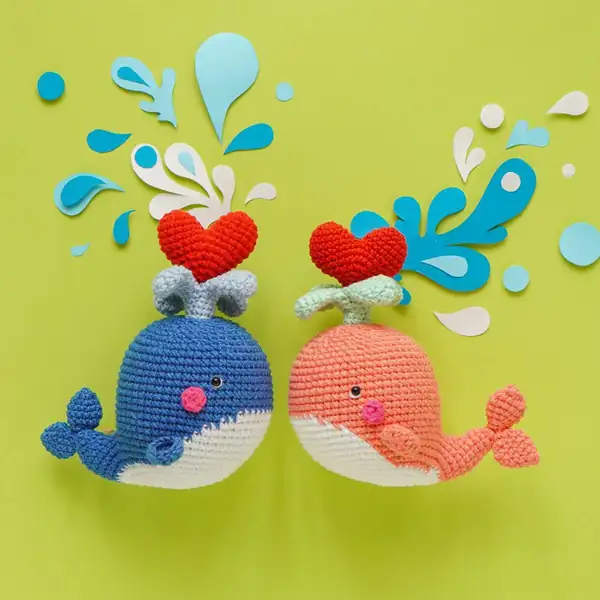
Two Cupid Whale amigurumi figures posed together
Join 100k+ crocheters

Get new free patterns, stitch tips and exclusive content in your inbox.