HowTo Amigurumi
Free Crochet Pattern
Beautiful Detailed Adorable

Bunny's House Amigurumi Pattern

Finished Bunny's House amigurumi with carrot house and bunny figures
4.0Rating
24-28 HoursTime
AdvancedSkill
Highlights

What makes it special

Cute Companion

An adorable friend to cherish, handcrafted with love to bring comfort and joy for years to come.

Multi-Day Project

This is a 24- to 28-hour journey, spanning multiple pieces and finishing touches—perfect for dedicated crafters who enjoy detailed, multi-part amigurumi.

Advanced Level

This project is best suited for experienced crocheters who enjoy multi-part amigurumi, color changes, invisible decreases, precise seaming, and assembling accessories into a tiny, narrative scene.

Delight blooms when you pick up the Bunny's House Amigurumi Pattern and slow your hands to a gentle rhythm. I love how the tiny ears and rounded head balance against the little house base, creating a sculpture that feels alive even before stuffing. Working with lace weight yarn on a 1.0 mm hook is a meditative craft, a whisper-thin fabric that rewards precise tension and careful color changes. The finished piece stands about 7 to 8 cm tall, a pocket-sized friend who still carries a big sense of character. This is an advanced project, and I savor every decision—from the magic ring to the invisible decreases that keep the lines clean.

Begin with planning the tiny color blocks, because Vita Pelican yarns in pink, white, and browns guide the Bunny's charm. I remind myself to align the ears to the head and to tuck the tail so it peeks shyly from beneath the body. The house motif comes alive through thoughtful rounds and shaping, while the bunny’s head and paws emerge as a cohesive sculpture. The road to completion is long—roughly a day to a day and a half for a patient maker—yet the rhythm of the stitches is soothing and satisfying. When the eyes are attached, either safety eyes or a glue-on option, the scene feels warm and welcoming, ready for a photo or a gift tag.

About This Bunny's House Amigurumi Pattern

From the moment the tiny ears pop from the head, you can sense a lived-in story in Bunny's House Amigurumi. The pattern guides you through a precise sequence of rounds, a magic ring foundation, and discreet color transitions that create the house’s frame and the bunny’s features without bulk. The lace-weight yarn behaves like a whisper on the hook, encouraging delicate folds and a crisp silhouette at a finished height of approximately 7–8 cm.

You’ll stitch with a 1.0 mm hook, switch between BLO and FLO to emphasize shaping, and use the invisible decrease technique to keep the seams seamless. The house-inspired base is built with clever increases and decreases that form a compact pedestal, while the bunny’s head, ears, and tiny paws emerge with careful placement. The finishing touches—glue eyes or safety eyes, neat ends tucked inside, and a small amount of pink pastel for toning—bring this character fully to life.

It’s a small sculpture you can display on a shelf, gift to a friend, or tuck into a dollhouse corner for storytelling.

At the heart of Bunny's House Amigurumi Pattern lies a tiny home motif realized in meticulous rounds and a magic ring. You’ll work with lace weight yarn on a 1.0 mm hook, so the fabric remains crisp and the sculpted shapes hold their shape when stuffed. Each element—head, ears, paws, and the house base—emerges from careful increases, decreases, and stitch placement that a confident crocheter will recognize as advanced technique. The color sequence uses N3854 pink for highlights, N3951 white for the bunny, N3952 black for tiny facial details, and browns and greens for the house features, but you can swap to create a fresh character every time. Invisible decreases ensure the seams vanish as you close the body, while BLO and FLO help you sculpt features and cradle the little ears with precision.

Assembly is a satisfying puzzle, inviting you to align the tiny pieces with pins and a yarn needle before sewing. I guide readers through soft stuffing to preserve a neat, compact form without lumps, keeping the bunny at the signature 7–8 cm height. The eyes can be safety eyes (4 mm) or glue-on alternatives, allowing flexibility for different age groups or preferences for a gentler look. You’ll learn to set the in-between spaces so the head sits naturally on the neck, and the little tail peeks in a way that reads shy and sweet. Caution with tension is essential—too tight and the lace weight yarn will flatten; too loose and the house’s silhouette may wobble. The finished figure balances whimsy and precision, a tiny sculpture you’ll be proud to display.

Finally, this pattern teaches you to manage multiple color changes while maintaining a clean finish. I emphasize keeping ends tucked and weaving in as you go so nothing unravels when you handle the Bunny’s House friend. The modular approach—the bunny and the house as separate components before joining—gives you flexibility to experiment with textures by swapping BLO to FLO or layering colors for shading. You’ll appreciate how the tiny 1 mm hook creates an almost architectural look, perfect for a shelf companion or a mini scene in a dollhouse. With the right patience, you’ll complete this advanced amigurumi and discover that the process is as heartwarming as the finished Bunny.

Close-up of bunny amigurumi head and ears

This pattern is built for close inspection and careful execution, starting with the magic ring that anchors the tiny bunny. I describe the exact color blocks using Vita Pelican yarns in pink, white, black, beige, and soft browns to form the bunny’s face and the house’s trim. The 1.0 mm crochet hook delivers delicate stitches that create a sculpted silhouette at roughly 7–8 cm tall when stuffed. You’ll switch between BLO and FLO to shape ears, cheeks and the little door on the house, keeping texture lively and readable in photos. Each round has a clear purpose, from the first MR to the final slip stitch, so you can trust your progress as the measurements stay consistent.

After assembly, I show how to conceal ends and reinforce joints with a fine yarn needle, ensuring the figure remains sturdy yet touchable. The eyes can be glued or set with small safety eyes, and a dab of pink pastel softens the cheeks for a gentle expression. Because lace weight fabric is light, I recommend proper stuffing and a tiny amount of sculptural shaping to hold the head at the correct angle. The result is a portable treasure that fits in a dollhouse corner or on a bedside shelf, ready for photos or gifting. If you want to shoot tutorials or detailed closeups, this piece holds still long enough for clean, well-lit images.

Stitches & Skills You'll Use

I call out the core stitches that give Bunny's House its soul: MR, CH, SC, INC, DEC. I explain how a magic ring anchors the body in a tightly worked round, letting the tiny limbs attach with invisible seams. The pattern asks you to work in BLO for sides that sit smoothly against the torso, and then switch to FLO for shaping the ears and the house’s roof line so the texture reads as deliberate. You’ll measure your tension carefully, because lace weight yarn on a 1.0 mm hook can tighten quickly, and the result should stand with a confident little poise. Each round has a defined purpose that keeps the overall silhouette stable as you progress toward the 7–8 cm finished size.

Next comes the 4-dc bobble st, a playful detail that creatively builds the bunny’s nose, cheeks, or window accents on the house frame. The dc-inc technique lets you push the scale outward in small bursts, creating gentle curves without bulging; practicing it here prevents the head from flattening when stuffed. I include tips on where to place increases to sustain symmetry between the left and right sides of the face, and where to decrease to maintain a smooth neck join. When you work around the tiny house block, you’ll see how color changes accent the door and window frames, elevating character without overwhelming the base form. The end result is a micro-sculpture whose lines stay crisp, thanks to careful stitch orientation and precise round counts.

Finally, I guide you through finishing stitches with meticulous end-taming, avoiding loose ends that mar the tiny finish. The pattern’s architecture rewards measured assembly, and you’ll learn to pin parts before sewing, ensuring the head sits at a natural angle. You can test variations in fiber feel by alternating the color order—perhaps a white bunny with a pale gray house—and still keep the final height consistent. I encourage photographing the Bunny’s House from several angles to celebrate the subtle textures the stitch choices create. With patience, your amigurumi will transition from pattern notes to a charming, camera-ready little home.

Why You'll Love This Bunny's House Amigurumi Pattern

I designed Bunny's House Amigurumi to be a tiny ambassador for cozy storytelling. The finished piece fits in the palm, about 7–8 cm tall, yet it carries a big personality—the shy tilt of the head, the house-like base, and those precise little features that read clearly in photos. The lace-weight Vita Pelican yarns in pink, white, brown, and green let you craft a soft, tactile surface that photographs well and feels gentle to the touch. Owning this one means you’re ready for a new mini-scene—one that sits on a shelf or in a dollhouse corner and prompts a story. I love how the project invites focus, patience, and a little improvisation within its precise round counts.

Beyond technique, the pattern is a template for storytelling with fabric. You’ll enjoy swapping colors to create a dozen different bunnies—perhaps a cream bunny with a lavender roof, or a gray bunny with a mint-green door—without changing the core shape. The assembly is the heart of the experience; I guide you through aligning parts, stuffing lightly for a crisp silhouette, and attaching eyes with care so the expression stays friendly rather than startling. The tiny scale makes it a perfect desk buddy for work or study and travels well in a tote or photo backdrop. You’ll discover that the creative process here doubles as a mindful practice, a small ritual you can repeat with new palettes.

As a gift, this amigurumi becomes more than a toy; it’s a moment of time stitched in thread. Its 7–8 cm height makes it easy to wrap in tissue and tuck into a card, or bundle with a tiny carrot prop for a whimsical scene. The Bunny’s House speaks through texture and color, inviting you to share your build in a photo group or with friends who love handmade décor. The pattern also lends itself to family-friendly teaching moments: kids can help pick colors, or you can guide a friend through the magic ring while you supervise. When you finish, you’ll understand why this small house holds big charm in every stitch.

Colour & Yarn Inspiration

Color ideas for Bunny's House Amigurumi start with the primary palette from Vita Pelican yarns—pink for accents, white for the bunny, black for tiny facial details, and soft browns for the house trim. You can keep the same scheme and simply play with shading by using the light beige (N3976) or gray (N4011) to soften edges. Consider swapping the roof line to a mint green or lavender for a fresh twist, while preserving the bunny’s crisp silhouette. Another option is to reverse the color roles: a white bunny with a pink house, which creates a high-contrast, playful effect. I love testing two-tone cheeks with a touch of pastel pink for warmth without overpowering the face.

Pastel palettes work beautifully with lace weight yarn, letting color blocks read clearly in photos. For a cozy cottage look, choose warm browns and mossy greens to evoke a little garden beside the doorway, or try a snowy white bunny against a slate gray base for modern display. If you plan to create a seasonal version, swap greens for soft orange (N3966) and brown for caramel to echo autumn light. Remember to keep the texture consistent by carrying colors or weaving ends neatly so the color breaks stay clean along the limbs. The Bunny’s House remains striking whether you keep it traditional or push toward bold, modern color stories.

Finally, document your color experiments with quick progress photos to track how each shade behaves on the tiny stitches. You’ll find that the 1 mm hook and lace-weight yarn emphasize what you can do with even subtle color shifts. The goal is to preserve the scale—the bunny’s features should remain gentle, while the house lines stay crisp against the float of color. By rotating color families and testing different pairings, you’ll build a small library of ready-to-use palettes for future amigurumi scenes. When you publish or share your ideas, you’ll help others imagine fresh Bunny’s House variations too.

Garden and leaves pattern

Switch Things Up

Switching things up with Bunny's House Amigurumi is all about honoring the tiny-yet-strong silhouette while exploring color, texture, and proportion. Start by swapping out the pink-and-white palette for a soft cream bunny paired with a slate-gray house, then experiment with a mint-green roof and a pale beige base to shift the mood from whimsical to modern. You can also try a two-tone bunny where the face uses one shade and the ears another, keeping the 7–8 cm height intact with careful distribution of increases and decreases. If you want more texture, designate a few rounds in BLO for the sides and in FLO for the ears to emphasize shape and light play in photos. The key is to preserve the rhythm of rounds and the placement of the final seam lines so the figure remains balanced in any color story.

Another switch-up is in the eyes and facial features. Use safety eyes in one version and glue-on eyes in another, then nude the eyes with a tiny amount of acrylic paint to soften the gaze. You can also add a minuscule accessory—a carrot prop, a little hat, or a tiny flower pot—to create a scene the bunny can “live in,” which is perfect for display or storytelling. For display options, consider placing Bunny’s House in a small display square with a forest or garden backdrop; the scale is small enough to fit into a desk vignette that tells a tale without crowding the frame. Finally, document each variation with a quick color-block chart so you can reproduce or reverse the palette whenever you like, keeping the same overall shape intact.

The beauty of this pattern is that it rewards thoughtful experimentation without sacrificing the core sculpture. I encourage you to note every swap, from shade depth to yarn brand, so you can compare outcomes and choose the version that speaks to you. Maintain the same stitch relationships—the magic ring, the round counts, and the house’s base geometry—so that the bunny’s proportions stay consistent even when you remix colors. The result is a gallery of tiny houses and bunnies, each with its own personality but the same charming silhouette. The act of switching things up becomes a creative practice, not a detour from the original design.

Ways to Use & Gift It

Gifting this Bunny's House Amigurumi pattern or the finished piece invites a moment of shared creativity. The tiny bunny, standing at 7–8 cm, is a delightful surprise for a friend who loves dolls, miniatures, or cozy décor. When wrapped with care, the yarn colors—pink, white, beige, and brown—signal a thoughtful, hand-crafted touch that’s hard to equal with store-bought gifts. A handmade soft toy like this becomes a memory your recipient can keep on a shelf or in a dollhouse and revisit in photos or stories. Pairing the bunny with a tiny carrot prop or a handwritten note adds an extra layer of charm.

Adults and teens will treasure the patience and focus that goes into completing an advanced amigurumi, and gifting it supports mindful crafting as a shared hobby. You might host a mini crochet club afternoon where each person makes one Bunny’s House and exchanges colors for variety. The finished piece travels well in a gift bag or small box, and its compact size makes it ideal for a desk companion at work or school. Include care tips on a cute tag so the recipient knows how to keep the stitching neat and to wash lightly if needed. The result is a gift that whispers thoughtfulness and invites a story to unfold.

Finally, this project becomes part of a larger narrative—an invitation to start a little collection of mini houses, each with a different bunny family. The pattern’s structure supports future expansion: you can imagine adding a carrot-plant garden, a tiny fence, or a window box without altering the core technique. The act of giving a hand-made Bunny’s House is about more than the object; it’s about sharing time, skill, and a moment of patience that both giver and receiver can celebrate together. In that spirit, I hope your gift opens up smiles, photos, and new crochet adventures for years to come.

Common Mistakes & How to Fix Them

Mis-counting rounds during color changes can lead to misaligned parts; count stitches after every round, especially when you join multiple pieces. Over-stuffing causes stiff joints; stuff gradually and shape curves as you go, so limbs and the head stay proportionate. Using yarns of different weights will change size; adjust hook size and stuffing to maintain consistent dimensions. Skip markers at the start of rounds; always place a stitch marker to track round beginnings.

Maker's Notes

Testing notes for Bunny's House Amigurumi Pattern run through gauge, stitch density, color behavior, and assembly flow. Because lace weight yarn on a 1.0 mm hook produces a fine fabric, I recommend practicing sections twice to lock in tension before proceeding to the next color change. You should expect the finished height to hover around 7–8 cm, with slight variation due to fiber thickness and stuffing amount; measure after final stuffing for accuracy.

The invisible decrease instructions are precise but require patience; I suggest labeling rounds on your pattern sheet to avoid mixing up BLO and FLO sections. For color management, I tested the palette with Vita Pelican N3854, N3951, N3952, and complementary browns and greens; for best results, pull the yarn snugly but not so tight that the stitches distort the ring. When attaching eyes, decide if you want safety eyes or glue-on options; if the recipient is a child, consider safety eyes and seal with a dab of acrylic paint for a softer look.

Make sure to pin every piece before sewing and allow the stuffing to settle before final assembly; this helps you avoid gaps at the neck or head seams. If you are documenting your work for a blog or social feed, take close-ups of the magic ring, the 4-dc bobble st, and the final assembly so readers can see the tiny details that define the character. Finally, store scraps neatly and label them by color family so you can reproduce the Bunny's House with the same palette later.

If you experiment with different grips or tension, record the perceived differences on paper, because even tiny changes can alter the final silhouette by a millimeter or two.

I tried a substitution: When substituting materials for Bunny's House Amigurumi, expect small shifts in texture and size. If lace weight is unavailable, you can experiment with slightly heavier weight yarn (like fingering) but adjust hook size and number of rounds to maintain the 7–8 cm finished stature. I recommend starting with a 0.75–1.25 mm range; adjust tension to keep the magic ring compact and the body proportionate. If you must use a different brand of white or pink, test colorfastness on a swatch and compare shade depth before joining pieces. For stuffing, polyester fiberfill will behave similarly, but you may notice the final firmness changes with different brands; plan accordingly. The color blocking should stay readable, so you may need to reposition joints slightly if your yarn has a different thickness. If you substitute eyes, ensure safety and size compatibility; you can use safety eyes or glue-on options to achieve the same result. Alternative hook sizes or substitute yarns can affect drape and the delicate silhouette of Bunny's House. When going up a half-hook size, you may end up with a slighter fabric that reduces the house's balance; if so, increase total rounds by two to compensate. Likewise, dropping down a size may require you to reduce a few stitches to prevent crowding around the magic ring. In all cases, jot down precise changes so you can replicate or revert them later. This section is less about one perfect recipe and more about how the finished sculpture maintains its character regardless of the small changes you make. The key is to keep the same round count logic, so the bunny remains proportionate to the 7–8 cm target.

Bunny's House Amigurumi Pattern

From the moment the tiny ears pop from the head, you can sense a lived-in story in Bunny's House Amigurumi. The pattern guides you through a precise sequence of rounds, a magic ring foundation, and discreet color transitions that create the house’s frame and the bunny’s features without bulk. The lace-weight yarn behaves like a whisper on the hook, encouraging delicate folds and a crisp silhouette at a finished height of approximately 7–8 cm. You’ll stitch with a 1.0 mm hook, switch between BLO and FLO to emphasize shaping, and use the invisible decrease technique to keep the seams seamless. The house-inspired base is built with clever increases and decreases that form a compact pedestal, while the bunny’s head, ears, and tiny paws emerge with careful placement. The finishing touches—glue eyes or safety eyes, neat ends tucked inside, and a small amount of pink pastel for toning—bring this character fully to life. It’s a small sculpture you can display on a shelf, gift to a friend, or tuck into a dollhouse corner for storytelling.

Advanced 24-28 Hours
Pattern at a glance
Skill level
Advanced
Time to make
24-28 Hours
Hook size
1.0 mm
Yarn weight
Lace weight / #1
Finished size
Approx. 7-8 cm tall
Gauge
Not specified in PDF; derived from rounds and stuffing
Yarn used
Main color: ~70-90 g; Accents: ~40-60 g

Materials Needed

Main Fabric
  • 01
    Lace weight / 1ply Vita Pelican yarn (50g / 330m)
  • 02
    N3854 – pink
  • 03
    N3951 – white
  • 04
    N3952 – black
  • 05
    N3954 – light brown
  • 06
    N3966 – orange
  • 07
    N3976 – beige
  • 08
    N3995 – green
  • 09
    N3973 – brown
  • 10
    N4011 – gray
  • 11
    N4002 – purple
  • 12
    N4335 – light green
  • 13
    1 mm crochet hook
  • 14
    Stuffing material, fiberfill
  • 15
    Needle for sewing pieces together
  • 16
    Glue eyes (4mm) – 2 pairs
  • 17
    Super glue
  • 18
    Pink pastel for toning
  • 19
    Black acrylic paint
  • 20
    Scissors
Tools Required
  • 01
    Crochet hook size 1.0 mm
  • 02
    Needle for sewing pieces together
  • 03
    Yarn needle for sewing
  • 04
    Scissors
  • 05
    Polyster stuffing
  • 06
    Safety eyes 4mm (2 pairs)
  • 07
    Glue (clear)
  • 08
    Pins for assembly

— Part 1 :

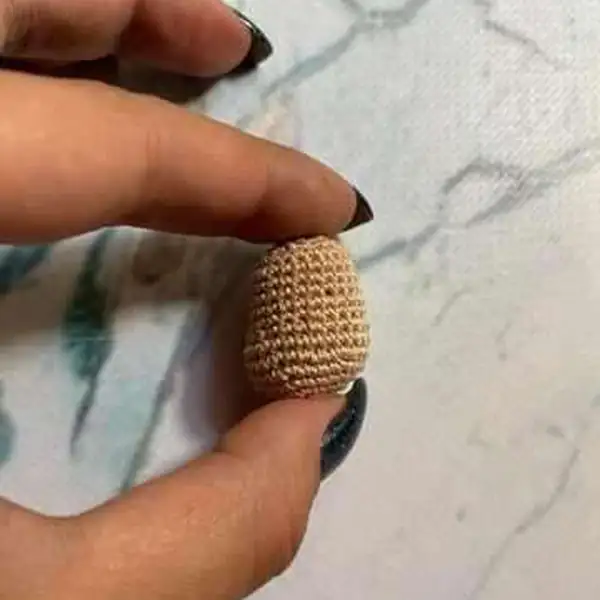
Round 1: 6sc in MR;
Round 2: 6inc (12)
Round 3: (1sc, inc) *6 (18)
Round 4: (2sc, inc) *6 (24)
Round 5: (3sc, inc) *6 (30)
Round 6: 30sc (3 rounds) (30)
Round 7: 30sc (3 rounds) (30)
Round 8: 30sc (3 rounds) (30)
Round 9: (1sc, dec) *6, 12sc (24)
Round 10: 24sc (5 rounds) (24)
Round 11: 24sc (5 rounds) (24)
Round 12: 24sc (5 rounds) (24)
Round 13: 24sc (5 rounds) (24)
Round 14: 24sc (5 rounds) (24)
Round 15: (2sc, dec) *6 (18)
Round 16: 18sc (18)
Round 17: 18inc (36)
Round 18: (5sc, inc) *6 (42)
Round 19: 42sc (5 rounds) (42)
Round 20: 42sc (5 rounds) (42)
Round 21: 42sc (5 rounds) (42)
Round 22: 42sc (5 rounds) (42)
Round 23: 42sc (5 rounds) (42)
Round 24: (5sc, dec) *6 (36)
Round 25: (4sc, dec) *6 (30)
Round 26: 30sc (4 rounds) (30)
Round 27: 30sc (4 rounds) (30)
Round 28: 30sc (4 rounds) (30)
Round 29: 30sc (4 rounds) (30)
Round 30: (3sc, dec) *6 (24)
Round 31: (2sc, dec) *6 (18)
Round 32: (1sc, dec) *6 (12)
Round 33: 6dec;

— Part 2 :

Round 1: Chain 6. Start in the second;
Round 3: 8sc, (4-dc Bobble st, sc) *3,;
Round 4: 4sc, 6dec, 2sc (12)
Round 5: (2sc, dec) *3 (9)
Round 6: (1sc, dec) *3 (6)
Round 7: 6sc (4 rounds) (6)
Round 8: 6sc (4 rounds) (6)
Round 9: 6sc (4 rounds) (6)
Round 10: 6sc (4 rounds) (6)

— Part 3 :

Round 1: 6sc in MR;
Round 2: (1sc, inc) *3 (9)
Round 3: 9sc (9)
Round 4: (2sc, inc) *3 (12)
Round 5: 12sc (12)
Round 6: (1sc, inc) *6 (18)
Round 7: 18sc (4 rounds) (18)
Round 8: 18sc (4 rounds) (18)
Round 9: 18sc (4 rounds) (18)
Round 10: 18sc (4 rounds) (18)
Round 11: (1sc, dec) *6 (12)
Round 12: 12sc (5 rounds) (12)
Round 13: 12sc (5 rounds) (12)
Round 14: 12sc (5 rounds) (12)
Round 15: 12sc (5 rounds) (12)
Round 16: 12sc (5 rounds) (12)
Round 17: 6dec (6)
Round 18: 6sc. Do not stuff.

— Part 4 :

Round 1: 6sc in MR;
Round 2: 6sc (2 rounds) (6)
Round 3: 6sc (2 rounds) (6)
Round 4: inc, 5sc (7)
Round 5: 7sc (4 rounds) (7)
Round 6: 7sc (4 rounds) (7)
Round 7: 7sc (4 rounds) (7)
Round 8: 7sc (4 rounds) (7)
Round 9: 3sc, dec, 2sc (6)

— Part 5 :

Round 1: 6sc in MR;
Round 2: 6inc (12)
Round 3: 12sc (12)
Round 4: 6dec;

— Part 6 :

Round 1: 6sc in MR;
Round 2: (1sc, inc) *3 (9)
Round 3: 9sc (9)
Round 4: (2sc, inc) *3 (12)
Round 5: 12sc (12)
Round 6: (1sc, inc) *6 (18)
Round 7: 18sc (3 rounds) (18)
Round 8: 18sc (3 rounds) (18)
Round 9: 18sc (3 rounds) (18)
Round 10: (1sc, dec) *6 (12)
Round 11: 12sc (4 rounds) (12)
Round 12: 12sc (4 rounds) (12)
Round 13: 12sc (4 rounds) (12)
Round 14: 12sc (4 rounds) (12)
Round 15: 6dec (6)

— Part 7 :

Round 1: 6sc in MR;
Round 2: 6inc (12)
Round 3: (1sc, inc) *6 (18)
Round 4: (2sc, inc) *6 (24)
Round 5: (3sc, inc) *6 (30)
Round 6: 30sc (3 rounds) (30)
Round 7: 30sc (3 rounds) (30)
Round 8: 30sc (3 rounds) (30)
Round 9: (1sc, dec) *6, 12sc (24)
Round 10: 24sc (5 rounds) (24)
Round 11: 24sc (5 rounds) (24)
Round 12: 24sc (5 rounds) (24)
Round 13: 24sc (5 rounds) (24)
Round 14: 24sc (5 rounds) (24)
Round 15: (2sc, dec) *6 (18)
Round 16: (1sc, dec) *6 (12)
Round 17: 6dec;

— Part 8 :

Round 1: 6sc in MR;
Round 2: 6inc (12)
Round 3: (1sc, inc) *6 (18)
Round 4: (2sc, inc) *6 (24)
Round 5: (3sc, inc) *6 (30)
Round 6: (4sc, inc) *6 (36)
Round 7: (5sc, inc) *6 (42)
Round 8: 42sc (3 rounds) (42)
Round 9: 42sc (3 rounds) (42)
Round 10: 42sc (3 rounds) (42)
Round 11: (5sc, dec) *6 (36)
Round 12: (4sc, dec) *6 (30)
Round 13: 30sc (4 rounds) (30)
Round 14: 30sc (4 rounds) (30)
Round 15: 30sc (4 rounds) (30)
Round 16: 30sc (4 rounds) (30)
Round 17: (3sc, dec) *6 (24)
Round 18: (2sc, dec) *6 (18)
Round 19: (1sc, dec) *6 (12)
Round 20: 6dec;

— Part 9 :

Round 1: 6sc in MR;
Round 2: 6sc (2 rounds) (6)
Round 3: 6sc (2 rounds) (6)
Round 4: inc, 5sc (7)
Round 5: 7sc (4 rounds) (7)
Round 6: 7sc (4 rounds) (7)
Round 7: 7sc (4 rounds) (7)
Round 8: 7sc (4 rounds) (7)
Round 9: 3sc, dec, 2sc (6)

— Part 10 :

Round 1: Chain 6. Start in the second;
Round 3: 8sc, (4-dc Bobble st , sc) *3,;
Round 4: 4sc, 6dec, 2sc (12)
Round 5: (2sc, dec) *3 (9)
Round 6: (1sc, dec) *3 (6)
Round 7: 6sc (3 rounds) (6)
Round 8: 6sc (3 rounds) (6)
Round 9: 6sc (3 rounds) (6)

— Part 11 :

Round 1: 6sc in MR;
Round 2: 6inc (12)
Round 3: 12sc (12)
Round 4: 6dec;

— Part 12 :

Round 1: 6sc in MR;
Round 2: 6sc (6)
Round 3: (1sc, inc) *3 (9)
Round 4: 9sc (9)
Round 5: (2sc, inc) *3 (12)
Round 6: 12sc (2 rounds) (12)
Round 7: 12sc (2 rounds) (12)
Round 8: 6dec (6)

— Part 13 :

Round 1: 8sc in MR;
Round 3: 2sc, 2dec, 2sc (6)
Round 4: 6sc;
Round 5: 6sc;
Round 6: 6sc;
Round 7: 6sc;

— Part 14 :

Round 1: 6sc in MR;
Round 2: 6sc (5 rounds) (6)
Round 3: 6sc (5 rounds) (6)
Round 4: 6sc (5 rounds) (6)
Round 5: 6sc (5 rounds) (6)
Round 6: 6sc (5 rounds) (6)

— Part 15 :

Round 1: 6sc in MR;
Round 2: 6inc (12)
Round 3: (1sc, inc) *6 (18)
Round 4: 18sc (4 rounds) (18)
Round 5: 18sc (4 rounds) (18)
Round 6: 18sc (4 rounds) (18)
Round 7: 18sc (4 rounds) (18)
Round 8: (1sc, dec) *6 (12)
Round 9: 12sc;
Round 10: 12sc;
Round 11: 12sc;
Round 12: 12inc (24)
Round 13: 24sc (3 rounds) (24)
Round 14: 24sc (3 rounds) (24)
Round 15: 24sc (3 rounds) (24)
Round 16: (2sc, dec) *6 (18)
Round 17: 18sc;
Round 18: 18sc;
Round 19: 18sc;
Round 20: (1sc, dec) *6 (12)
Round 21: 6dec;

— Part 16 :

Round 1: 6sc in MR;
Round 2: (1sc, inc) *3 (9)
Round 3: 9sc (9)
Round 4: (1sc, dec) *3 (6)

— Part 17 :

Round 1: Chain 13. From the second;
Round 2: ch1, 12sc, turn;
Round 3: ch1, 12sc, turn;
Round 4: ch1, 12sc, turn;
Round 5: ch1, 12sc, turn;
Round 6: ch1, 12sc, turn;
Round 7: ch1, 12sc, turn;
Round 8: ch1, 12sc, turn;
Round 9: ch1, 12sc, turn;
Round 10: ch1, 12sc, turn;
Round 11: ch1, 12sc, turn;
Round 12: ch1, 12sc, turn;
Round 13: ch1, 12sc, turn;
Round 14: ch1, 12sc, turn;
Round 15: ch1, 12sc, turn;
Round 16: ch1, 12sc, turn;
Round 17: ch1, 12sc, turn;
Round 18: ch1, 12sc, turn;
Round 19: ch1, 12sc, turn;
Round 20: ch1, 12sc, turn;
Round 21: ch1, 12sc, turn;
Round 22: ch1, 12sc, turn;
Round 23: ch1, 12sc, turn;
Round 24: ch1, 12sc, turn;
Round 25: ch1, 12sc, turn;
Round 26: ch1, 12sc, turn;
Round 27: ch1, 12sc, turn;
Round 28: ch1, 12sc, turn;
Round 29: ch1, 12sc, turn;
Round 30: ch1, 12sc, turn;
Round 31: ch1, 12sc, turn;
Round 32: ch1, 12sc, turn;
Round 33: ch1, 12sc, turn;
Round 34: ch1, 12sc, turn;
Round 35: ch1, 12sc, turn;
Round 36: ch1, 12sc, turn;
Round 37: ch1, dec, 8sc, dec, turn (10)
Round 38: ch1, 10sc, turn (10)
Round 39: ch1, dec, 6sc, dec, turn (8)
Round 40: ch1, 8sc, turn (8)
Round 41: ch1, dec, 4sc, dec, turn (6)
Round 42: ch1, 6sc;

— Part 18 :

Round 1: 6sc in MR;
Round 2: 6inc (12)
Round 3: (1sc, inc) *6 (18)
Round 4: (2sc, inc) *6 (24)
Round 5: (3sc, inc) *6 (30)
Round 6: (4sc, inc) *6 (36)
Round 7: (5sc, inc) *6 (42)
Round 8: (6sc, inc) *6 (48)
Round 9: 48sc (3 rounds) (48)
Round 10: 48sc (3 rounds) (48)
Round 11: 48sc (3 rounds) (48)
Round 12: (7sc, inc) *6 (54)
Round 13: 54sc (7 rounds) (54)
Round 14: 54sc (7 rounds) (54)
Round 15: 54sc (7 rounds) (54)
Round 16: 54sc (7 rounds) (54)
Round 17: 54sc (7 rounds) (54)
Round 18: 54sc (7 rounds) (54)
Round 19: 54sc (7 rounds) (54)

— Part 19 :

Round 1: 5sc in MR, turn;
Round 2: ch1, 2sc, 3sc inc, 2sc, turn;
Round 3: ch1, sc, inc, sc, 3sc inc, sc,;
Round 4: ch1, 2sc, inc, 2sc, 3sc inc,;
Round 5: ch1, 3sc, inc, 3sc, 3sc inc,;
Round 6: ch1, 4sc, inc, 4sc, 3sc inc,;

— Part 20 :

Round 1: 6sc in MR;
Round 2: 6inc (12)
Round 3: (1sc, inc) *6 (18)
Round 4: (2sc, inc) *6 (24)
Round 5: (3sc, inc) *6 (30)
Round 6: (4sc, inc) *6 (36)
Round 7: (5sc, inc) *6 (42)
Round 8: (6sc, inc) *6 (48)
Round 9: (7sc, inc) *6 (54)
Round 10: (8sc, inc) *6 (60)

— Part 21 :

Round 1: 6sc in MR;
Round 2: 6inc (12)
Round 3: (1sc, inc) *6 (18)
Round 4: (2sc, inc) *6 (24)
Round 5: (3sc, inc) *6 (30)
Round 6: (4sc, inc) *6 (36)
Round 7: (5sc, inc) *6 (42)
Round 8: 42sc (6 rounds) (42)
Round 9: 42sc (6 rounds) (42)
Round 10: 42sc (6 rounds) (42)
Round 11: 42sc (6 rounds) (42)
Round 12: 42sc (6 rounds) (42)
Round 13: 42sc (6 rounds) (42)
Round 14: (5sc, dec) *6 (36)
Round 15: (4sc, dec) *6 (30)
Round 16: (3sc, dec) *6 (24)
Round 17: (2sc, dec) *6 (18)
Round 18: (1sc, dec) *6 (12)
Round 19: 6dec;

— Part 22 :

Round 1: 5sc in MR, turn;
Round 2: ch1, 2sc, 3sc inc, 2sc, turn;
Round 3: ch1, sc, inc, sc, 3sc inc, sc,;
Round 4: ch1, 2sc, inc, 2sc, 3sc inc,;
Round 5: ch1, 3sc, inc, 3sc, 3sc inc,;
Round 6: ch1, 4sc, inc, 4sc, 3sc inc,;

— Part 23 :

Round 1: 6sc in MR;
Round 2: 6inc (12)
Round 3: (1sc, inc) *6 (18)
Round 4: (2sc, inc) *6 (24)
Round 5: (3sc, inc) *6 (30)
Round 6: (4sc, inc) *6 (36)
Round 7: (5sc, inc) *6 (42)
Round 8: (6sc, inc) *6 (48)

— Part 24 :

Round 1: 6sc in MR;
Round 2: 6inc (12)
Round 3: (1sc, inc) *6 (18)
Round 4: 18sc (18)
Round 5: (2sc, inc) *6 (24)
Round 6: 24sc (24)
Round 7: (3sc, inc) *6 (30)
Round 8: (4sc, inc) *6 (36)
Round 9: 36sc (36)
Round 10: (5sc, inc) *6 (42)
Round 11: 42sc (42)
Round 12: (6sc, inc) *6 (48)
Round 13: 48sc (2 rounds) (48)
Round 14: 48sc (2 rounds) (48)
Round 15: (7sc, inc) *6 (54)
Round 16: 54sc (54)
Round 17: (8sc, inc) *6 (60)
Round 18: 60sc (60)
Round 19: (9sc, inc) *6 (66)
Round 20: (10sc, inc) *6 (72)
Round 21: 72sc (72)
Round 22: (11sc, inc) *6 (78)
Round 23: (12sc, inc) *6 (84)
Round 24: 84sc (2 rounds) (84)
Round 25: 84sc (2 rounds) (84)
Round 26: 10sc, skip 10sc, 64sc (74)
Round 27: 8sc, dec, skip distance for;
Round 28: 7sc, dec, skip distance for;
Round 29: 6sc, dec, skip distance for;
Round 30: 5sc, dec, skip distance for;
Round 31: 6sc, skip distance for;
Round 32: 6sc, skip distance for;
Round 33: 6sc, skip distance for;
Round 34: 6sc, skip distance for;
Round 35: 6sc, skip distance for;
Round 36: 6sc, skip distance for;
Round 37: 6sc, skip distance for;
Round 38: 6sc, skip distance for;
Round 39: 5sc, inc, skip distance for;
Round 40: 6sc, inc, skip distance for;
Round 41: 7sc, inc, skip distance for;
Round 42: 8sc, inc, skip distance for;
Round 43: 10sc, skip distance for the;
Round 44: 10sc, ch10, 64sc (84)
Round 45: 10sc, 10sc on the chain,;
Round 46: 84sc (5 rounds) (84)
Round 47: 84sc (5 rounds) (84)
Round 48: 84sc (5 rounds) (84)
Round 49: 84sc (5 rounds) (84)
Round 50: 84sc (5 rounds) (84)
Round 51: (12sc, dec) *6 (78)
Round 52: (11sc, dec) *6 (72)
Round 53: (10sc, dec) *6 (66)
Round 54: (9sc, dec) *6 (60)
Round 55: (8sc, dec) *6 (54)
Round 56: (7sc, dec) *6 (48)
Round 57: (6sc, dec) *6 (42)
Round 58: (5sc, dec) *6 (36)
Round 59: (4sc, dec) *6 (30)
Round 60: (3sc, dec) *6 (24)
Round 61: (2sc, dec) *6 (18)
Round 62: BLO (1sc, dec) *6 (12)
Round 63: BLO 6dec;

— Part 25 :

Round 1: 6sc in MR;
Round 2: 6inc (12)
Round 3: (1sc, inc) *6 (18)
Round 4: (2sc, inc) *6 (24)
Round 5: Change color to Green. (3sc, inc) *6 (30). Leave a long tail for;

— Part 26 :

Round 1: 6sc in MR;
Round 2: 6sc (11 rounds) (6)
Round 3: 6sc (11 rounds) (6)
Round 4: 6sc (11 rounds) (6)
Round 5: 6sc (11 rounds) (6)
Round 6: 6sc (11 rounds) (6)
Round 7: 6sc (11 rounds) (6)
Round 8: 6sc (11 rounds) (6)
Round 9: 6sc (11 rounds) (6)
Round 10: 6sc (11 rounds) (6)
Round 11: 6sc (11 rounds) (6)

— Part 27 :

Round 1: 6sc in MR;
Round 2: 6sc (29 rounds) (6)
Round 3: 6sc (29 rounds) (6)
Round 4: 6sc (29 rounds) (6)
Round 5: 6sc (29 rounds) (6)
Round 6: 6sc (29 rounds) (6)
Round 7: 6sc (29 rounds) (6)
Round 8: 6sc (29 rounds) (6)
Round 9: 6sc (29 rounds) (6)
Round 10: 6sc (29 rounds) (6)
Round 11: 6sc (29 rounds) (6)
Round 12: 6sc (29 rounds) (6)
Round 13: 6sc (29 rounds) (6)
Round 14: 6sc (29 rounds) (6)
Round 15: 6sc (29 rounds) (6)
Round 16: 6sc (29 rounds) (6)
Round 17: 6sc (29 rounds) (6)
Round 18: 6sc (29 rounds) (6)
Round 19: 6sc (29 rounds) (6)
Round 20: 6sc (29 rounds) (6)
Round 21: 6sc (29 rounds) (6)
Round 22: 6sc (29 rounds) (6)
Round 23: 6sc (29 rounds) (6)
Round 24: 6sc (29 rounds) (6)
Round 25: 6sc (29 rounds) (6)
Round 26: 6sc (29 rounds) (6)
Round 27: 6sc (29 rounds) (6)
Round 28: 6sc (29 rounds) (6)
Round 29: 6sc (29 rounds) (6)
Round 30: 6sc (29 rounds) (6)

— Part 28 :

Round 1: 6sc in MR;
Round 2: 6inc (12)
Round 3: (1sc, inc) *6 (18)
Round 4: (2sc, inc) *6 (24)
Round 5: (3sc, inc) *6 (30)
Round 6: (4sc, inc) *6 (36)
Round 7: (5sc, inc) *6 (42)
Round 8: (6sc, inc) *6 (48)
Round 9: (7sc, inc) *6 (54)
Round 10: (8sc, inc) *6 (60)
Round 11: (9sc, inc) *6 (66)
Round 12: (10sc, inc) *6 (72)
Round 13: (11sc, inc) *6 (78)
Round 14: (12sc, inc) *6 (84)
Round 15: (13sc, inc) *6 (90)
Round 16: (14sc, inc) *6 (96)
Round 17: (15sc, inc) *6 (102)
Round 18: (16sc, inc) *6 (108)
Round 19: (17sc, inc) *6 (114)
Round 20: (18sc, inc) *6 (120)
Round 21: (19sc, inc) *6 (126)
Round 22: (20sc, inc) *6 (132)
Round 23: (21sc, inc) *6 (138)
Round 24: (22sc, inc) *6 (144)
Round 25: (23sc, inc) *6 (150)
Round 26: (24sc, inc) *6 (156)
Round 27: (25sc, inc) *6 (162)
Round 28: (26sc, inc) *6 (168)
Round 29: (27sc, inc) *6 (174)
Round 30: (28sc, inc) *6 (180)
Round 31: (29sc, inc) *6 (186)
Round 32: (30sc, inc) *6 (192)
Round 33: (31sc, inc) *6 (198)
Round 34: (32sc, inc) *6 (204)
Round 35: (33sc, inc) *6 (210)
Round 36: (34sc, inc) *6 (216)
Round 37: (35sc, inc) *6 (222)
Round 38: (1sc, 3dc in the one stitch)

— Part 29 :

Round 1: Chain 11. Start from the;
Round 2: ch1, 10sc, turn;
Round 3: ch1, 10sc, turn;
Round 4: ch1, 10sc, turn;
Round 5: ch1, 10sc, turn;

— Part 30 :

Round 1: 5sc in MR;
Round 3: (4-tr cluster, ch1, sc) *5;

— Part 31 :

Round 1: Chain 7, from the second;

— Part 32 :

Round 1: 6sc in MR;
Round 2: 6inc (12)
Round 3: (1sc, inc) *6 (18)
Round 4: (2sc, inc) *6 (24)
Round 5: (3sc, inc) *6 (30)
Round 6: (4sc, inc) *6 (36)
Round 7: (5sc, inc) *6 (42)
Round 8: 42sc (2 rounds) (42)
Round 9: 42sc (2 rounds) (42)
Round 10: (6sc, inc) *6 (48)
Round 11: 48sc (6 rounds) (48)
Round 12: 48sc (6 rounds) (48)
Round 13: 48sc (6 rounds) (48)
Round 14: 48sc (6 rounds) (48)
Round 15: 48sc (6 rounds) (48)
Round 16: 48sc (6 rounds) (48)
Round 17: 12sc, ch22 (skip 12;
Round 18: 68sl st;

— Part 33 :

Round 1: 6sc in MR;
Round 2: 6sc (6)
Round 3: (1sc, inc) *3 (9)
Round 4: 9sc (9)
Round 5: (2sc, inc) *3 (12)
Round 6: 12sc (12)
Round 7: (3sc, inc) *3 (15)
Round 8: 15sc (3 rounds) (15)
Round 9: 15sc (3 rounds) (15)
Round 10: 15sc (3 rounds) (15)
Round 11: (3sc, dec) *3 (12)
Round 12: 6dec;

Assembly Instructions

  1. Attach head to body by inserting the neck portion (rounds 21-25) into the opening at the top of the body, then sew securely using whipstitch.
  2. Position arms on either side of the body between rounds 12-14, angling slightly forward for a natural pose, and sew in place.
  3. Sew legs to the bottom of the body, spacing them evenly and ensuring they're firmly attached for stability.
  4. Attach ears to the top of the head at rounds 6-8, spacing them about 8-10 stitches apart for symmetry.
  5. Add any facial features or accessories according to the pattern, using photos as reference for accurate placement.

Important Notes

  • Use stitch markers to keep track of your rounds, especially during color changes and shaping sections.
  • Stuff firmly but not too tightly for the best shape and structure - overstuffing can distort your work.
  • Pin all parts in place before sewing to ensure correct positioning and symmetry.
  • Weave in ends as you go to avoid a tedious finishing session at the end.
  • Work with consistent tension throughout for even, professional-looking results.

Thank you for exploring Bunny's House Amigurumi Pattern with me; I hope this tiny project becomes a welcome companion in your craft room and a favorite finish on your shelf. The 7–8 cm tall bunny with its little house sits somewhere between a sculpture and a toy, inviting you to pause, observe the shaping, and appreciate the skill in each stitch. May your colors stay true, your tension stay even, and your final piece travel well in photos or gifts. If you share your version, please tag your photos so fellow crocheters can celebrate your handiwork and be inspired to begin their own Bunny's House.
Good to know

You ask, we answer

The finished amigurumi measures approximately 7-8 cm tall when using the recommended yarn and hook size.

Yes, you can use different yarn weights, but this will affect the final size. Make sure to use an appropriate hook size for your chosen yarn.

This pattern is advanced; basic knowledge of crochet stitches and techniques is recommended for best results.

Most crocheters complete this project in 24-28 hours, though time may vary based on experience level and working pace.

Carrot house and carrot pieces
Join 100k+ crocheters

Get new free patterns, stitch tips and exclusive content in your inbox.