HowTo Amigurumi
Free Crochet Pattern
Beautiful Detailed Adorable

Little frog Amigurumi Pattern

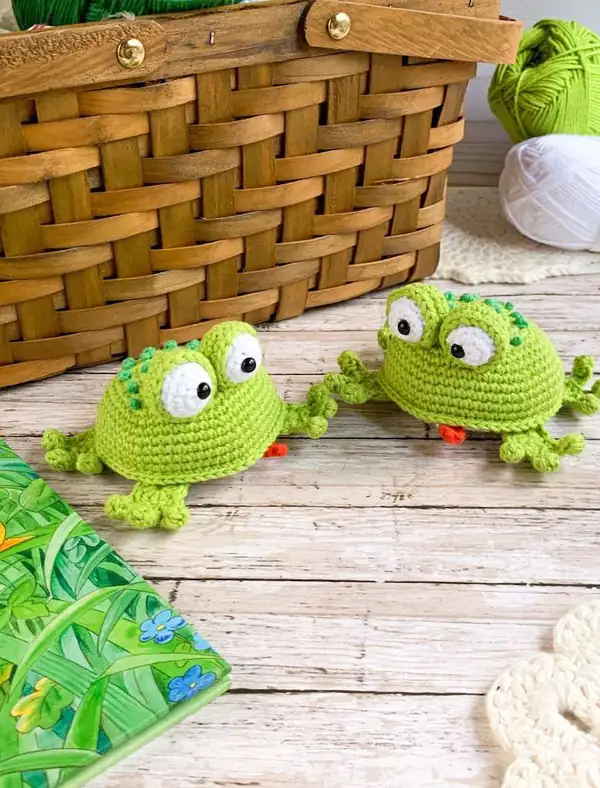
Green frog amigurumi head with white belly
4.0Rating
5-7 HoursTime
Beginner FriendlySkill
Highlights

What makes it special

Cute Companion

An adorable friend to cherish, handcrafted with love to bring comfort and joy for years to come.

Weekend Treat

Takes 5-7 hours, making it an enjoyable project to finish over a couple of days.

Beginner Friendly Level

Perfect for those just starting their crochet journey, with clear instructions and simple techniques

About This Little frog Amigurumi Pattern

This little frog amigurumi is a friendly, squeezable toy that fits perfectly in small hands. It blends simple crochet stitches with a round, bouncy belly and bright lime limbs to create a character that feels alive as soon as you finish the last seam. The pattern guides you from a tight magic ring into a fully assembled plush using DK weight cotton, with Lime Green (629) as the main color, Paper White (601) for the belly, Spearmint Green (626) for accents, and Pillar Red (615) for tiny details. You’ll practice color changes that are clean and compact, learn how to keep your stitches tight so stuffing stays neatly hidden, and master finishing techniques that give the frog a polished, toy-quality look. Each piece is designed to be sturdy enough for daily hugs, yet soft enough for gentle play. It’s a beginner-friendly but deeply satisfying project: five to seven hours of focused crochet that results in a durable, giftable little creature you’ll be proud to share. The round belly centers the body and adds a pleasing dimension, while the small feet complete the character’s charm. The finished frog measures about 7–9 cm tall, making it perfect for small hands to hold and for gifting to a new crochet friend. This is the sort of project you’ll want to crochet again and again in different color stories, building confidence in color changes and careful finishing along the way.

This frog amigurumi is designed to be cuddly and playful, with a white belly and bright green limbs. The pattern emphasizes tight stitching and clean joins to keep stuffing from showing. You’ll crochet in continuous spirals for a smooth surface, then assemble the pieces with careful placement of eyes and paws. The frog’s round body sits on a compact torso that expands into a slightly larger belly, creating a friendly, huggable silhouette. The limbs are worked separately and attached to the body with small, even stitches, so there are no bulky seams to distract from the shape. The white belly reads cleanly against the lime body, and the tiny red accents are used sparingly to suggest a smile or a little tongue peeking out. The color changes are deliberate but not dramatic, and the DK weight ensures a dense textile that holds its shape without becoming stiff. The pattern uses a Magic Ring to begin the head and body sections, followed by multiple rounds of single crochet, increases, and decreases that preserve a round, uniform texture. For a touch of durability, the body is finished with a tight last round and careful weaving of ends. If you prefer a completely seamless look, you can use an invisible decrease technique at the closing stage. When you reach assembly, place the eyes evenly apart and level with the mouth line for a balanced expression. The limbs attach with simple slip stitches and a few secure passes so they stay in place through play. The overall result is a compact, 7–9 cm tall frog that’s huggable, durable, and adored by kids and collectors alike. The pattern’s logic is gentle and repetitive, which helps beginners: keep tension steady, count reliably, and trust the rhythm of rounds. Throughout, you’ll encounter the technique of invisible decrease in places where shaping meets seam, which helps maintain a smooth surface without bulk.
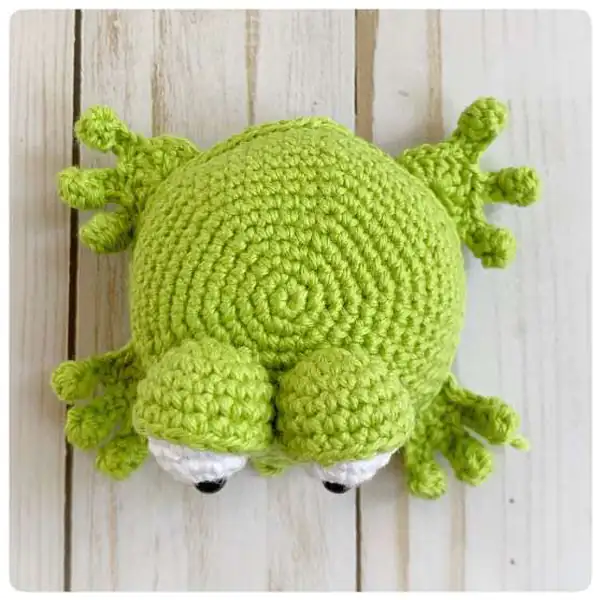
Close-up of frog belly and stitches

This frog’s round body, expressive eyes, and tiny feet make it a delightful first amigurumi project for those expanding their crochet skills. It’s crafted primarily in DK weight cotton with a bright lime body and crisp white belly, so you can practice clean color changes without losing your rhythm. The construction emphasizes quick wins—each piece is small, and the body grows in predictable rounds that encourage consistent tension. You’ll practice working in the round, using continuous spirals to avoid visible seam lines, and you’ll learn to secure the paws and eyes with even, careful stitches for a polished finish. The assembly steps are straightforward: align the belly seam with the center of the body, position the limbs for a balanced silhouette, then attach the eyes and belly patch with patience. By the end, you’ll have a sturdy little friend whose proportions feel correct and whose surface is smooth courtesy of even, tight stitches. It’s a light, approachable project that yields a high-joy result—the frog’s friendly face and compact size make it ideal for kids, display shelves, or gifting. If you want a slightly different look without changing the stitch counts, try swapping the Spearmint Green accents for a slightly darker shade or adding a tiny white highlight near the eyes to give extra pop to the expression. The finished size remains within the 7–9 cm target when you use the same yarn weight and hook.
Why You'll Love This Little frog Amigurumi Pattern

I love this pattern because it turns simple stitches into a character with personality. The eyes come to life with careful placement and the white belly contrasts beautifully with the lime green body. I enjoy how approachable the rounds are, making it easy to stay on track while practicing precise tension. The assembly steps are clear and logical, and the final steps—sewing the paws and attaching the safety eyes—feel like putting together a little friend, not just finishing a project. The pattern teaches color changes in a tidy sequence, so you can see how each color sits against the next and how to avoid color bleed. Building the frog's body using a tight gauge means the stuffing sits nicely and the limbs stay firm without becoming stiff. The magic ring at the start gives a secure center, while the consistent counting keeps the surface even, letting you admire the roundness of the belly and the curve of the limbs. I appreciate that the project grows your crochet confidence without requiring advanced techniques; it’s a great stepping stone for those who want to tackle small amigurumi with a predictable, forgiving process. When I finish, I always admire the little friend I created—it’s a tangible reminder that practice translates into charm, and that a handful of rounds can blossom into a character you’ll carry in your memory as well as in your project bag.

Switch Things Up

Color play is a joyful way to personalize this frog without altering the pattern’s stitch counts or sizing. Swap lime green for teal or cobalt to create a bold, modern look, while keeping the same DK yarn and 2.0 mm hook so the final size stays exactly as written. Two-tone greens on the limbs add shading and depth, and a variegated yarn can introduce playful pattern without changing any rounds or stitches.

For a softer vibe, try pastel greens with a lighter hook to obtain a more compact finish, preserving the crisp edges around the belly. If you prefer a stronger contrast, switch the Pillar Red details to a deeper coral or royal red, again maintaining the same color count and yarn weight so the frog remains in scale with the described finished size.

Eye placement is a powerful way to alter personality. Move the eyes slightly higher for a surprised vibe or a touch lower for a gentle look. Test positions with a pin before sewing and compare both sides for symmetry; you’ll be surprised how small shifts change the expression.

Embellishments are a charming route to customization. Add a tiny felt lilypad under one paw, or stitch a miniature hat from scraps of green felt for a whimsical touch. Embroidered features—such as a tiny smile in Pillar Red or a pair of rosy cheeks—keep the look kid-friendly while giving a handcrafted finish that feels personal.

Texture adds character without changing the pattern’s scale. Try a two-row stripe on the limbs or a subtle single crochet faux-shading along the back using the same colors, so the surface looks richer without needing extra rows or stitches. The key is to stay within the pattern’s gauge and to keep tension even so the surface remains smooth and the transitions clean.

Safety considerations stay paramount. The pattern as written uses safety eyes 6 mm, but you can substitute a small embroidered eye or a felt eye if you’re crocheting for a younger child; the rest of the construction remains unchanged, and the final size stays within the recommended range. Always tuck and weave ends securely when you change any decorative detail to preserve durability and safety for playtime.

Finally, display ideas can elevate your finished frog. Create a tiny diorama with a crocheted lilypad and a few toy-sized foam flowers, or set your frog on a shallow dish of decorative moss for a playful shelf scene. The possibilities are endless, and exploring them while staying faithful to the original stitch counts is part of the fun of this amigurumi adventure.

Common Mistakes & How to Fix Them

Not tightening stitches at color changes around the belly is a common mistake (Problem; fix.) and it can leave subtle gaps that reveal stuffing; rejoin tightly, pull snugly on the last loop, and smooth the transition before continuing. Uneven stuffing leaves lumps in the limbs (Problem; fix.) and can distort the frog’s intended roundness; stuff gradually, distribute the filling evenly, and recheck symmetry before closing each part. Skipping stitch markers during color changes can cause misalignment (Problem; fix.); always place a marker at the beginning of each round and advance it as you work to keep track of rounds. Pulling yarn too tightly during increases distorts the shape (Problem; fix.) and creates stiff edges; maintain a steady tension, pause to readjust if you feel tightness building, and keep increments uniform. Attaching eyes off-center yields an unbalanced look (Problem; fix.); mark the center line on the head, align eyes evenly, and secure with multiple passes to prevent shifting. Forgetting to weave in ends as you go can leave loose tails (Problem; fix.) and create opportunities for cords to snag; weave ends carefully into the stitches as you close each section and trim flush.

Maker's Notes

In my test of this frog pattern, I used PaintBox Yarns Cotton DK in Lime Green (629) and Paper White (601) with a 2.0 mm hook. The project took about 5–6 hours from start to finish, with short breaks to stretch hands and recheck tension. Beginners tend to stumble at the color changes around the belly and the eye assembly, so I used small, color-coded markers at each round start to stay on track. The most challenging parts were attaching the eyes securely and sewing the paws symmetrically; I found that placing the eyes first and then matching the paws to their positions helped achieve balance. I stuffed gradually, distributing the filling evenly as I closed each section, which produced a smoother silhouette and minimized lumps at the limbs. I also experimented with the “faux-puff” eye approach as a practice to see what it would look like without safety eyes; the final result with real safety eyes felt more expressive, but the alternative offered a helpful visual exercise for planning. Overall, the density of the fabric remained comfortable—tight enough to hold shape yet soft enough to be cuddly and safe for gentle play.

I tried a substitution: I substituted the Cotton DK with a closely matched DK-weight cotton from a different brand, while keeping the hook at 2.0 mm. The frog ended up slightly larger, measuring about 8–9 cm tall rather than the stated 7–9 cm, but the construction, stitch density, and proportions stayed true to the original design. Color changes remained clean, and the white belly sat crisply against the lime body. Because the yarn had a slightly different loft, I adjusted only the tension a touch during increases and decreases to maintain a smooth round surface. Weaving in ends remained straightforward, and the limbs attached securely with the same number of stitches as written. The final toy still feels soft, huggable, and true to the pattern’s spirit, which confirms that substitutions of DK-weight cotton can preserve the overall look when gauge is kept close to the original.

Little frog Amigurumi Pattern

This little frog amigurumi is a friendly, squeezable toy that fits perfectly in small hands. It blends simple crochet stitches with a round, bouncy belly and bright lime limbs to create a character that feels alive as soon as you finish the last seam. The pattern guides you from a tight magic ring into a fully assembled plush using DK weight cotton, with Lime Green (629) as the main color, Paper White (601) for the belly, Spearmint Green (626) for accents, and Pillar Red (615) for tiny details. You’ll practice color changes that are clean and compact, learn how to keep your stitches tight so stuffing stays neatly hidden, and master finishing techniques that give the frog a polished, toy-quality look. Each piece is designed to be sturdy enough for daily hugs, yet soft enough for gentle play. It’s a beginner-friendly but deeply satisfying project: five to seven hours of focused crochet that results in a durable, giftable little creature you’ll be proud to share. The round belly centers the body and adds a pleasing dimension, while the small feet complete the character’s charm. The finished frog measures about 7–9 cm tall, making it perfect for small hands to hold and for gifting to a new crochet friend. This is the sort of project you’ll want to crochet again and again in different color stories, building confidence in color changes and careful finishing along the way.

Beginner Friendly 5-7 Hours
Pattern at a glance
Skill level
Beginner Friendly
Time to make
5-7 Hours
Hook size
2.0 mm (B/1)
Yarn weight
DK / #3
Finished size
Approx. 7-9 cm tall
Gauge
Not specified; approximate gauge inferred from 2.0 mm hook with DK cotton
Yarn used
Main color Lime Green ~50 g; White Belly ~20 g; Small amounts of Spearmint Green and Pillar Red

Materials Needed

Main Fabric
  • 01
    Yarn 100% cotton DK (#3 weight) in Lime Green (629), Paper White (601), Spearmint Green (626) and Pillar Red (615), approximately 125 m total
  • 02
    Lime Green and Paper White are the primary colors for the frog body and belly
  • 03
    Small amounts of Spearmint Green for accents and Pillar Red for tiny details
Tools Required
  • 01
    Crochet hook size 2.0 mm
  • 02
    Stuffing (hollow fiber)
  • 03
    Safety eyes 6 mm (2 pieces)
  • 04
    A needle with a big eye
  • 05
    Sewing pins

— Belly :

Round 1 :

6 SC in magic ring (6)

Round 2 :

2 SC in each sc (12)

Round 3 :

(1 SC, 1 INC) * 6 (18)

Round 4 :

(2 SC, 1 INC) * 6 (24)

Round 5 :

(3 SC, 1 INC) * 6 (30)

Round 6 :

(4 SC, 1 INC) * 6 (36)

Round 7 :

(5 SC, 1 INC) * 6 (42)

Round 8 :

(6 SC, 1 INC) * 6 (48)

Round 9 :

48 SC (48)

Round 10 :

(7 SC, 1 INC) * 6 (54)

Round 11 :

54 SC (54)

Round 12 :

(8 SC, 1 INC) * 6 (60)

Round 13-14 :

60 SC (60) for two rounds

Info :

Don’t cut the work thread. Join the belly and the back together: put the wrong sides of the pieces to each other, insert the crochet hook through the loops of the both pieces (pic.3) and crochet sc. Work sc around the edge (pic.4). Stuff the body as you go. Finish with sl.st. Tie off the thread and leave enough for sewing.

— Back :

Round 1 :

6 SC in magic ring (6)

Round 2 :

6 INC (12)

Round 3 :

(1 SC, 1 INC) * 6 (18)

Round 4 :

(2 SC, 1 INC) * 6 (24)

Round 5 :

(3 SC, 1 INC) * 6 (30)

Round 6 :

(4 SC, 1 INC) * 6 (36)

Round 7 :

(5 SC, 1 INC) * 6 (42)

Round 8 :

(6 SC, 1 INC) * 6 (48)

Round 9 :

48 SC (48)

Round 10 :

(7 SC, 1 INC) * 6 (54)

Round 11 :

54 SC (54)

Round 12 :

(8 SC, 1 INC) * 6 (60)

Round 13-14 :

60 SC (60) for two rounds

Info :

Don’t cut the work thread. Join the belly and the back together: put the wrong sides of the pieces to each other, insert the crochet hook through the loops of the both pieces (pic.3) and crochet sc. Work around the outer edge to form the back half of the frog. Stuff lightly and sew as indicated (pic.4/5).

Assembly Instructions

  1. Attach belly to back by aligning right sides and sewing around the edge with a whip stitch.
  2. Place the eyes between the eyelids and secure them so they sit evenly on the head.
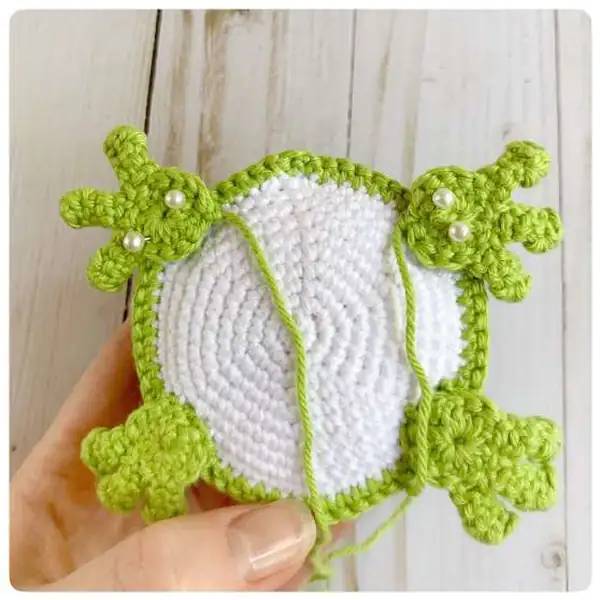
  3. Sew the front paws onto the bottom of the frog symmetrically to the muzzle.
  4. Sew the back paws onto the bottom of the frog as shown in the reference pictures.
  5. Attach the tongue to the muzzle area and secure it firmly.
  6. Embroider details on the back using the dark green yarn for knots as desired.

Important Notes

  • Use stitch markers to keep your rounds even when changing colors.
  • Stuff firmly but not too tightly to maintain shape and avoid distortion.
  • Weave in all ends as you go to prevent loose ends from showing and to keep the seam tidy.
  • Ensure the eyes sit symmetrically and are securely fastened to avoid detaching during play.
  • Double-check color changes around the belly and maintain consistent tension to keep a smooth, even surface.

This little frog is ready to hop into your world! It’s a pocket-sized amigurumi that makes a charming gift and a cheerful addition to any toy collection. With its bright lime body, crisp white belly, and tiny red details, it’s sure to bring smiles. Happy crocheting and may your stitches stay tight and bright as you bring this little friend to life.

Good to know

You ask, we answer

When you follow the pattern with the specified DK weight cotton and the 2.0 mm hook, the finished frog measures approximately 7–9 cm tall. This size is ideal for little hands to hold, display shelves, and as a pocket-friendly gift. Minor variation can occur due to yarn loft or individual tension, but the overall proportions stay within the intended range, ensuring a consistent user experience across different skeins.

The pattern is written specifically for 100% cotton DK weight yarn. If you choose a different weight, you must expect a size and density change. To stay as close as possible to the listed dimensions, keep using the same hook size and maintain a similar gauge; otherwise, the final size may shift outside the 7–9 cm target. For a true test, try a substitution with careful swatching first.

This project is designed to be beginner-friendly, but it does require basic knowledge of crochet stitches and techniques. You should be comfortable with a magic ring, making single crochet, working in rounds, changing colors cleanly, and performing basic increases and decreases. If you can handle those skills, you’ll find the assembly steps logical and satisfying as you progress from ring to finished frog.

Most crocheters complete this project in 5–7 hours, though time can vary based on experience, pace, and how meticulously you pause to place eyes and mark rounds. I found that taking short breaks helps maintain consistent tension and prevents fatigue in the small, precise stitches. The joy comes from watching the pieces come together into a complete little character.

The pattern uses safety eyes sized 6 mm, placed symmetrically for a friendly expression. If safety eyes aren’t suitable for your project (for example, for very young children), you can substitute with embroidery or felt eyes, keeping the same placement logic. In any case, ensure the eyes are securely fastened and aligned to maintain that balanced, inviting look that defines the frog’s personality.

Absolutely. You can experiment with color schemes, eye placement, and accessories while preserving the same stitch counts and rounds. Try different color pairings, add tiny embellishments such as a felt lilypad or a small embroidered mouth, and adjust the expression by shifting eye alignment slightly. Keep the same gauge and hook to maintain the designed 7–9 cm height and the crisp, tight fabric.

Eyes being attached to the frog
Join 100k+ crocheters

Get new free patterns, stitch tips and exclusive content in your inbox.